
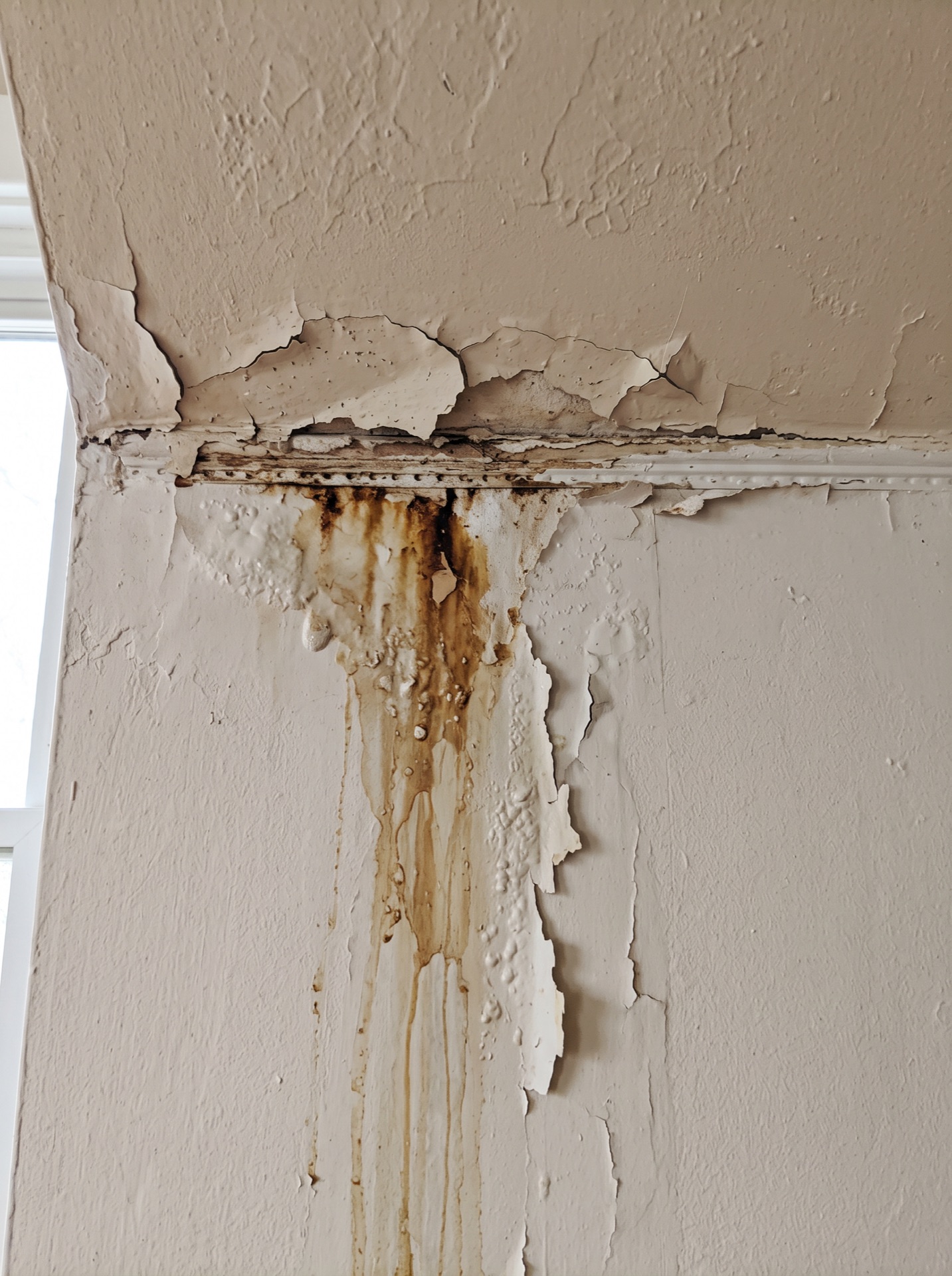
Why it sags
Water pooling on top of a drywall ceiling is heavy — a gallon weighs over eight pounds, and a saturated area can hold many gallons. Gypsum loses strength rapidly when wet, so the board softens at exactly the moment it is being asked to carry more.
The failure is usually sudden rather than gradual. A ceiling that has been bulging quietly for hours can come down in one piece in a second.
Drain it deliberately
With everyone and everything out from underneath, and a bucket positioned, pierce the lowest point of the bulge with a screwdriver on a pole or from the side — not standing directly beneath it. Several small holes drain it faster and more safely than one big one.
It feels wrong to put a hole in your own ceiling. It is much better than the alternative, and the repair is the same either way.
Snow load is a separate question
If the sag is accompanied by doors binding, visible deflection in the roof line, or creaking, that is not just water in a ceiling — that is a structural load question and it needs looking at urgently. Deep, dense, or rain-soaked snow is far heavier than people assume, and flat and low-slope roofs are the ones to worry about.
How to tell which one you have
It is probably ice dam water
Bulge on a top-floor ceiling near an outside wall, with snow and ice on the roof and a thaw under way.
It is probably a burst pipe
A fast, heavy flow and a rapidly growing bulge, often after a hard freeze. Turn the water off at the stopcock immediately.
It is probably snow load
Deflection in the roof structure itself, doors and windows binding, creaking noises, with very deep or wet snow on a low-slope roof. Leave the building and get it assessed.
What to do in the next ten minutes
- Get people and pets out of the room, and anything valuable with them.
- Turn off the water at the stopcock if there is any chance it is a pipe.
- Turn off the electrical circuit for that room.
- Drain the bulge deliberately into a bucket, standing clear of it.
- Call us and say the ceiling is sagging. That is an emergency dispatch, not a next-available booking.
Questions people ask
No. Propping a wet ceiling concentrates the load and does not remove the water. Drain it.
Active structural risk goes to the front of the line. We dispatch same day where we have a crew in range, and typically within 24 to 48 hours elsewhere in the 38 states we cover. Tell dispatch the ceiling is sagging when you call.
A sudden ceiling collapse from water is about as clear a sudden loss as a homeowners policy sees, but it is still your adjuster who decides and your policy that governs. Photograph the bulge before you drain it, and the water in the bucket afterwards.