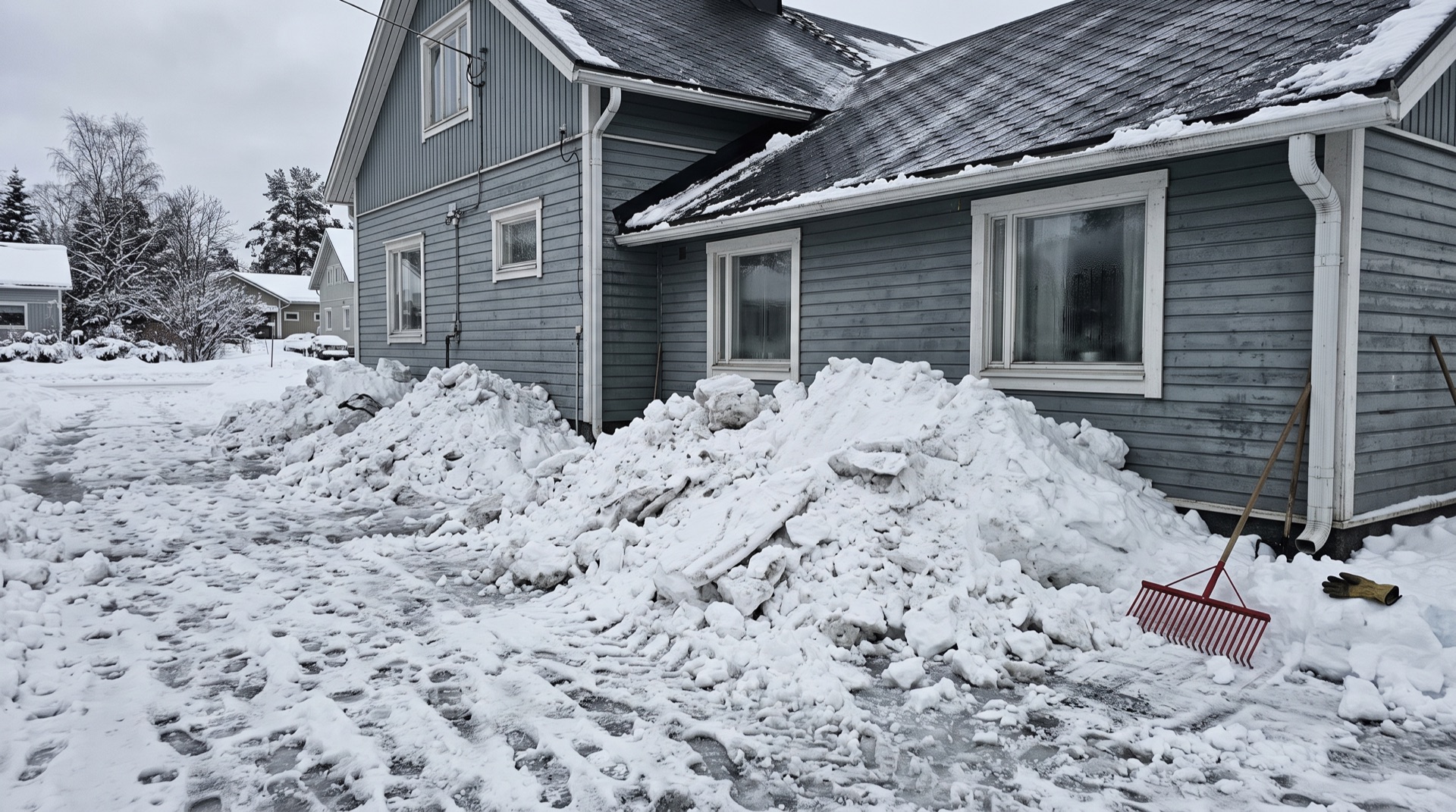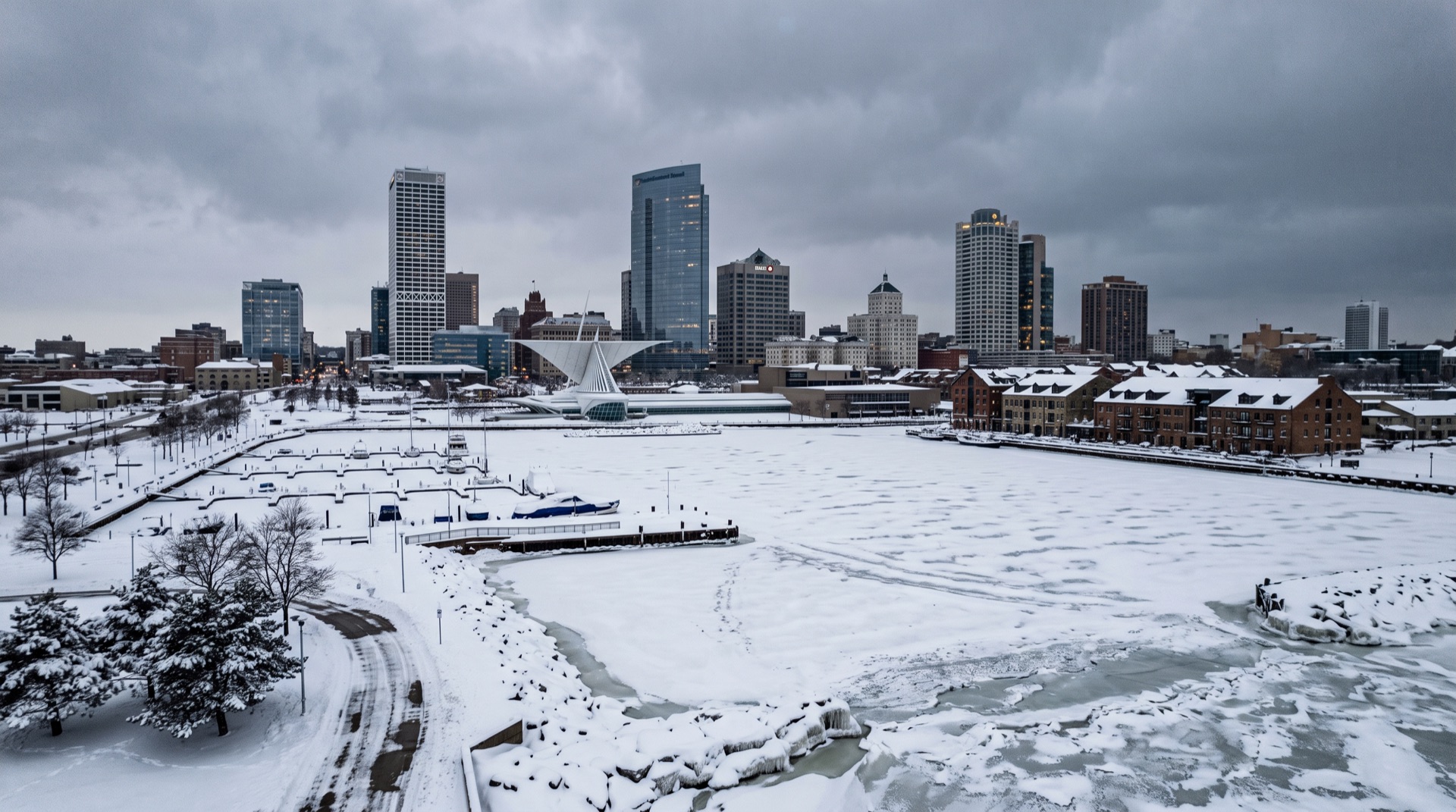
A Milwaukee roof can look fine from the driveway and still be backing water under the shingles at the eave, where nobody can see it. As part of our complete Milwaukee winter roof services, crews handle roof snow removal across Milwaukee County.
The Milwaukee County Pattern: Heavy Bands, Fast Thaws
Lake-effect snow arrives in bands rather than fronts, which is why Milwaukee can take a foot overnight while a town twenty miles inland takes two inches. It falls wet, it compacts fast, and it does not blow off.

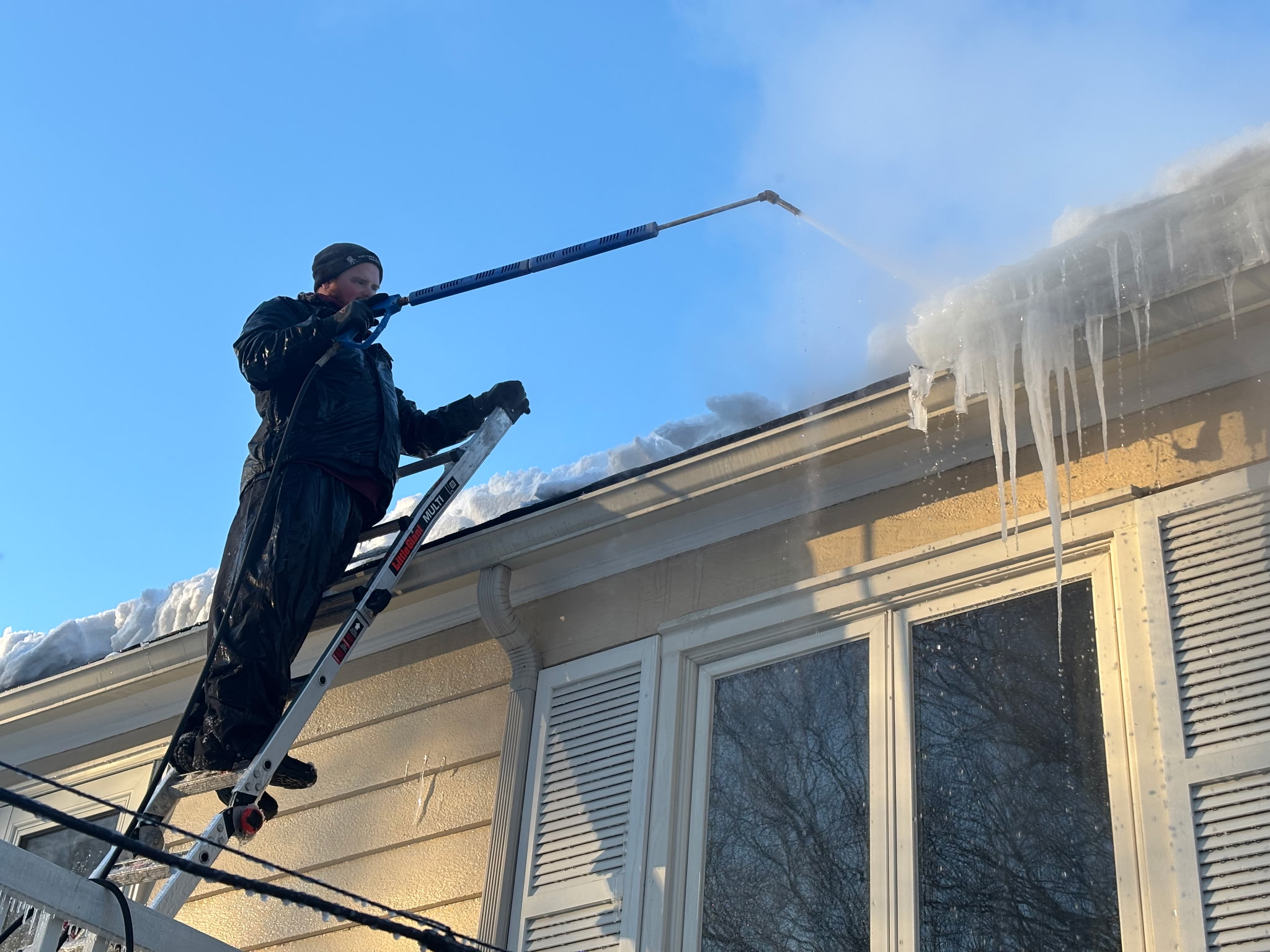
The damage comes on the thaw. Warm air leaking into the attic melts the underside of that pack, the meltwater runs to an eave that is still well below freezing, and it sets. Repeat that four or five times in a January and the ridge of ice at the gutter line stops being cosmetic.
Ice-barrier practice in Milwaukee County
The relevant detail is how far up the roof the membrane runs — it has to reach past the interior wall line, not just cover the first course. On older Milwaukee roofs it frequently does neither.
Roof Snow Removal in Milwaukee: How The Work Runs
Skylights, vents and what gets flagged before clearing
Before a shovel moves, the crew walks the roof plan: skylights, solar panels, bath and ridge vents, satellite mounts, plumbing stacks and anything else that disappears under eighteen inches of snow. Each gets located and left proud of the surface. Ceiling Sagging or Bulging After Snow.
On an older Milwaukee roof the more useful part of that walk is often what it finds underneath - a lifted flashing or a soft spot in the deck that was there before the snow arrived and gets reported rather than covered back up.
How much of the roof actually needs clearing
Rarely all of it. The band that matters is the lower three to six feet above the gutter, because that is the strip sitting past the heated envelope where meltwater refreezes.
On a roof in Milwaukee with no load concern, clearing that band and the valleys is usually the whole job. Scraping the full plane costs more, takes longer, and buys very little extra.
Wet snow, dry snow and what the weight actually is
Depth tells you very little on its own. Light powder runs around seven pounds per cubic foot; old settled snow two or three times that; the saturated layer sitting at the bottom of a pack after a thaw can approach the weight of standing water. Two roofs in Milwaukee under the same twenty inches can be carrying loads that differ by a factor of four.
Crews take a core and weigh it rather than guessing from the ruler, because that measurement is what decides whether a roof is near its limit or nowhere close.
Why the second storm is the dangerous one
A roof usually carries the first storm without trouble. The problem is that the first pack settles, hardens and stops sliding, so the second storm lands on a base that is not going anywhere and the third has nowhere to go at all.
That is why clearing between storms is worth more than clearing after the whole sequence: each clear resets the base, and the roof never gets to the compounded load in the first place.
Standing clears for repeat properties
Properties that dam at the same eave every year are better on a schedule than on a phone call. A standing clear-after-every-storm arrangement means the snow comes off before the thaw instead of after it.
It also means an address in Milwaukee is on the route rather than in line during the week when everybody calls at once.
What you get in Milwaukee
- Eave-first clearingThe lower roof band where dams form gets cleared first, not last
- Drift points measuredDepth read where snow collects, not in the middle of the field
- Surface never touchedA cushion layer is left so the rake never rides on bare shingle
| Local ice-barrier practice | Eave membrane expected on re-roofs |
|---|---|
| Removal method | Low-pressure steam only. No chipping, salt or pressure washing. |
| Dispatch window | Same day to 24 hours |
| Coverage area | Milwaukee and Milwaukee County |
| Service | Roof Snow Removal in Milwaukee, WI |
| Documentation | Dated before and after photos, written scope in Xactimate line items |
| Primary climate stressor | Lake-effect bands, wet heavy pack |
Where We Dispatch Around Milwaukee
Crews working Milwaukee cover the adjoining communities on the same route — Cudahy, Greendale, Elm Grove, Butler and Hales Corners — so a storm week usually means one truck handling several addresses in Milwaukee County rather than separate trips.
Nearest hub towns with their own roof snow removal pages: Wauwatosa, West Allis, Greenfield, South Milwaukee, Brookfield, Oak Creek.
During a cold snap Milwaukee gets worked alongside the neighboring Milwaukee County towns on the same route, with active interior leaks moved to the front of the list.
Most jobs do not stop at one service. Roof Snow Removal in Milwaukee often runs alongside ice dam removal in Milwaukee, and both get written into one scope rather than billed as separate visits.
Active leak right now? Our 24/7 Milwaukee steam ice dam removal crews are dispatched first during a freeze event. Call (888) 561-9664.