
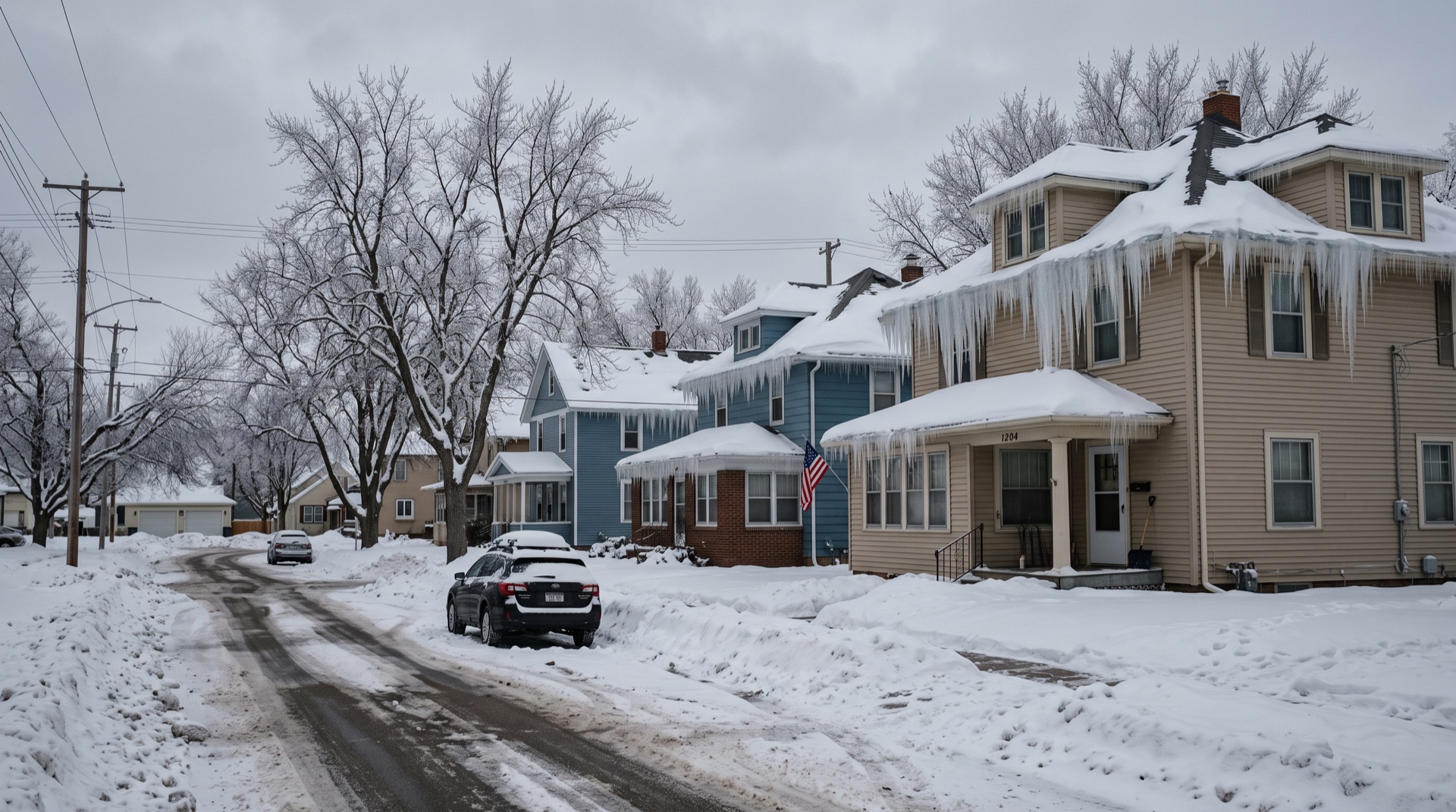
Homeowners across Lincoln County call about icicles. Icicles are cosmetic. The dam behind them, holding back standing water, is not. As part of our complete Sioux Falls winter roof services, crews handle roof shoveling across Lincoln County.
Months of Load: Why Sioux Falls Eaves Carry Ice
Snow that falls on a roof in Sioux Falls in December tends to stay there. A pack that never fully clears is a pack that keeps feeding meltwater to the same eave for months on end.

Depth accumulates faster than people expect because nothing in between melts it away. By February a Sioux Falls eave can be carrying several hundred pounds of ice with standing water sitting behind the whole length of it.
Ice-barrier practice in Lincoln County
Ice barrier at the eaves is a standard requirement on new work across South Dakota. The question on any particular Sioux Falls house is when it was last roofed, because that decides whether it is there at all.
Roof Shoveling in Sioux Falls: How The Work Runs
The last two inches stay on
Crews deliberately leave a thin layer of snow across the covering rather than scraping to a bare surface. That layer is what keeps the shovel off the shingle, the membrane and the seams, and it weighs almost nothing compared with the pack above it. Ceiling Sagging or Bulging After Snow.
A roof shovelled to bare deck in Sioux Falls has usually been damaged somewhere, even if it does not show until the next rain. Reduction is the goal; bare is not.
Where hand clearing is the only option
A roof rake reaches the first several feet from the edge and nothing beyond it. Dead valleys between roof planes, the pockets behind dormers and chimneys, low-slope and flat sections, and upper roofs on anything over a story and a half all need someone on the roof with a shovel.
Those are also the places snow collects deepest, because wind deposits it there and nothing sheds it. A Sioux Falls roof can look mostly clear from the street and still be carrying two feet of drifted pack in the valleys.
What happens to the ground below
Several tons of snow has to land somewhere. Shrubs, railings, air conditioning condensers, downspout extensions, low roofs over porches and anything made of lattice are all easy to flatten with material coming off a roof above.
The drop zones get chosen before the clear starts and anything fragile is either moved or worked around. On a tight Sioux Falls lot that sometimes means carrying material to the street rather than dropping it, which costs hours and gets quoted that way.
Access when the ground is buried too
Ladder footing is the quiet half of this job. Setting a ladder on a packed drift that is going to soften by noon, or against a gutter already loaded with ice, is how people end up in hospital.
Crews dig and level ladder footings, use standoffs so no weight goes on the gutter, and tie off at the top. Where no safe setting exists, the work goes through a lift instead and that gets said rather than improvised around.
Timing a clear against the forecast
Clearing a roof the day before eight more inches arrive is money spent twice. Clearing it the day before a thaw, or ahead of a rain-on-snow event, is money that prevents a claim.
Scheduling in Sioux Falls is built around the forecast rather than the order calls came in, and a job gets moved - with a reason - when the weather makes a different day obviously better.

What you get in Sioux Falls
- Skylights worked aroundFlagged and avoided rather than cleared over
- Plastic blades onlyCut and lifted in layers, never scraped down to the surface
- Drains openedScuppers and outlets cleared so the melt has somewhere to go
| Local ice-barrier practice | Eave membrane required on new work |
|---|---|
| Dispatch window | Same day to 24 hours |
| Typical scope | Steam, 6-14 crew hours typical |
| Primary climate stressor | Sustained sub-freezing, long season |
| Documentation | Dated before and after photos, written scope in Xactimate line items |
| Coverage area | Sioux Falls and Lincoln County |
| Removal method | Low-pressure steam only. No chipping, salt or pressure washing. |
Neighborhoods and Towns We Reach From Sioux Falls
Crews working Sioux Falls cover the adjoining communities on the same route — Harrisburg, Tea, Rowena, Renner and Brandon — so a storm week usually means one truck handling several addresses in Lincoln County rather than separate trips.
Nearest hub towns with their own roof shoveling pages: Yankton, Brookings, Mitchell, Watertown, Aberdeen, Pierre.
Coverage runs across Sioux Falls and the nearby towns all winter, and capacity is surged into whichever South Dakota market the storm actually hits.
Most jobs do not stop at one service. Roof Shoveling in Sioux Falls often runs alongside roof snow removal in Sioux Falls, and both get written into one scope rather than billed as separate visits.
Active leak right now? Our 24/7 Sioux Falls steam ice dam removal crews are dispatched first during a freeze event. Call (888) 561-9664.

