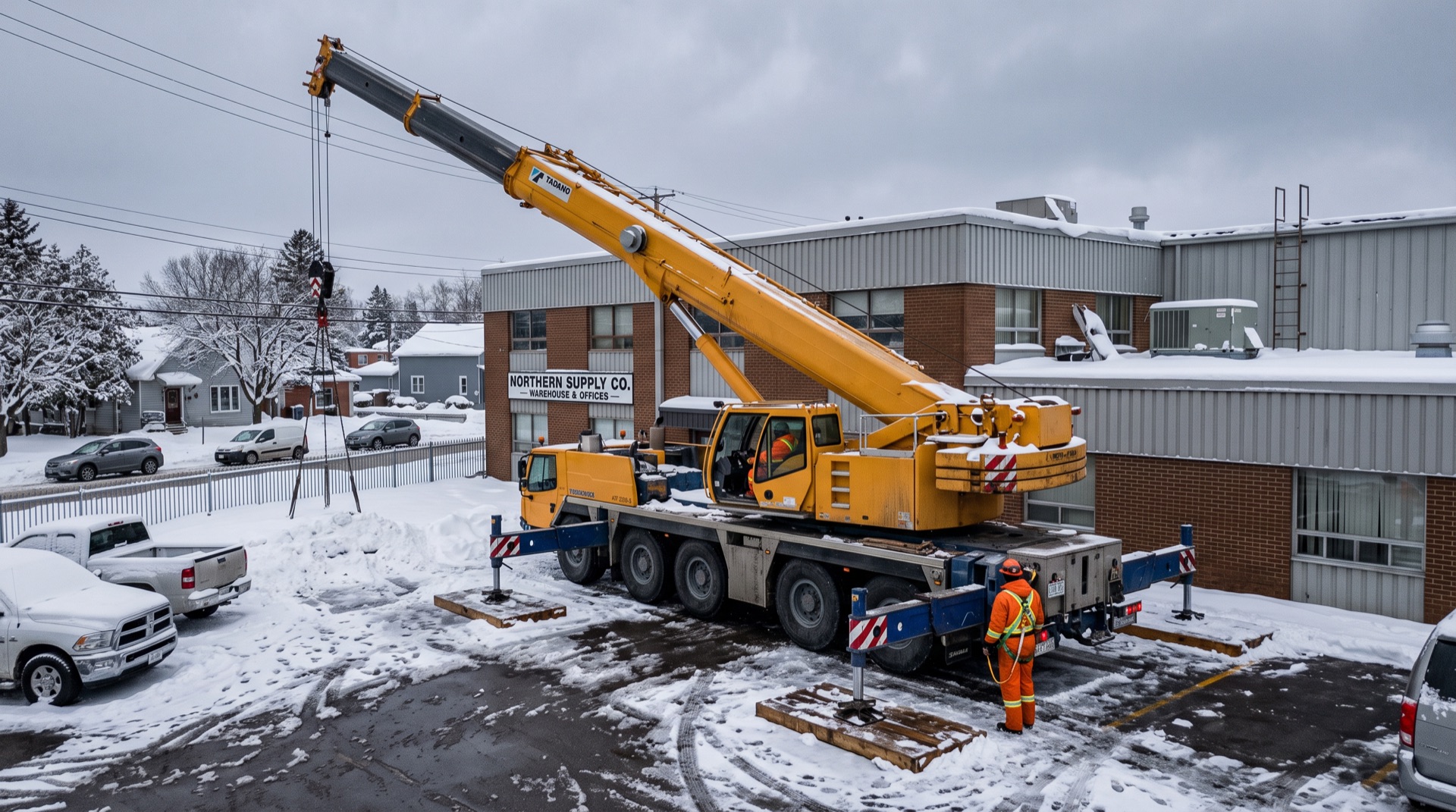
Webster County sees the same pattern every winter: snow on the roof, warm air in the attic, and a line of ice building along the eave where the two meet. As part of our complete Fort Dodge winter roof services, crews handle crane-assisted snow removal across Webster County.
What the Lake Does to a Roof in Fort Dodge
Lake-effect snow arrives in bands rather than fronts, which is why Fort Dodge can take a foot overnight while a town twenty miles inland takes two inches. It falls wet, it compacts fast, and it does not blow off.

Each band is followed by a clearance and a cold night, and that is the cycle doing the damage. Meltwater released during the day sets at the eave after dark, and the ridge at the gutter line gains a layer every time.
Ice-barrier practice in Webster County
What matters on a Fort Dodge roof is not whether ice barrier exists but how far up it runs. Water backed up behind a foot of ice travels much further than the first course, and a membrane that stops short is a membrane that stops working.
Crane-Assisted Snow Removal in Fort Dodge: How The Work Runs
Why it is often the cheaper number
Per hour a crane costs more than a crew with shovels. Per roof it frequently costs less, because a pick that takes an afternoon can replace several crew-days of hand clearing. Ceiling Sagging or Bulging After Snow.
On a large Fort Dodge deck the crane is routinely both the faster and the cheaper answer, and the comparison gets shown rather than asserted.
The arithmetic that justifies a crane
Snow weight is depth times density times area. Fresh powder is light; settled wet pack can be several times heavier for the same depth, and drifted pack heavier again.
Crews take depth and density readings at the drift points on a roof in Fort Dodge, work out the load, and compare it to the structure's design capacity. A crane gets mobilised when that number says hand clearing cannot win the race against the next storm.
When a crane is the right call
Multi-story homes and estates where the upper roof cannot be safely reached. Large commercial and industrial decks where the sheer tonnage makes hand clearing a multi-day job. Any roof where deflection is already visible and the load has to come off today rather than over a week.
The decision is made on numbers, not instinct. Depth, density and area give a working load figure, and that figure against the roof's design capacity is what determines whether a crane gets mobilised to a property in Fort Dodge.
What goes in the tarp and what does not
A pick lifts loose and broken snow. It does not lift a solid sheet of ice frozen to the membrane, and trying to make it do so is how a tarp takes the roof covering with it.
So the sequence is crews cutting and breaking the pack into liftable material, the crane moving it, and steam dealing with whatever is bonded to the surface. The crane is the transport, not the demolition.
How a pick actually works
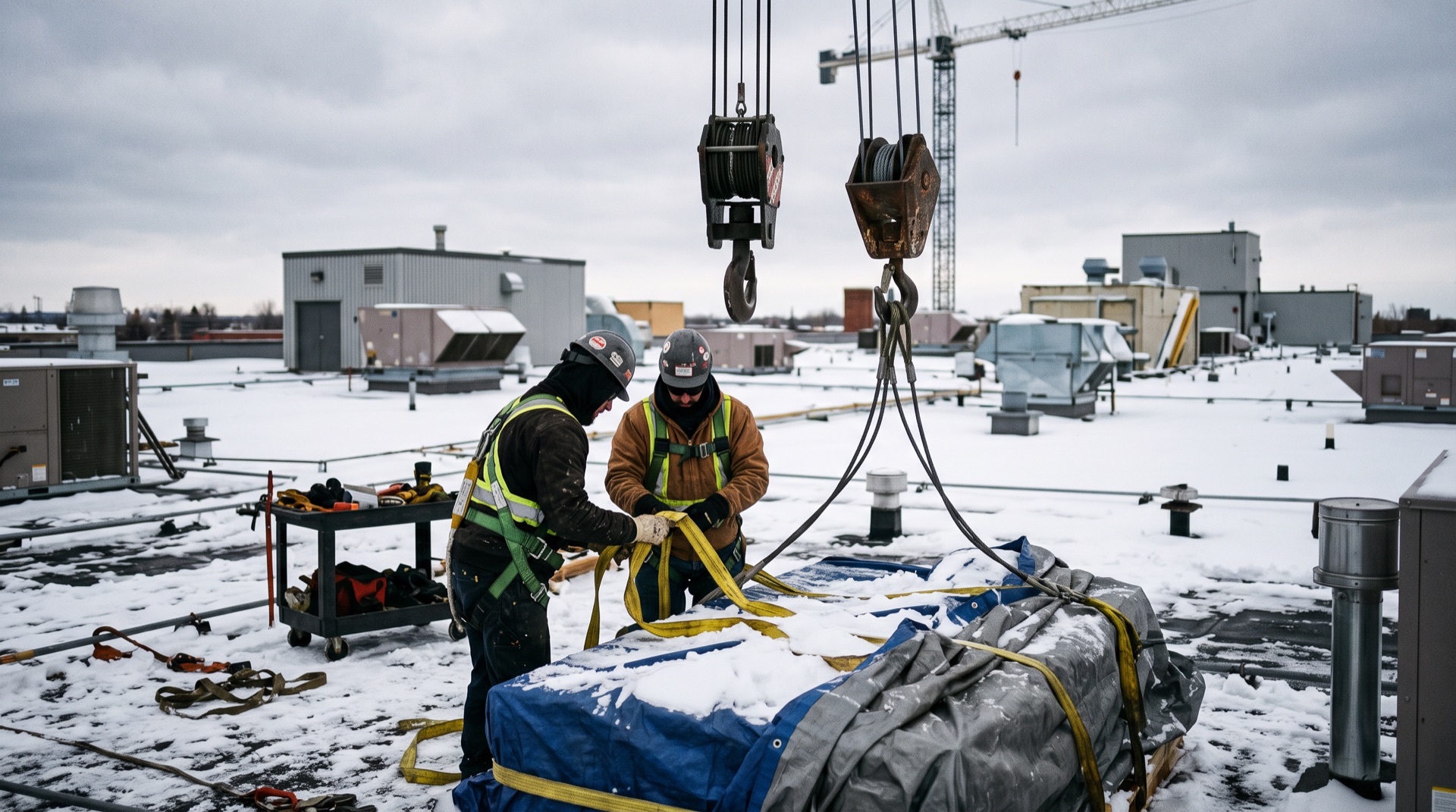
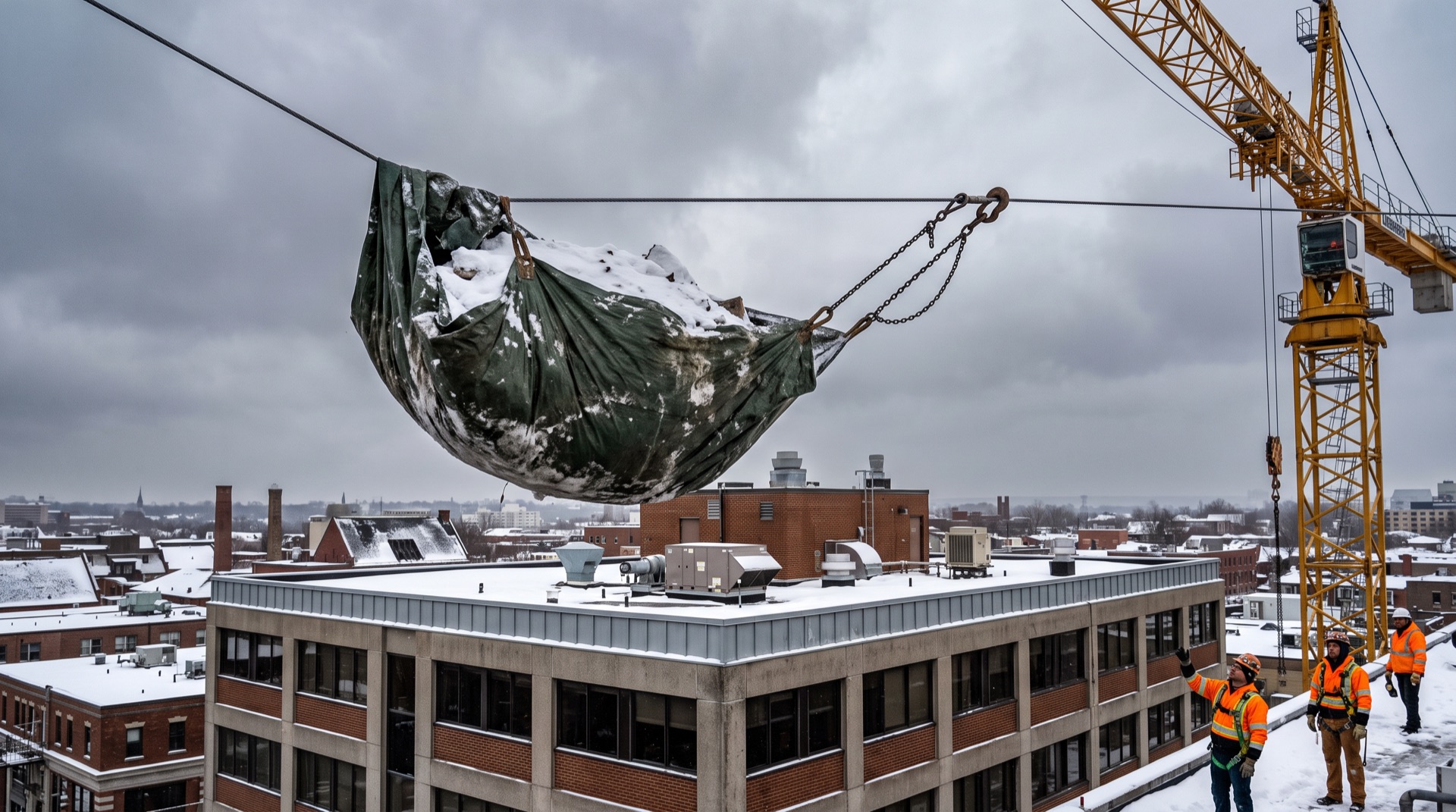
Rip-stop tarps are laid out and anchored on the deck, crews load them, and the boom lifts each loaded tarp clear and sets it down in a designated drop zone on the ground. Outrigger pads are placed on frozen ground rated for the load, and a pedestrian exclusion zone is set and marshalled for the whole operation.
It is a planned lift, not an improvisation. Site access, swing radius, overhead lines, drop zone and ground bearing all get walked before the first tarp goes down.
What you get in Fort Dodge
- Outrigger padsBearing pads sized and placed for frozen and uneven ground
- Lift planned firstAccess, swing radius, overhead lines and drop zone walked before scheduling
- Rip-stop tarp picksRated tarps and rigging, with lifts planned around the swing radius
| Coverage area | Fort Dodge and Webster County |
|---|---|
| Local ice-barrier practice | Eave membrane expected on re-roofs |
| Documentation | Dated before and after photos, written scope in Xactimate line items |
| Primary climate stressor | Lake-effect bands, wet heavy pack |
| Typical scope | Steam, 6-12 crew hours typical |
| Service | Crane-Assisted Snow Removal in Fort Dodge, IA |
| Dispatch window | Same day to 24 hours |
Neighborhoods and Towns We Reach From Fort Dodge
Crews working Fort Dodge cover the adjoining communities on the same route — Otho, Badger, Duncombe, Vincent and Moorland — so a storm week usually means one truck handling several addresses in Webster County rather than separate trips.
Nearest hub towns with their own crane snow removal pages: Ames, Ankeny, Johnston, Urbandale, Waukee, Mason City.
During a cold snap Fort Dodge gets worked alongside the neighboring Webster County towns on the same route, with active interior leaks moved to the front of the list.
Most jobs do not stop at one service. Crane Snow Removal in Fort Dodge often runs alongside commercial roof snow removal in Fort Dodge, and both get written into one scope rather than billed as separate visits.
Active leak right now? Our 24/7 Fort Dodge steam ice dam removal crews are dispatched first during a freeze event. Call (888) 561-9664.