Skip to content
Wilmette, IL
IICRC S500 Standard · Cook County

Ice Dam Water Mitigation in Wilmette, IL — Thaw‑Cycle Storm Response

Ice Dam Now provides water mitigation & dryout in Wilmette, IL and the surrounding Cook County after ice dam leaks. Work runs to IICRC standards with containment where needed and daily moisture readings, the interior repair is done in-house by the same company, and everything is documented in Xactimate line items on one insurance claim.

Wet insulation removed — It cannot be dried in place and it holds water against the framing
Containment and HEPA — Barriers and air scrubbers wherever tear-out is required
Documented to standard — Daily moisture readings until the structure meets IICRC S500 dry standard
Extraction first — Standing water out before anything else starts

Get Ice Dam Help Wilmette

A few quick questions, then pick a time. If water is coming in, call instead.

What is the zip code of the home?

Roof leaking right now? Call (888) 561-9664 — that is faster than any form.
Water coming through the ceiling?Every hour an ice dam sits there, more water gets under the shingles.Call (888) 561-9664
24/7
Dispatch All Winter
Steam
Only — No Pressure
Cook
County Coverage
Same Day
For Active Leaks
Insured
Licensed & Harness-Certified

Most Wilmette homeowners find out about an ice dam from the inside — a damp patch on a bedroom ceiling, or water tracking down the inside of a window frame. As part of our complete Wilmette winter roof services, crews handle water mitigation & dryout across Cook County.

The Wilmette Problem Is the Thermometer, Not the Snowfall

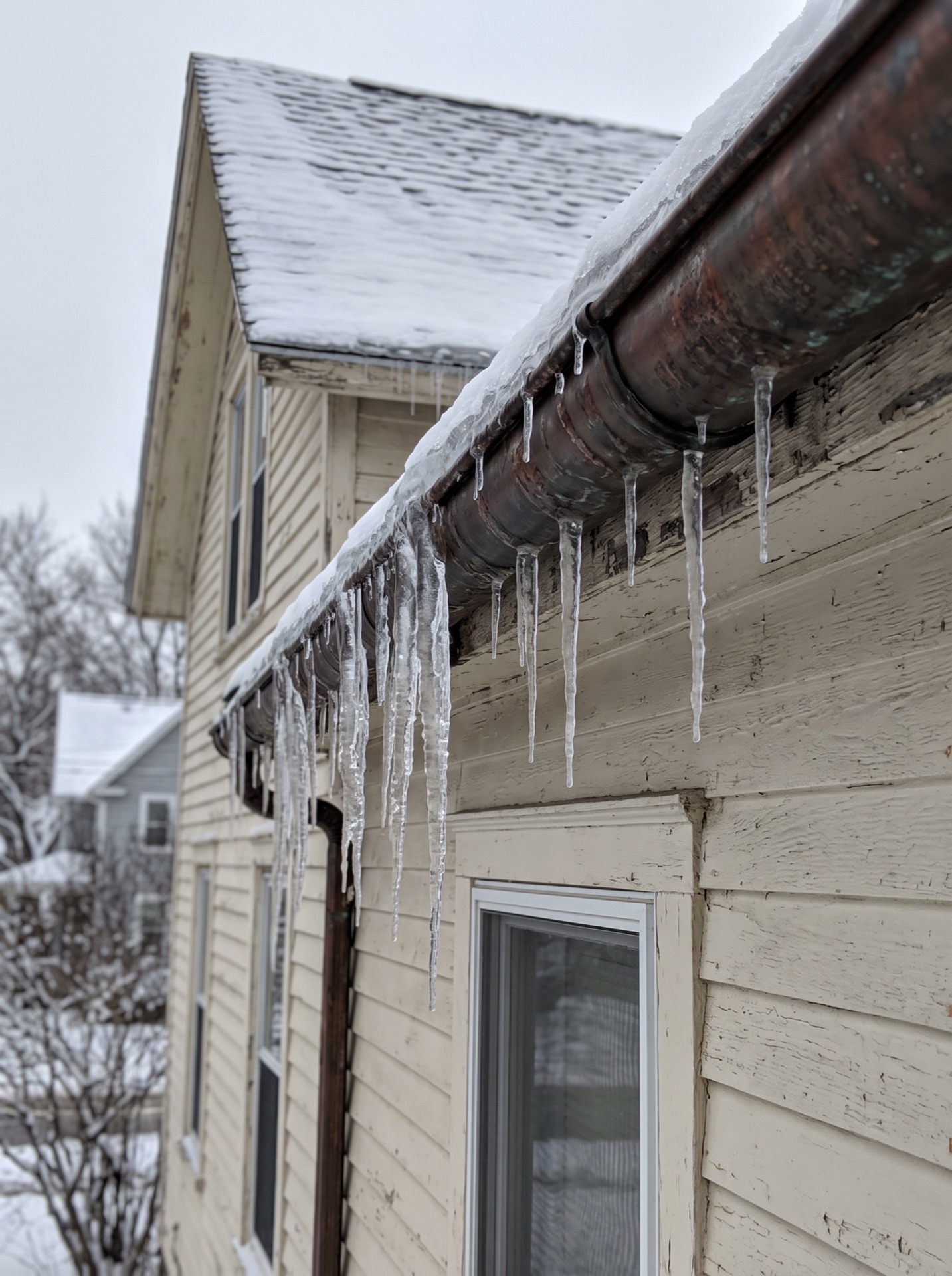
Three inches of snow and a week of days above freezing and nights below it will build ice on a Cook County eave just as reliably as a foot of snow further north.

Diagram showing how ice dams form on a roof from heat loss and snow melt
Heat escaping into the attic melts roof snow; the meltwater refreezes at the cold eave and the dam grows a layer every cycle.

The building stock has no margin for it. Because the winters here read as mild, attics tend to be under-insulated, eave details are less considered, and ice barrier is as often absent as present on a roof in Wilmette.

Ice-barrier practice in Cook County

The residential code Illinois follows requires eave ice barrier on new work, and Cook County enforces it. The variable on any given house is simply when it was last roofed.

Water Mitigation & Dryout in Wilmette: How The Work Runs

Drying to a number, not to a look

Air movers and dehumidifiers get placed to the room's volume and the moisture load, not scattered around. Readings are taken daily on framing, sheathing and drywall until they hit the dry standard for that material. Wet Insulation in the Attic.

In a Wilmette winter, with cold cavities and dry outside air, that generally takes longer than people expect. The job closes on the readings, not on appearance.

When the dryout finds mold

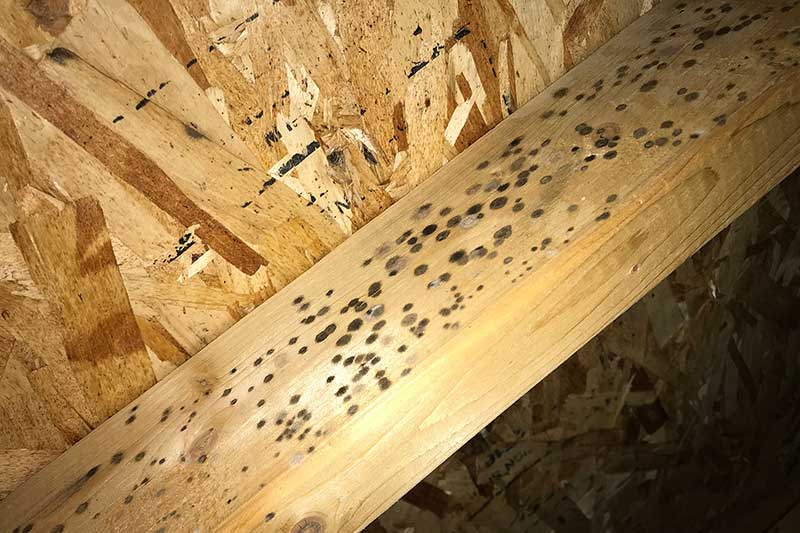
Opening a ceiling or a wall below an ice dam leak often finds growth that was not visible from the room: on the back of the drywall, on the top plate, or on the roof sheathing above.

When it does, the work moves under containment and becomes mold remediation, written into the same claim. It is far cheaper to find it now than after the room has been closed up and repainted.

Contents, storage and what moves out of the way

Mitigation needs the room. Furniture gets blocked up or moved, stored boxes come out of the affected area, and in a finished basement the contents usually have to leave entirely before tear-out starts.

What is already wet gets photographed and listed as it is moved, because contents are a separate part of most policies and the list is considerably harder to assemble once everything has been shifted.

Why a cold attic will not dry itself

Drying is evaporation, and evaporation needs warmth and air movement. A Wilmette attic in February has neither. Wet insulation and damp sheathing sit at near-freezing with no meaningful vapor drive, which is why a leak that stops in January can still be wet in March.

Equipment supplies what the season does not. Without it the structure is not drying slowly - in a cold cavity it is very largely not drying at all.

What happens to flooring

Hardwood cups as it absorbs and may flatten out on its own once the subfloor is dry, so it is given the chance before anyone talks about replacement. Laminate and engineered board usually do not recover.

Carpet and pad are a judgment call on how long they were wet and what the water passed through on the way down.

technician in Tyvek suit and respirator removing contaminated pink insulation in attic
A remediation technician removes mold-contaminated insulation from a tight attic space following ice dam damage.

What you get in Wilmette

  • Containment and HEPABarriers and air scrubbers wherever tear-out is required
  • Hidden water mappedThermal imaging and pin meters find what left no stain
  • Electrical made safeCircuits killed where water reached fixtures, before equipment goes in
Water Mitigation & Dryout in Wilmette, IL — specification
Service specification for Wilmette, IL
DocumentationDated before and after photos, written scope in Xactimate line items
Primary climate stressorRepeated thaw-freeze cycling
MethodContainment, HEPA filtration and drying to a measured IICRC standard
Dispatch windowSame day to 24 hours
Interior repairInsulation, drywall, texture, trim and paint, done in-house after drying
Local ice-barrier practiceEave membrane on new work, often absent
ServiceWater Mitigation & Dryout in Wilmette, IL

Wilmette Coverage and the Adjoining Communities

Crews working Wilmette cover the adjoining communities on the same route — Kenilworth, Winnetka, Golf, Morton Grove and Lincolnwood — so a storm week usually means one truck handling several addresses in Cook County rather than separate trips.

Nearest hub towns with their own water mitigation pages: Evanston, Skokie, Glencoe, Glenview, Northbrook, Park Ridge.

During a cold snap Wilmette gets worked alongside the neighboring Cook County towns on the same route, with active interior leaks moved to the front of the list.

Most jobs do not stop at one service. Water Mitigation in Wilmette often runs alongside ice dam removal in Wilmette, and both get written into one scope rather than billed as separate visits.

Active leak right now? Our 24/7 Wilmette steam ice dam removal crews are dispatched first during a freeze event. Call (888) 561-9664.


One Event, One Claim

Everything The Ice Dam Caused In Wilmette, On One Claim

Taking the ice off is usually the cheapest part. The water that already got in, the mold it leaves, the ceiling that has to come down and sometimes the roof itself are one loss event, so they go on one insurance claim, handled by one company.

How it goes on the claim

  • One loss, one claim number. Removal, mitigation, mold, interior repair and roof damage from the same ice dam are reported as one event.
  • Broken out by coverage. Mitigation, mold (often under its own sublimit), interior repair and the roof are written as separate Xactimate sections, so a question on one line does not hold up the rest.
  • Documented the whole way. Dated photographs and moisture readings run from the ice on the roof to the finished room, from one company, in one file.
  • Honest about the limits. Coverage depends on your policy. A roof that was simply old is not storm damage, and you and your carrier make the coverage decision.
Ice Dam Claims In Wilmette
Conditions We Work In

Water Mitigation & Dryout In Practice

Conditions crews work in across Cook County. Every job is photographed before and after.

contractor using drill to repair ceiling drywall after ice dam water damage
A contractor drills into a water-damaged ceiling where drywall was removed to expose insulation after ice dam damage.
technician in Tyvek suit and respirator removing contaminated pink insulation in attic
A remediation technician removes mold-contaminated insulation from a tight attic space following ice dam damage.
plastic containment sheeting and air mover set up inside living room after water damage
Plastic containment barriers and a commercial air mover protect the living area during water damage remediation.
FAQ

Local Questions About Wilmette Roofs

It is billed by the crew hour, and the rate plus a realistic time estimate are quoted on the phone before anyone is dispatched.

  • Scope drives the hours: length and thickness of the ice, roof pitch and height, and whether the gutters are frozen solid.
  • Access matters too — a three-story Wilmette roof takes longer to set up on than a ranch.
  • The invoice matches the quote. There are no surprise add-ons written on the tailgate.

No, but there is a worse one: after the thaw, when the evidence has melted and the damage is all that is left.

  • Mid-storm calls are fine — crews work through freeze events.
  • An evening call for a leak that started that afternoon usually gets a next-morning slot.
  • Waiting for a weekend to pass is the most common and most expensive delay.

Often for the interior water damage, sometimes for the removal itself, but it depends entirely on your carrier and policy wording.

  • Many policies treat emergency mitigation separately under a duty to protect property clause.
  • Denials usually cite the maintenance exclusion, which dated photographs taken during the event are the direct counter to.
  • Crews photograph the dam, the entry points and the interior damage, and write the scope in Xactimate line items.
  • The coverage decision is between you and your carrier — no contractor can promise an outcome there.

Only where there is interior damage to document or dry. Pure exterior removal happens entirely from outside.

  • If water has come in, seeing it is what makes the claim documentation worth anything.
  • Attic access helps identify the heat source but is not required for removal.
  • Nobody needs to be home for exterior-only work, provided access and payment are arranged.

Before the thaw rather than after it. The leak happens when the ice has water behind it, which is a day or two after the snow stops.

  • Calling during the storm is fine and often gets an earlier slot.
  • The expensive version is waiting until water appears on a ceiling.
  • Crews run across Cook County from first light through a freeze event.

In an open, heated room, sometimes. Inside an attic, a wall cavity or above a ceiling in winter, no — there is no air movement and no evaporation to speak of. Those are exactly the spaces ice dam water gets into.

Given moisture and an organic surface, growth can begin within a couple of days. Cold slows it but does not stop it, and the spring warm-up finds whatever is still wet. That is why drying starts immediately rather than after the roof is sorted out.

Nearby

Water Mitigation In Towns Around Wilmette

Same-Day Response

Get A Wilmette Crew Out

Waiting for a thaw is a strategy, but it is an expensive one — the melt has to go somewhere, and it goes into the insulation first.

✓ Licensed & insured✓ Low-pressure steam only✓ Rate quoted up front✓ Photos for your claim
Online Quote(888) 561-9664