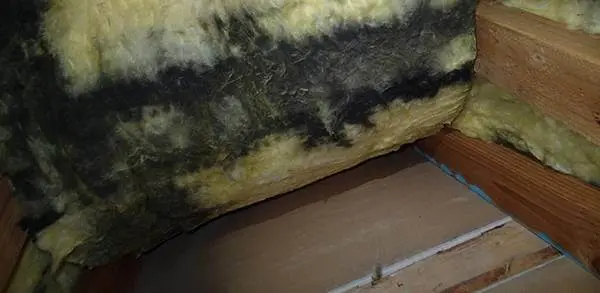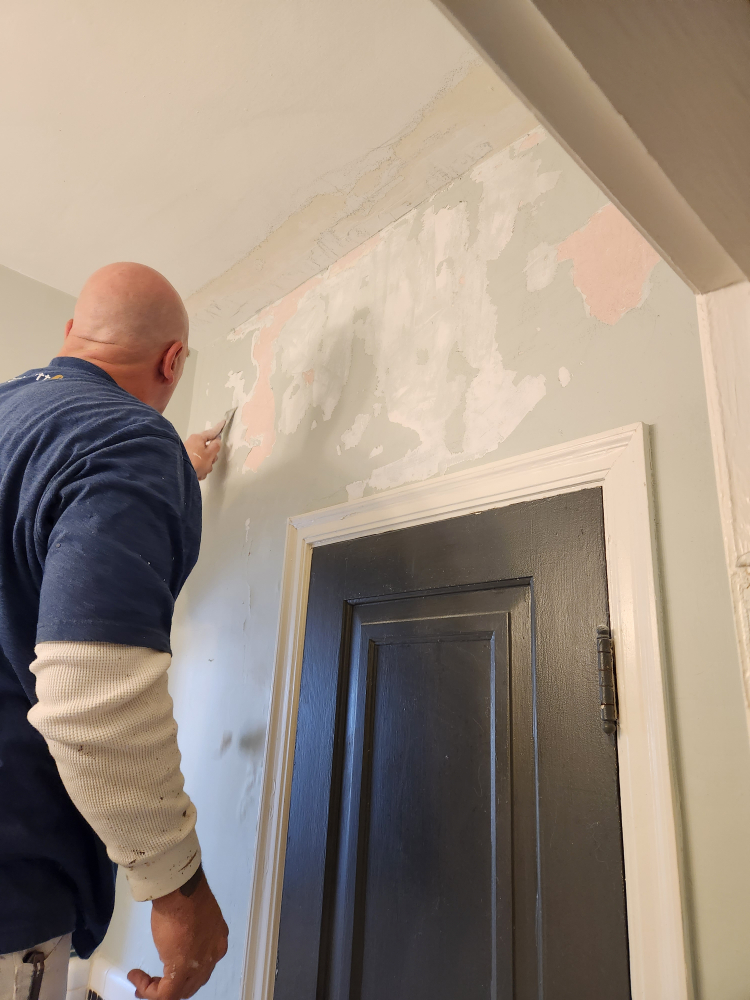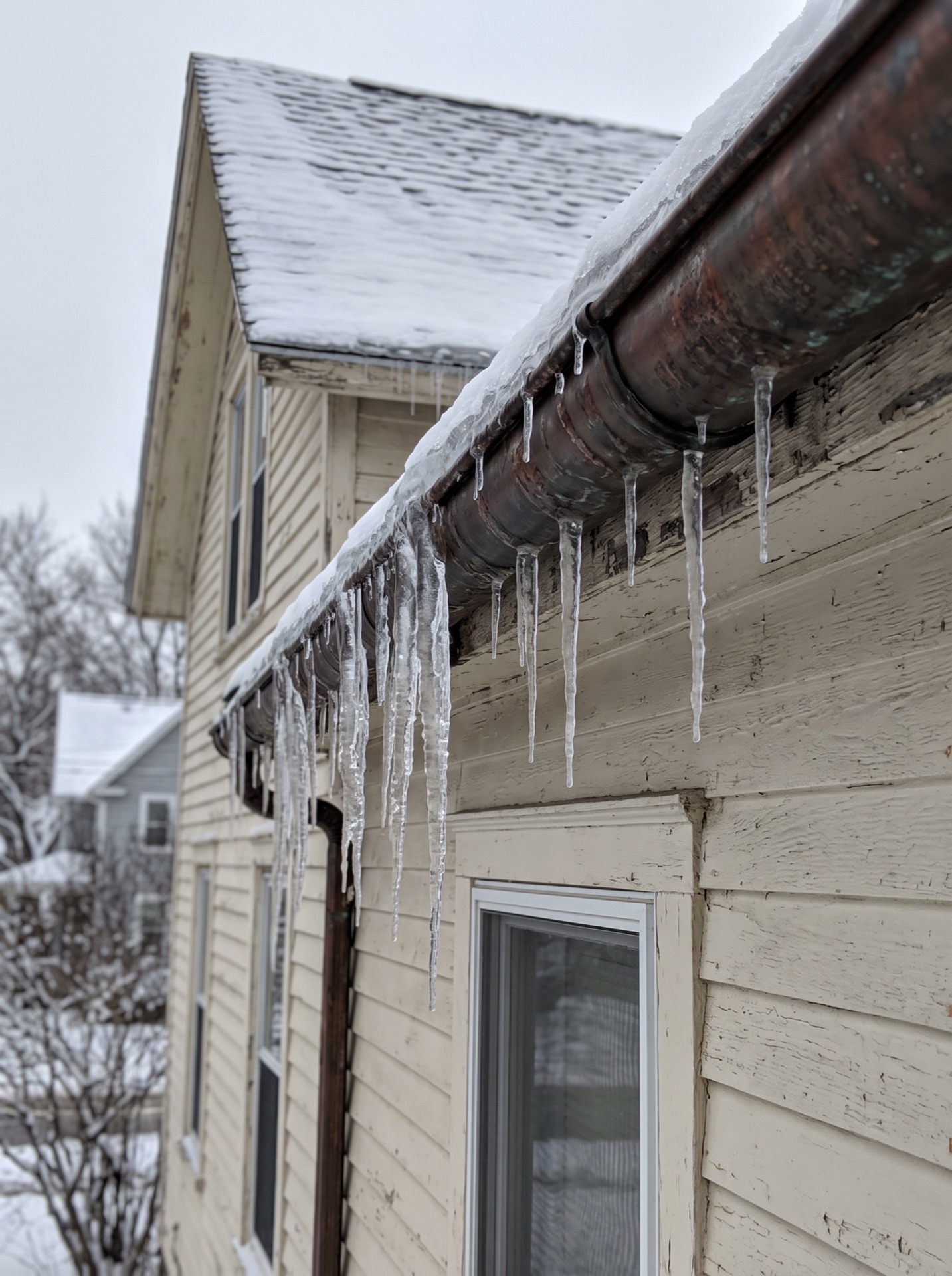
Every Caledonia winter produces the same two calls: the ones who see the ice early, and the ones who see the ceiling stain first. As part of our complete Caledonia winter roof services, crews handle ice dam removal across Racine County.
Caledonia Ice Dams: What Lake-Effect Snow Does to an Eave
What makes Racine County roofs dam is not the seasonal total, it is how the snow arrives. Bands dump a heavy, saturated pack in hours, and that pack becomes a water reservoir sitting on a heated surface.

The damage comes on the thaw. Warm air leaking into the attic melts the underside of that pack, the meltwater runs to an eave that is still well below freezing, and it sets. Repeat that four or five times in a January and the ridge of ice at the gutter line stops being cosmetic.
Ice-barrier practice in Racine County
Ice-barrier membrane at the eaves is standard practice across the lake-effect counties, and most Wisconsin jurisdictions enforce it on re-roofs. If your roof predates that, the eave has nothing under the shingles holding water out.
Ice Dam Removal in Caledonia: How The Work Runs
What steam actually does
A steam unit delivers water at roughly 290°F at a pressure low enough to rest your hand in the plume. It cuts a channel straight through the ice and lifts the dam off in sections, right down to the shingle. The heat does the work, not force, so granules, seal strips and flashing come through untouched. Water Stain on the Ceiling in Winter.
That is the whole difference between steam and the hot pressure washers often sold as steam. A pressure washer cuts ice fast because of its pressure — and that same pressure strips the granules off asphalt shingles and drives water up under the courses. One method removes ice. The other removes ice and roof.
Working at night and during an active storm
Freeze events do not keep office hours, and the worst leaks tend to announce themselves in the evening when the day's melt refreezes. Crews run lit, and a roof that is actively collecting snow is worked anyway, because waiting for better weather means the dam is bigger when somebody finally gets to it.
What does stop a crew is wind and lightning. Both are judgment calls made on site in Caledonia, and a postponed start gets explained rather than dressed up.
What gets photographed, and why it matters later
Before the lance comes out, the crew shoots the dam from the ground and from the roof, the icicle line, any staining visible inside, and the specific courses where water is tracking under the shingles. Timestamps are on every frame.
That record is the whole case if a claim follows. An adjuster arriving in March sees a dry roof and a stained ceiling; the photographs are what connect the two, and they are what a maintenance-exclusion denial runs into.
Why salt and ice melt make it worse
Calcium chloride opens a narrow channel and leaves the dam standing. The channel refreezes, the dam does not go anywhere, and in the meantime the runoff corrodes gutter seams, fasteners, flashing and anything growing underneath.
It is a stopgap at best. On a roof in Caledonia with an active leak it buys hours, not days, and it adds a corrosion problem to the water problem.
What the dam has already done to the gutter and fascia
Ice expands as it forms, and a trough packed solid pushes the gutter away from the fascia a little more every cycle. By the time the dam is thick enough to leak, the hangers are often pulled, the back of the trough has lifted, and the fascia board behind it has been wet for weeks.
None of that is visible until the ice is off. It gets photographed when it appears, because a bent gutter found in February is a great deal easier to argue about with a carrier than one discovered in May.

What you get in Caledonia
- No salt, no chippingNothing corrosive and nothing mechanical touches the covering
- Gutters cleared tooTrough and downspout steamed through to daylight in the same visit
- Steam onlySafe on asphalt, cedar, slate, tile and metal — no chipping, no pressure, no salt
| Local ice-barrier practice | Eave membrane expected on re-roofs |
|---|---|
| Removal method | Low-pressure steam only. No chipping, salt or pressure washing. |
| Service | Ice Dam Removal in Caledonia, WI |
| Dispatch window | Same day to 24 hours |
| Primary climate stressor | Lake-effect bands, wet heavy pack |
| Typical scope | Steam, 6-12 crew hours typical |
| Documentation | Dated before and after photos, written scope in Xactimate line items |
Neighborhoods and Towns We Reach From Caledonia
Crews working Caledonia cover the adjoining communities on the same route — Franksville, Greendale, Cudahy, Sturtevant and Hales Corners — so a storm week usually means one truck handling several addresses in Racine County rather than separate trips.
Nearest hub towns with their own ice dam removal pages: Oak Creek, South Milwaukee, Franklin, Mount Pleasant, Racine, Greenfield.
Scheduling for Caledonia tightens up during a freeze event, which is exactly when the phone beats the form. Water coming in means a call, not an email.
Most jobs do not stop at one service. Ice Dam Removal in Caledonia often runs alongside water mitigation & dryout in Caledonia, and both get written into one scope rather than billed as separate visits.
Active leak right now? Our 24/7 Caledonia steam ice dam removal crews are dispatched first during a freeze event. Call (888) 561-9664.