

Skip to content
Gahanna, OH
Hand Clearing · Franklin County

Roof Shoveling in Gahanna, OH — Rapid Freeze‑Thaw Crews

Roof Shoveling in Gahanna, OH from Ice Dam Now: low-pressure steam only, across Franklin County. No chipping, no salt, no pressure washing. Crews carry licensing, insurance and fall-protection certification, bill by the crew hour at a rate quoted on the phone, prioritize active interior leaks the same day, and document the work for insurance.

Flat sections included — Garage, porch and addition roofs that shed nothing on their own
Valleys and dormers — The pockets a rake physically cannot reach get cleared properly
Harnessed and anchored — Rated anchor points on every pitched roof, every time
Drains opened — Scuppers and outlets cleared so the melt has somewhere to go

Get Ice Dam Help Gahanna

A few quick questions, then pick a time. If water is coming in, call instead.

What is the zip code of the home?

Roof leaking right now? Call (888) 561-9664 — that is faster than any form.
Water coming through the ceiling?Every hour an ice dam sits there, more water gets under the shingles.Call (888) 561-9664
24/7
Storm Season Dispatch
No Chipping
Steam Only
Franklin
County Coverage
Crew Hour
Rate Quoted Up Front
Documented
Photos On Every Job

Winter in Gahanna does not need a record storm to put water inside a house. It needs a roof with snow on it, an attic leaking heat, and one cold night. As part of our complete Gahanna winter roof services, crews handle roof shoveling across Franklin County.

Why Gahanna Roofs Dam Up: Cycling, Not Snowfall Totals

An ice dam needs meltwater and a cold eave, and Gahanna supplies both on an ordinary week. A thin cover that melts by lunchtime and sets again after dark is a perfectly good dam factory.

Diagram showing how ice dams form on roofs due to inadequate insulation and poor ventilation
Heat escaping into the attic melts roof snow; the meltwater refreezes at the cold eave and the dam grows a layer every cycle.

The expectation is the problem. Nobody in Gahanna re-roofs with ice dams in mind, so when a cycling stretch arrives the houses with the least margin all leak in the same week.

Ice-barrier practice in Franklin County

The residential code Ohio follows calls for eave ice barrier on new work. Enforcement in Franklin County is real but recent, so the age of the roof is what decides whether it is there.

Roof Shoveling in Gahanna: How The Work Runs

Anchors, rope and why this is not a DIY job

Every crew member on a pitched roof is tied to a rated anchor. On ice over shingle, footing is unreliable in a way that is hard to appreciate from the ground. Ceiling Sagging or Bulging After Snow.

Roof falls are the most common serious winter injury in this trade and they happen to people who have done it for years. A Gahanna homeowner in work boots on a January roof is taking a risk out of all proportion to the money saved.

Working around what is up there

Rooftop units, exhaust fans, conduit runs, gas lines, solar racking, skylights and safety railing all have to be cleared around rather than over. The drift shadow behind a unit is usually the deepest snow on the roof.

Skylights in particular get flagged and worked around deliberately — a shovel through cold glass is a bad afternoon for everyone.

How crews work without wrecking the roof

Plastic-bladed shovels only, never steel. Snow is cut and lifted in layers rather than scraped, and a cushion layer stays on the surface at all times so the blade never contacts shingle, membrane or seam. Discharge is aimed away from walkways, decks, shrubs and mechanical units.

Everyone on the roof is harnessed to a rated anchor. On an icy pitch that is not a formality — it is the whole reason this is not a homeowner job.

Where hand clearing is the only option

A roof rake reaches the first several feet from the edge and nothing beyond it. Dead valleys between roof planes, the pockets behind dormers and chimneys, low-slope and flat sections, and upper roofs on anything over a story and a half all need someone on the roof with a shovel.

Those are also the places snow collects deepest, because wind deposits it there and nothing sheds it. A Gahanna roof can look mostly clear from the street and still be carrying two feet of drifted pack in the valleys.

Flat and low-slope roofs shed nothing

A pitched roof loses some of its load on its own. A flat or low-slope roof does not: whatever falls stays, settles, and gets heavier as it absorbs the next melt.

On Gahanna properties with a flat section — a garage, an addition, a porch roof, a whole commercial deck — hand clearing is not optional maintenance, it is the only way the load comes off.

Large sheet of snow sliding off residential roof during winter removal
A heavy slab of accumulated snow breaks free and cascades off a residential rooftop during a winter storm.

What you get in Gahanna

  • Flat sections includedGarage, porch and addition roofs that shed nothing on their own
  • Controlled dischargeSnow lands away from walkways, decks, landscaping and HVAC
  • Drains openedScuppers and outlets cleared so the melt has somewhere to go
Roof Shoveling in Gahanna, OH — specification
Service specification for Gahanna, OH
Typical scopeSteam, 4-8 crew hours typical
Coverage areaGahanna and Franklin County
Removal methodLow-pressure steam only. No chipping, salt or pressure washing.
DocumentationDated before and after photos, written scope in Xactimate line items
Primary climate stressorRepeated thaw-freeze cycling
Pricing modelBilled by the crew hour, rate quoted before dispatch
Local ice-barrier practiceEave membrane on new work, often absent

Where We Dispatch Around Gahanna

Crews working Gahanna cover the adjoining communities on the same route — Blacklick, New Albany, Summit Station, Brice and Pickerington — so a storm week usually means one truck handling several addresses in Franklin County rather than separate trips.

Nearest hub towns with their own roof shoveling pages: Reynoldsburg, Westerville, Columbus, Upper Arlington, Dublin, Grove City.

Gahanna sits inside the regular Ohio service area, so a crew is usually scheduled the same day or the following morning.

Most jobs do not stop at one service. Roof Shoveling in Gahanna often runs alongside roof snow removal in Gahanna, and both get written into one scope rather than billed as separate visits.

Active leak right now? Our 24/7 Gahanna steam ice dam removal crews are dispatched first during a freeze event. Call (888) 561-9664.

Conditions We Work In

Roof Shoveling In Practice

Conditions crews work in across Franklin County. Every job is photographed before and after.

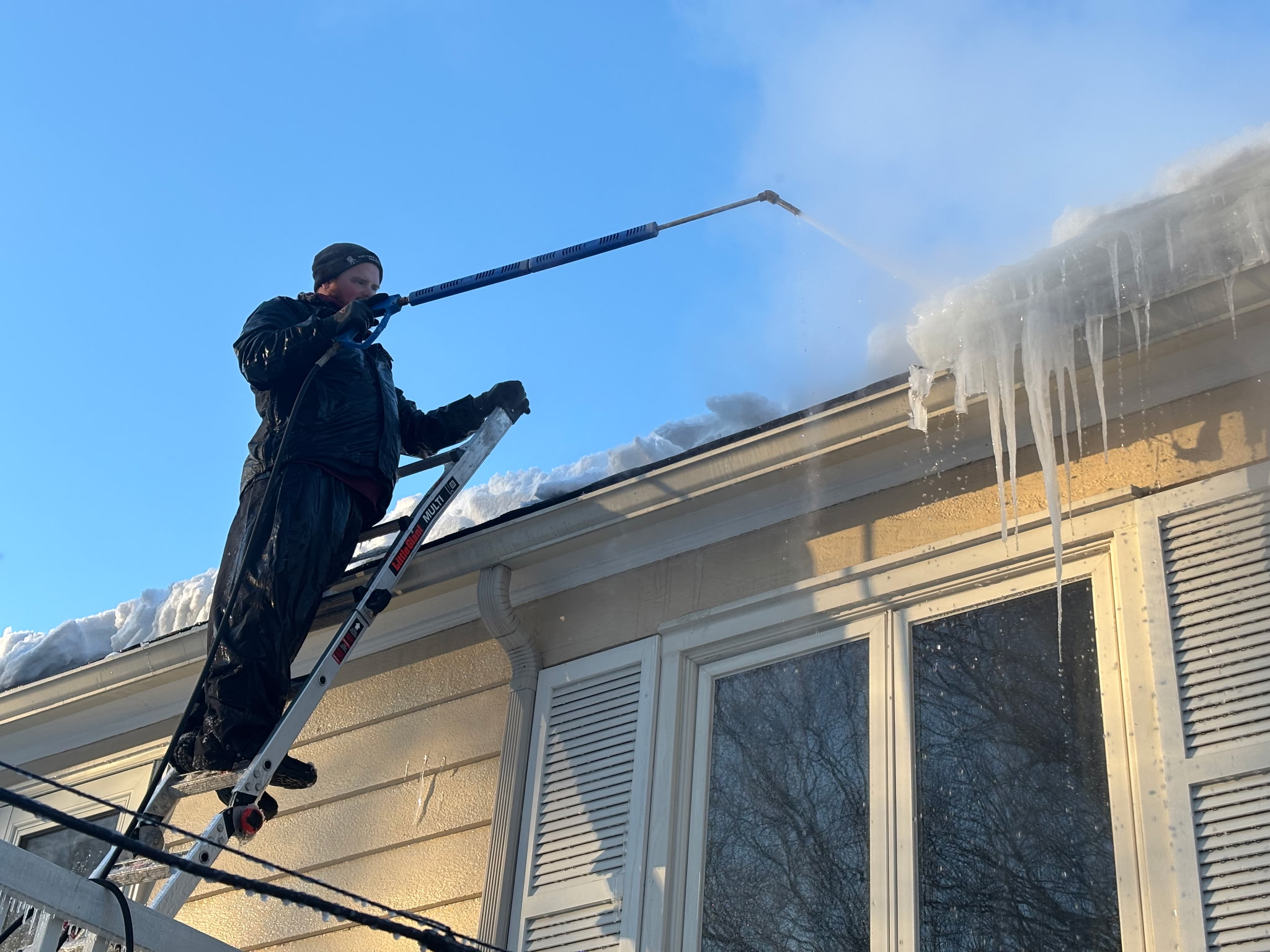
Worker on ladder using steam wand to remove ice dams and icicles from residential roof
A technician uses a high-pressure steam wand to melt ice dams and icicles from a home's roofline.
Worker in safety harness shoveling heavy snow off a residential roof
A roofing professional uses a safety harness and blue shovel to clear heavy snow accumulation from a residential roof.
Large sheet of snow sliding off residential roof during winter removal
A heavy slab of accumulated snow breaks free and cascades off a residential rooftop during a winter storm.
FAQ

Gahanna and Franklin County FAQ

It is billed by the crew hour, and the rate plus a realistic time estimate are quoted on the phone before anyone is dispatched.

  • Scope drives the hours: length and thickness of the ice, roof pitch and height, and whether the gutters are frozen solid.
  • Access matters too — a three-story Gahanna roof takes longer to set up on than a ranch.
  • The invoice matches the quote. There are no surprise add-ons written on the tailgate.

No. Steam removal is maintenance work, not construction, so no building permit is pulled for it anywhere in Franklin County.

  • A permit does come into it once the work becomes a repair — new decking, a re-roof or structural work.
  • That is handled through the Gahanna building department, or the Franklin County building authority where the city has no department of its own.
  • Ask before signing anything: a contractor who says a re-roof in Gahanna needs no permit is telling you something useful about how they work.

Clear a path to the affected side, move vehicles off the driveway and unlock any side gate.

  • Put something under an active interior drip and move what you can out of the way.
  • Photograph the interior damage yourself as well - more evidence is never a problem.
  • Do not go on the roof or up a ladder. That is the part that sends people to hospital.

Tell the crew. Chipping marks change what the roof needs and they matter for the claim.

  • Cracked shingles and punctures get photographed and reported rather than steamed over.
  • Damage caused by removal attempts is treated differently by carriers than storm damage.
  • It is extremely common and nobody is going to lecture you about it.

Because ice dams are made by heat loss, and two houses on the same street rarely leak heat the same way.

  • Attic air leaks around can lights, bath fans and the attic hatch are the usual source.
  • Crushed or missing soffit baffles stop the intake ventilation that would otherwise keep the deck cold.
  • An addition or dormer built over unheated space puts warm air right against a cold eave.
  • Local factor: repeated thaw-freeze cycling makes the difference show up faster here than it would further south.

Not the way crews do it. Plastic blades, snow cut in layers, and a cushion layer always left behind means the blade never reaches the shingle surface. The damage people picture comes from steel shovels scraped to bare roof.

Typically two or three. More than that on a small residential roof concentrates weight and gets in its own way; fewer than that on a large deck turns a day into three. The number is set by the roof and quoted before anyone turns up.

Nearby

Roof Shoveling In Towns Around Gahanna

Same-Day Response

Get A Gahanna Crew Out

Nothing about an ice dam improves by waiting. It refreezes tonight, thicker, and the water behind it keeps looking for a way in.

✓ Licensed & insured✓ Low-pressure steam only✓ Rate quoted up front✓ Photos for your claim
Online Quote(888) 561-9664