The ice along a roof in Clevelandline is the symptom. The cause is warm air escaping into the attic, and it is still running right now. As part of our complete Cleveland winter roof services, crews handle crane-assisted snow removal across Cuyahoga County.
The Cleveland Problem Is the Thermometer, Not the Snowfall
The snow totals here are unremarkable, which is exactly why Cleveland roofs get caught out. An ice dam needs meltwater and a cold eave, not a record storm.

That is the part homeowners miss. Total snowfall here is modest compared with the northern belt, so roofs in Cuyahoga County are often built and insulated as though ice is not a concern. Then a cycling week in January finds every weak eave at once.
Ice-barrier practice in Cuyahoga County
Ice-barrier membrane at the eaves is required on new work under the residential code Ohio follows, but on a roof built before that it is frequently absent — and this is the region where it is most often skipped.
Crane-Assisted Snow Removal in Cleveland: How The Work Runs
Reach, radius and why the chart decides
Capacity falls away sharply with radius. A machine that lifts comfortably at thirty feet may be well short of the same load at eighty, which is why the far corner of a large deck sometimes needs a bigger crane rather than a longer day. Ceiling Sagging or Bulging After Snow.
The chart is run before the quote, so the number given is for a machine that can actually reach the whole roof in Cleveland rather than most of it.
What goes in the tarp and what does not
A pick lifts loose and broken snow. It does not lift a solid sheet of ice frozen to the membrane, and trying to make it do so is how a tarp takes the roof covering with it.
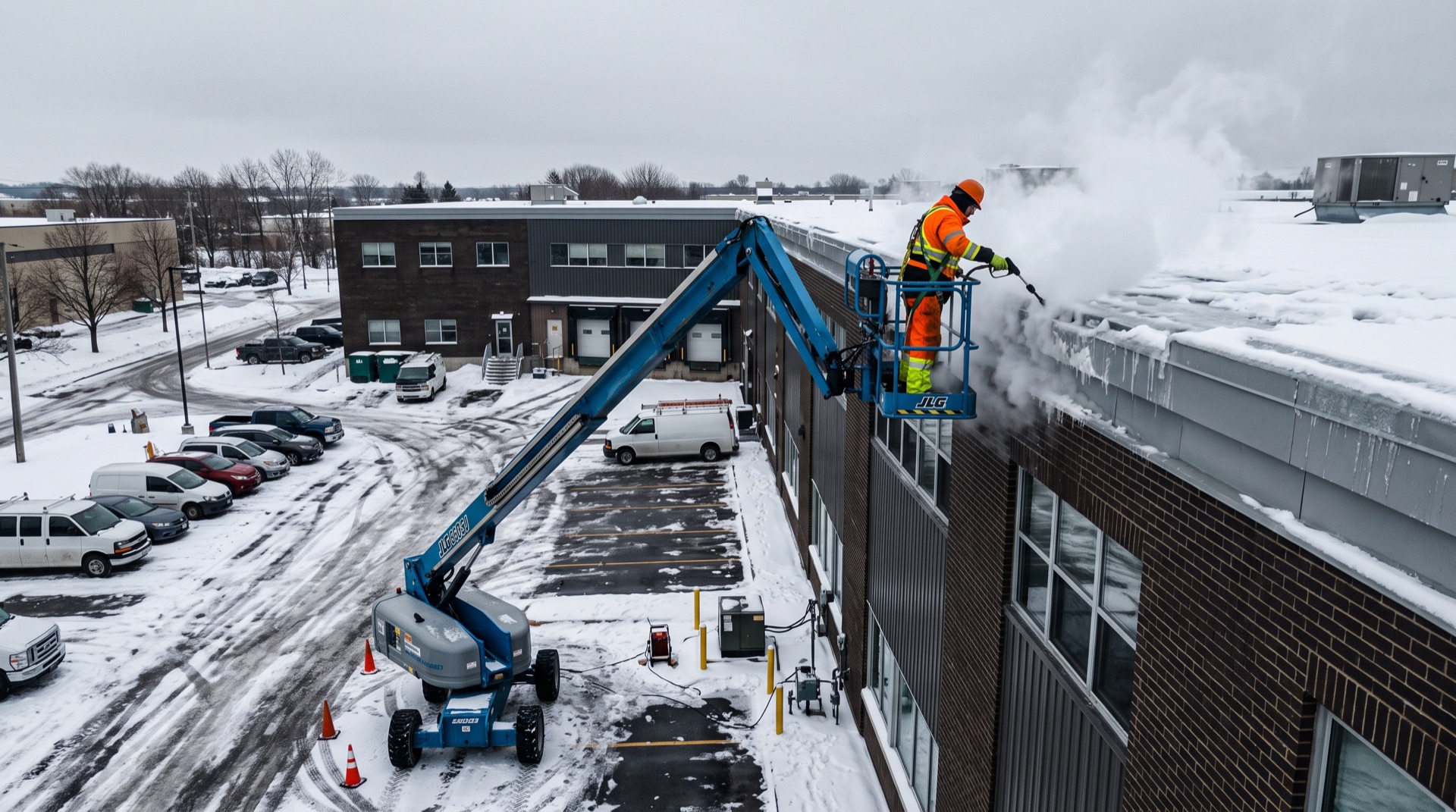
So the sequence is crews cutting and breaking the pack into liftable material, the crane moving it, and steam dealing with whatever is bonded to the surface. The crane is the transport, not the demolition.
How a pick actually works
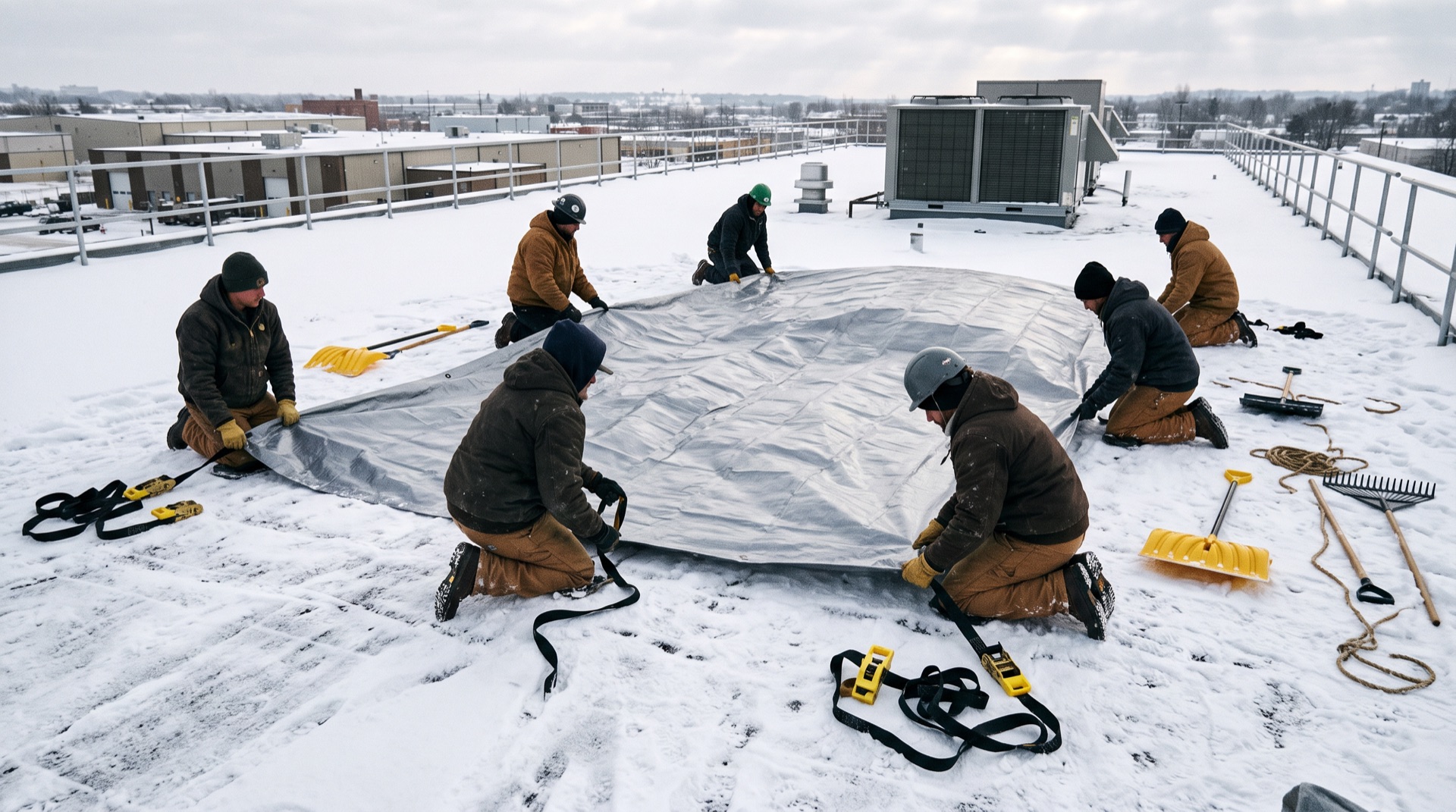
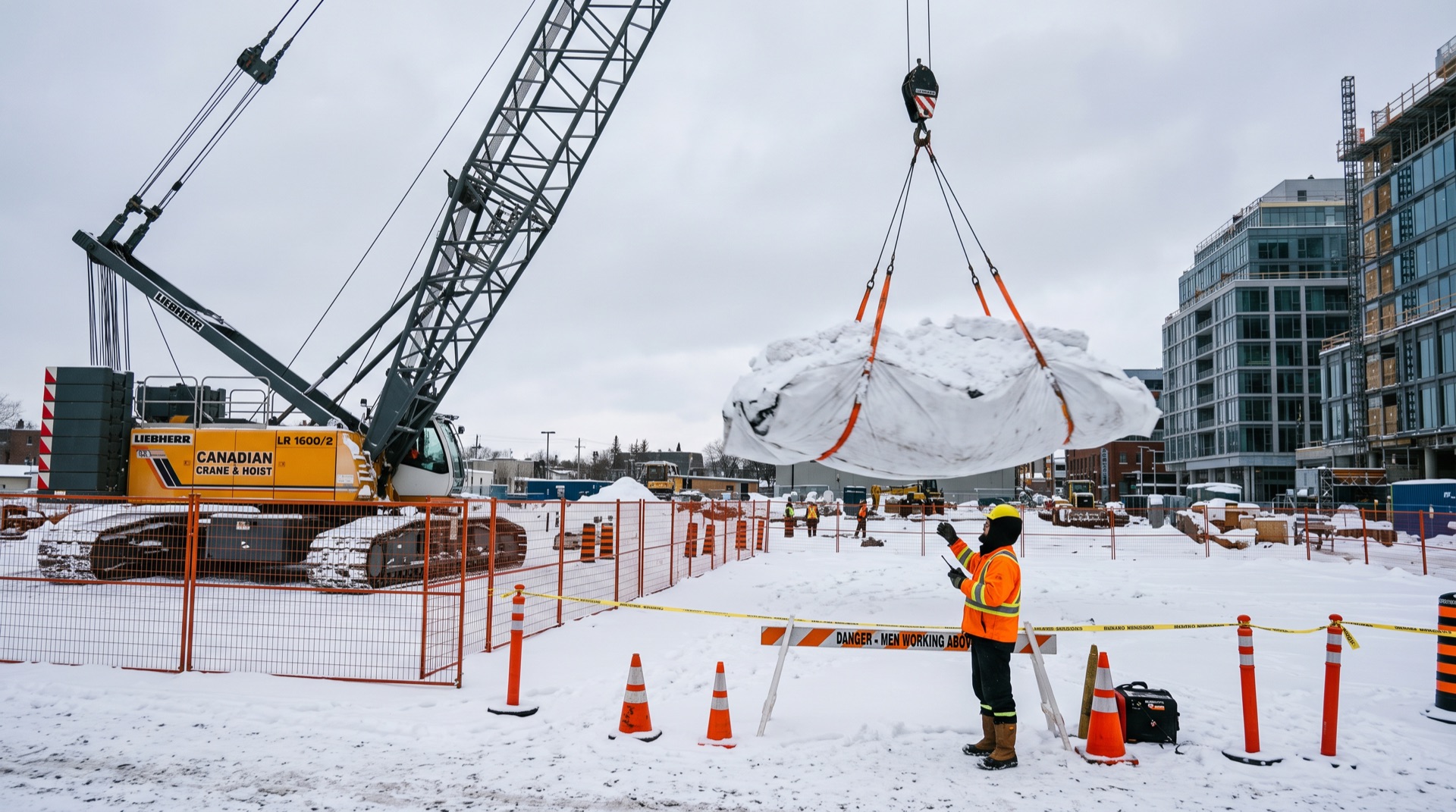
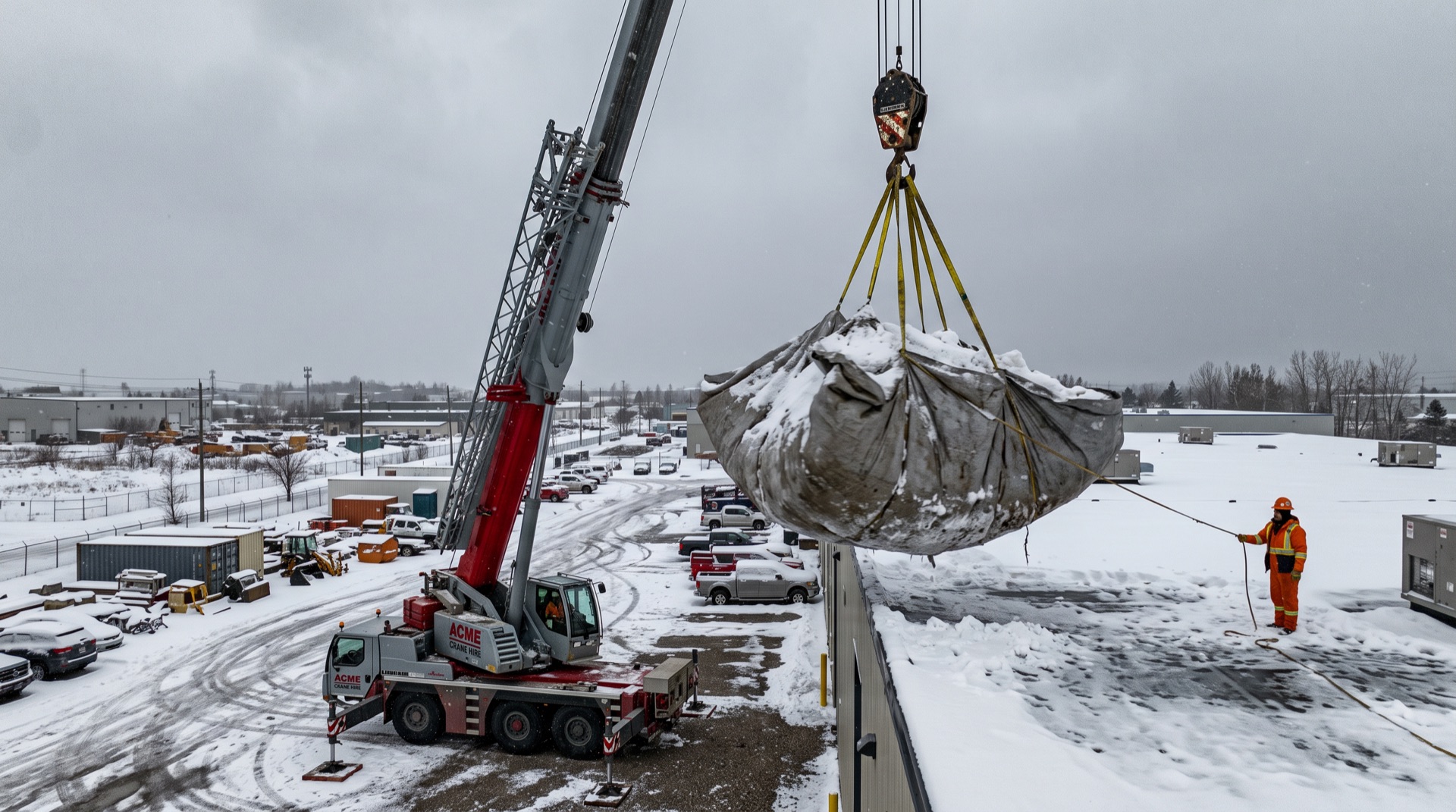
Rip-stop tarps are laid out and anchored on the deck, crews load them, and the boom lifts each loaded tarp clear and sets it down in a designated drop zone on the ground. Outrigger pads are placed on frozen ground rated for the load, and a pedestrian exclusion zone is set and marshalled for the whole operation.
It is a planned lift, not an improvisation. Site access, swing radius, overhead lines, drop zone and ground bearing all get walked before the first tarp goes down.
What happens if the crane cannot get close enough
Overhead power, a narrow alley, soft ground that will not take outrigger loads, or a neighboring building in the swing path can all rule out a setup after a site visit.
That gets found on the walk rather than on the day. Where a crane genuinely will not work, the honest answer is a larger hand crew over more days with the cost difference laid out - not a pick that was never going to fit.
Why it is often the cheaper number
Per hour a crane costs more than a crew with shovels. Per roof it frequently costs less, because a pick that takes an afternoon can replace several crew-days of hand clearing.
On a large Cleveland deck the crane is routinely both the faster and the cheaper answer, and the comparison gets shown rather than asserted.
What you get in Cleveland
- Lift planned firstAccess, swing radius, overhead lines and drop zone walked before scheduling
- Load calculated firstDepth, density and area against design capacity before anything mobilises
- Weights documentedDepths, densities and loads recorded for the carrier
| Typical scope | Steam, 4-8 crew hours typical |
|---|---|
| Coverage area | Cleveland and Cuyahoga County |
| Local ice-barrier practice | Eave membrane on new work, often absent |
| Documentation | Dated before and after photos, written scope in Xactimate line items |
| Service | Crane-Assisted Snow Removal in Cleveland, OH |
| Pricing model | Billed by the crew hour, rate quoted before dispatch |
| Primary climate stressor | Repeated thaw-freeze cycling |
Where We Dispatch Around Cleveland
Crews working Cleveland cover the adjoining communities on the same route — Independence, Beachwood, Maple Heights, Rocky River and Brook Park — so a storm week usually means one truck handling several addresses in Cuyahoga County rather than separate trips.
Nearest hub towns with their own crane snow removal pages: Garfield Heights, Lakewood, Cleveland Heights, Parma, Shaker Heights, Euclid.
Scheduling for Cleveland tightens up during a freeze event, which is exactly when the phone beats the form. Water coming in means a call, not an email.
Most jobs do not stop at one service. Crane Snow Removal in Cleveland often runs alongside commercial roof snow removal in Cleveland, and both get written into one scope rather than billed as separate visits.
Active leak right now? Our 24/7 Cleveland steam ice dam removal crews are dispatched first during a freeze event. Call (888) 561-9664.