
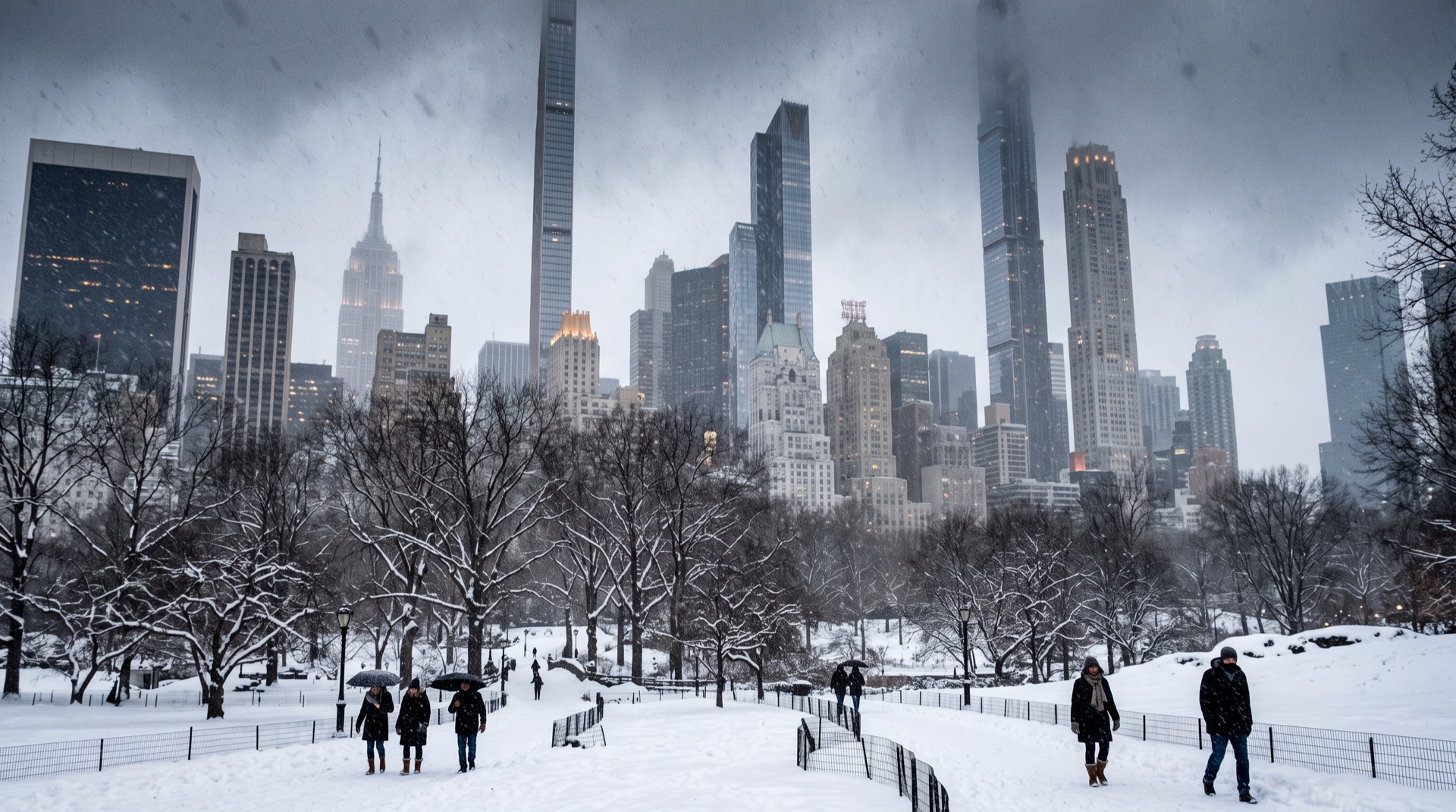
Winter in New York City does not need a record storm to put water inside a house. It needs a roof with snow on it, an attic leaking heat, and one cold night. As part of our complete New York City winter roof services, crews handle roof snow removal across New York County.
Wet Snow, Swinging Air: New York City Ice Dams
A nor'easter can load a roof in New York City with heavy, wet snow overnight. Coastal air then swings the temperature either side of freezing for days, which is the exact condition that builds ice fastest.

Add the architecture and the problem concentrates. Dormers, ells, knee walls and additions over porches all create pockets where warm air meets cold deck, and those are the eaves that dam first on a roof in New York City.
Ice-barrier practice in New York County
In most coastal New York towns the eave membrane requirement extends past the interior wall line rather than stopping at the first course. On a roof in New York City with a deep overhang, that is further up than it sounds.
Roof Snow Removal in New York City: How The Work Runs
Where the snow goes
Down is the easy part; where it lands matters. Crews work out the drop zones before starting so the pile does not end up on a deck, across a walkway, on top of shrubs, or against a basement window well. Ceiling Sagging or Bulging After Snow.
Driveways and paths get cleared behind the work rather than left buried, which on a corner lot in New York City is often the difference between a tidy job and a complaint.
Snow load is a structural question too
Snow is not weightless. Wet pack and drifted snow can carry serious weight per square foot, and it collects unevenly — behind dormers, against parapets, in valleys and on the lee side of a ridge. Older framing and low-slope roofs are where that shows up first as deflection.
If a roof in New York City is already groaning, sagging between rafters or showing new cracks in interior drywall, that is a load problem and not a cosmetic one. Say so on the call and the crew treats it as urgent.
When clearing becomes urgent rather than preventive
Deflection visible between rafters, doors inside that suddenly bind, fresh cracks in ceiling drywall and sprinkler lines that have shifted are all load signals, and all late ones.
Say so on the call if any of that is happening at a property in New York City. It changes the job from a scheduled clear to a same-day one.
Standing clears for repeat properties
Properties that dam at the same eave every year are better on a schedule than on a phone call. A standing clear-after-every-storm arrangement means the snow comes off before the thaw instead of after it.
It also means an address in New York City is on the route rather than in line during the week when everybody calls at once.
Wet snow, dry snow and what the weight actually is
Depth tells you very little on its own. Light powder runs around seven pounds per cubic foot; old settled snow two or three times that; the saturated layer sitting at the bottom of a pack after a thaw can approach the weight of standing water. Two roofs in New York City under the same twenty inches can be carrying loads that differ by a factor of four.
Crews take a core and weigh it rather than guessing from the ruler, because that measurement is what decides whether a roof is near its limit or nowhere close.

What you get in New York City
- Eave-first clearingThe lower roof band where dams form gets cleared first, not last
- Standing schedulesRepeat properties can be cleared automatically after every storm
- Load reductionWeight comes off valleys, dormer pockets and drift zones that collect the most
| Dispatch window | Same day to 24 hours |
|---|---|
| Typical scope | Steam, 4-10 crew hours typical |
| Documentation | Dated before and after photos, written scope in Xactimate line items |
| Removal method | Low-pressure steam only. No chipping, salt or pressure washing. |
| Local ice-barrier practice | Eave membrane standard on re-roofs |
| Coverage area | New York City and New York County |
| Primary climate stressor | Nor'easters, rapid thaw-freeze swing |
New York County Coverage From New York City
Crews working New York City cover the adjoining communities on the same route — New York, Long Island City, Brooklyn, Sunnyside and Astoria — so a storm week usually means one truck handling several addresses in New York County rather than separate trips.
Nearest hub towns with their own roof snow removal pages: Mount Vernon, Yonkers, New Rochelle, Valley Stream, Long Beach, Hempstead.
New York City sits inside the regular New York service area, so a crew is usually scheduled the same day or the following morning.
Most jobs do not stop at one service. Roof Snow Removal in New York City often runs alongside ice dam removal in New York City, and both get written into one scope rather than billed as separate visits.
Active leak right now? Our 24/7 New York City steam ice dam removal crews are dispatched first during a freeze event. Call (888) 561-9664.

