
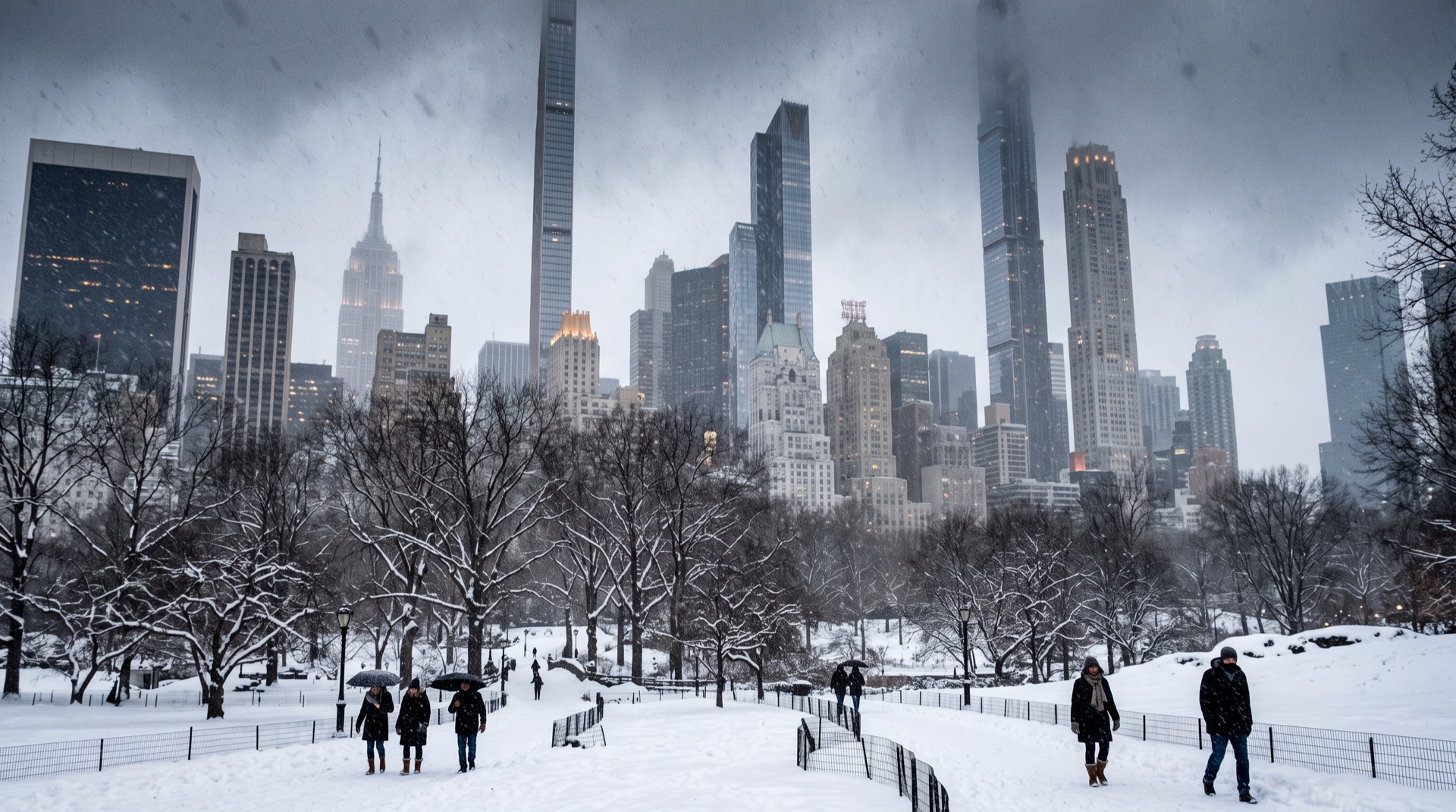
The ice along a roof in New York Cityline is the symptom. The cause is warm air escaping into the attic, and it is still running right now. As part of our complete New York City winter roof services, crews handle roof shoveling across New York County.
Wet Snow, Swinging Air: New York City Ice Dams
A nor'easter can load a roof in New York City with heavy, wet snow overnight. Coastal air then swings the temperature either side of freezing for days, which is the exact condition that builds ice fastest.

Add the architecture and the problem concentrates. Dormers, ells, knee walls and additions over porches all create pockets where warm air meets cold deck, and those are the eaves that dam first on a roof in New York City.
Ice-barrier practice in New York County
In most coastal New York towns the eave membrane requirement extends past the interior wall line rather than stopping at the first course. On a roof in New York City with a deep overhang, that is further up than it sounds.
Roof Shoveling in New York City: How The Work Runs
Flat and low-slope roofs shed nothing
A pitched roof loses some of its load on its own. A flat or low-slope roof does not: whatever falls stays, settles, and gets heavier as it absorbs the next melt. Ceiling Sagging or Bulging After Snow.
On New York City properties with a flat section — a garage, an addition, a porch roof, a whole commercial deck — hand clearing is not optional maintenance, it is the only way the load comes off.
Metal roofs and sudden releases
A standing-seam or corrugated roof holds snow until it does not. Warmth from below lubricates the pan, and the whole slab can release at once - several hundred pounds arriving on a driveway, a deck, a parked car or whoever is under it.
Crews work metal from the ground wherever the pitch allows, clear and mark the drop zone first, and never put a person below a loaded panel. Snow guards get noted where they are missing, because a release will keep happening every winter until something holds it.
Shoveling and steaming together
On a roof that already has a dam, shoveling and steaming usually happen in the same visit: the pack comes off first so the crew can see and reach the ice, then the dam gets steamed off the eave. Doing it in that order means less steam time, which usually means a smaller invoice.
How crews work without wrecking the roof
Plastic-bladed shovels only, never steel. Snow is cut and lifted in layers rather than scraped, and a cushion layer stays on the surface at all times so the blade never contacts shingle, membrane or seam. Discharge is aimed away from walkways, decks, shrubs and mechanical units.
Everyone on the roof is harnessed to a rated anchor. On an icy pitch that is not a formality — it is the whole reason this is not a homeowner job.
What happens to the ground below
Several tons of snow has to land somewhere. Shrubs, railings, air conditioning condensers, downspout extensions, low roofs over porches and anything made of lattice are all easy to flatten with material coming off a roof above.
The drop zones get chosen before the clear starts and anything fragile is either moved or worked around. On a tight New York City lot that sometimes means carrying material to the street rather than dropping it, which costs hours and gets quoted that way.

What you get in New York City
- Valleys and dormersThe pockets a rake physically cannot reach get cleared properly
- Controlled dischargeSnow lands away from walkways, decks, landscaping and HVAC
- Harnessed and anchoredRated anchor points on every pitched roof, every time
| Typical scope | Steam, 4-10 crew hours typical |
|---|---|
| Primary climate stressor | Nor'easters, rapid thaw-freeze swing |
| Coverage area | New York City and New York County |
| Pricing model | Billed by the crew hour, rate quoted before dispatch |
| Documentation | Dated before and after photos, written scope in Xactimate line items |
| Local ice-barrier practice | Eave membrane standard on re-roofs |
| Dispatch window | Same day to 24 hours |
New York County Coverage From New York City
Crews working New York City cover the adjoining communities on the same route — New York, Long Island City, Brooklyn, Sunnyside and Astoria — so a storm week usually means one truck handling several addresses in New York County rather than separate trips.
Nearest hub towns with their own roof shoveling pages: Mount Vernon, Yonkers, New Rochelle, Valley Stream, Long Beach, Hempstead.
When a storm hits New York County, crews are dispatched by severity rather than by call order — water already inside the house goes first.
Most jobs do not stop at one service. Roof Shoveling in New York City often runs alongside roof snow removal in New York City, and both get written into one scope rather than billed as separate visits.
Active leak right now? Our 24/7 New York City steam ice dam removal crews are dispatched first during a freeze event. Call (888) 561-9664.


