
Skip to content
Newark, NJ
Stops The Next Dam · Essex County

Roof Snow Removal in Newark, NJ — Nor'easter Storm Response

Roof Snow Removal in Newark, NJ from Ice Dam Now: low-pressure steam only, across Essex County. No chipping, no salt, no pressure washing. Crews carry licensing, insurance and fall-protection certification, bill by the crew hour at a rate quoted on the phone, prioritize active interior leaks the same day, and document the work for insurance.

Drop zones planned — Snow lands clear of decks, walkways, shrubs and window wells
Eave-first clearing — The lower roof band where dams form gets cleared first, not last
Surface never touched — A cushion layer is left so the rake never rides on bare shingle
Load reduction — Weight comes off valleys, dormer pockets and drift zones that collect the most

Get Ice Dam Help Newark

A few quick questions, then pick a time. If water is coming in, call instead.

What is the zip code of the home?

Roof leaking right now? Call (888) 561-9664 — that is faster than any form.
Water coming through the ceiling?Every hour an ice dam sits there, more water gets under the shingles.Call (888) 561-9664
24/7
Storm Season Dispatch
No Chipping
Steam Only
Essex
County Coverage
Crew Hour
Rate Quoted Up Front
Documented
Photos On Every Job

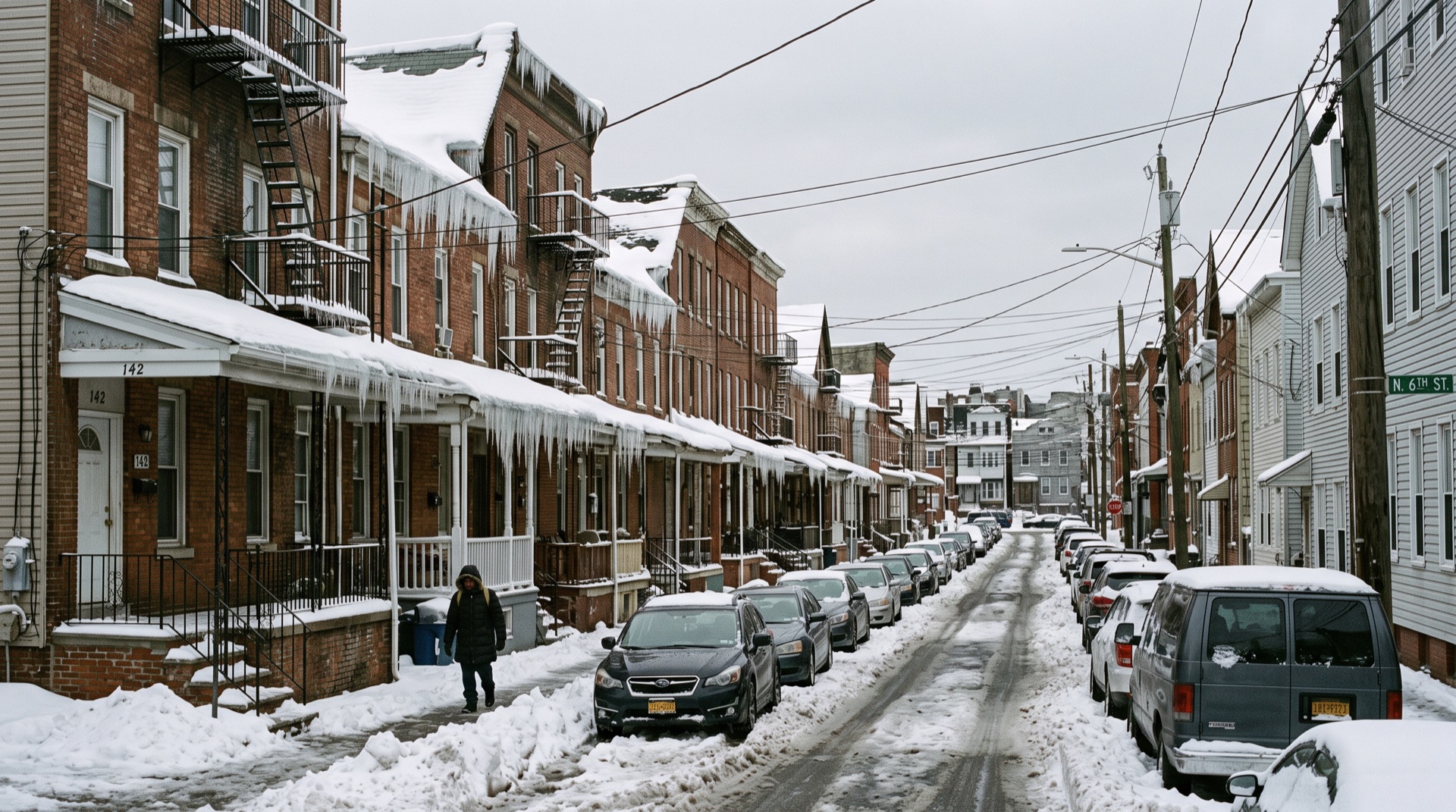
A Newark roof can look fine from the driveway and still be backing water under the shingles at the eave, where nobody can see it. As part of our complete Newark winter roof services, crews handle roof snow removal across Essex County.

Older Housing, Heavy Snow: The Essex County Case

The maritime air is the other half of it. Temperatures in Essex County move either side of freezing within the same day far more often than they do inland, and every crossing moves water down the roof and locks it at the eave.

Diagram showing how ice dams form on a roof from heat loss and snow melt
Heat escaping into the attic melts roof snow; the meltwater refreezes at the cold eave and the dam grows a layer every cycle.

Add the architecture and the problem concentrates. Dormers, ells, knee walls and additions over porches all create pockets where warm air meets cold deck, and those are the eaves that dam first on a roof in Newark.

Ice-barrier practice in Essex County

Most Essex County towns require self-adhering ice barrier at the eaves on a re-roof permit. In a historic district there may be additional review on materials, which is worth checking before work is scheduled.

Roof Snow Removal in Newark: How The Work Runs

How much of the roof actually needs clearing

Rarely all of it. The band that matters is the lower three to six feet above the gutter, because that is the strip sitting past the heated envelope where meltwater refreezes. Ceiling Sagging or Bulging After Snow.

On a roof in Newark with no load concern, clearing that band and the valleys is usually the whole job. Scraping the full plane costs more, takes longer, and buys very little extra.

Drift zones collect what the open roof sheds

Wind moves snow off exposed planes and dumps it in the lee — behind dormers, against parapets and chimneys, in valleys between bays, and on the low side of any roof that steps down.

A Newark roof can read as mostly clear from the curb and be carrying two feet of pack in those pockets. Crews measure where it collects, not where it is convenient.

Snow load is a structural question too

Snow is not weightless. Wet pack and drifted snow can carry serious weight per square foot, and it collects unevenly — behind dormers, against parapets, in valleys and on the lee side of a ridge. Older framing and low-slope roofs are where that shows up first as deflection.

If a roof in Newark is already groaning, sagging between rafters or showing new cracks in interior drywall, that is a load problem and not a cosmetic one. Say so on the call and the crew treats it as urgent.

Rain on top of snow

A warm rain onto a deep pack is the loading case that puts roofs on the news. The snow absorbs the rain instead of shedding it, the drains and gutters are still frozen, and the load can climb sharply within hours while the depth barely changes.

When that forecast appears over Essex the priority order changes: large flat spans and anything already carrying a deep pack get cleared ahead of the line, before the rain rather than after it.

Clearing the eaves is what matters

The first three to six feet above the gutter line is where dams build, because that strip of roof sits past the heated part of the house. Taking the snow off that band removes the meltwater supply before the next thaw-freeze cycle can turn it into ice.

Crews work from the ground with extended rakes wherever the pitch and height allow, and from the roof with harnesses and anchors when they do not. A cushion layer of snow is always left behind on the surface, because a rake run hard against bare shingle does its own damage.

Man using a roof rake to pull heavy snow off house eaves in winter
A homeowner uses a long-handled roof rake to clear heavy snow and ice from roof eaves after a winter storm.

What you get in Newark

  • Load reductionWeight comes off valleys, dormer pockets and drift zones that collect the most
  • Drop zones plannedSnow lands clear of decks, walkways, shrubs and window wells
  • Eave-first clearingThe lower roof band where dams form gets cleared first, not last
Roof Snow Removal in Newark, NJ — specification
Service specification for Newark, NJ
Pricing modelBilled by the crew hour, rate quoted before dispatch
Typical scopeSteam, 4-10 crew hours typical
Dispatch windowSame day to 24 hours
Coverage areaNewark and Essex County
Primary climate stressorNor'easters, rapid thaw-freeze swing
DocumentationDated before and after photos, written scope in Xactimate line items
ServiceRoof Snow Removal in Newark, NJ

Neighborhoods and Towns We Reach From Newark

Crews working Newark cover the adjoining communities on the same route — Harrison, Hillside, Orange, Belleville and South Orange — so a storm week usually means one truck handling several addresses in Essex County rather than separate trips.

Nearest hub towns with their own roof snow removal pages: Kearny, Irvington, East Orange, Elizabeth, Bayonne, Union.

When a storm hits Essex County, crews are dispatched by severity rather than by call order — water already inside the house goes first.

Most jobs do not stop at one service. Roof Snow Removal in Newark often runs alongside ice dam removal in Newark, and both get written into one scope rather than billed as separate visits.

Active leak right now? Our 24/7 Newark steam ice dam removal crews are dispatched first during a freeze event. Call (888) 561-9664.


Conditions We Work In

Roof Snow Removal In Practice

Conditions crews work in across Essex County. Every job is photographed before and after.

Worker in safety harness shoveling snow off a residential roof in winter
A roofing professional clears heavy snow from a residential roof while wearing a safety harness.
Worker on ladder using steam wand to remove ice dams and icicles from residential roof
A technician uses a high-pressure steam wand to melt ice dams and icicles from a home's roofline.
Worker in safety harness shoveling heavy snow off a residential roof
A roofing professional uses a safety harness and blue shovel to clear heavy snow accumulation from a residential roof.
FAQ

Local Questions About Newark Roofs

It is billed by the crew hour, and the rate plus a realistic time estimate are quoted on the phone before anyone is dispatched.

  • Scope drives the hours: length and thickness of the ice, roof pitch and height, and whether the gutters are frozen solid.
  • Access matters too — a three-story Newark roof takes longer to set up on than a ranch.
  • The invoice matches the quote. There are no surprise add-ons written on the tailgate.

No, but there is a worse one: after the thaw, when the evidence has melted and the damage is all that is left.

  • Mid-storm calls are fine — crews work through freeze events.
  • An evening call for a leak that started that afternoon usually gets a next-morning slot.
  • Waiting for a weekend to pass is the most common and most expensive delay.

Yes. Steam is safe on slate, cedar shake, tile and metal as well as asphalt, because it removes ice with heat rather than force.

  • Older Newark housing stock with original slate is exactly where chipping does the most damage.
  • Crews adjust the lance distance and dwell rather than the pressure.
  • Nothing mechanical touches the covering at any point.

Clear a path to the affected side, move vehicles off the driveway and unlock any side gate.

  • Put something under an active interior drip and move what you can out of the way.
  • Photograph the interior damage yourself as well - more evidence is never a problem.
  • Do not go on the roof or up a ladder. That is the part that sends people to hospital.

Before the thaw rather than after it. The leak happens when the ice has water behind it, which is a day or two after the snow stops.

  • Calling during the storm is fine and often gets an earlier slot.
  • The expensive version is waiting until water appears on a ceiling.
  • Crews run across Essex County from first light through a freeze event.

It lands in drop zones chosen before the work starts, clear of shrubs, condensers, railings and anything made of lattice. Walkways and the driveway get cleared again afterwards. Where there is nowhere safe to drop, material gets carried out and that adds hours, which is said in the quote rather than discovered later.

No. Crews work the snow, not the roof surface, and leave a protective layer behind. Frozen gutters are cleared with steam rather than forced, because a gutter full of ice bends and tears when it is pried at.

Nearby

Roof Snow Removal In Towns Around Newark

Same-Day Response

Get A Newark Crew Out

Every freeze-thaw cycle adds another layer to the dam and pushes a little more water under the shingles. That clock is already running.

✓ Licensed & insured✓ Low-pressure steam only✓ Rate quoted up front✓ Photos for your claim
Online Quote(888) 561-9664
