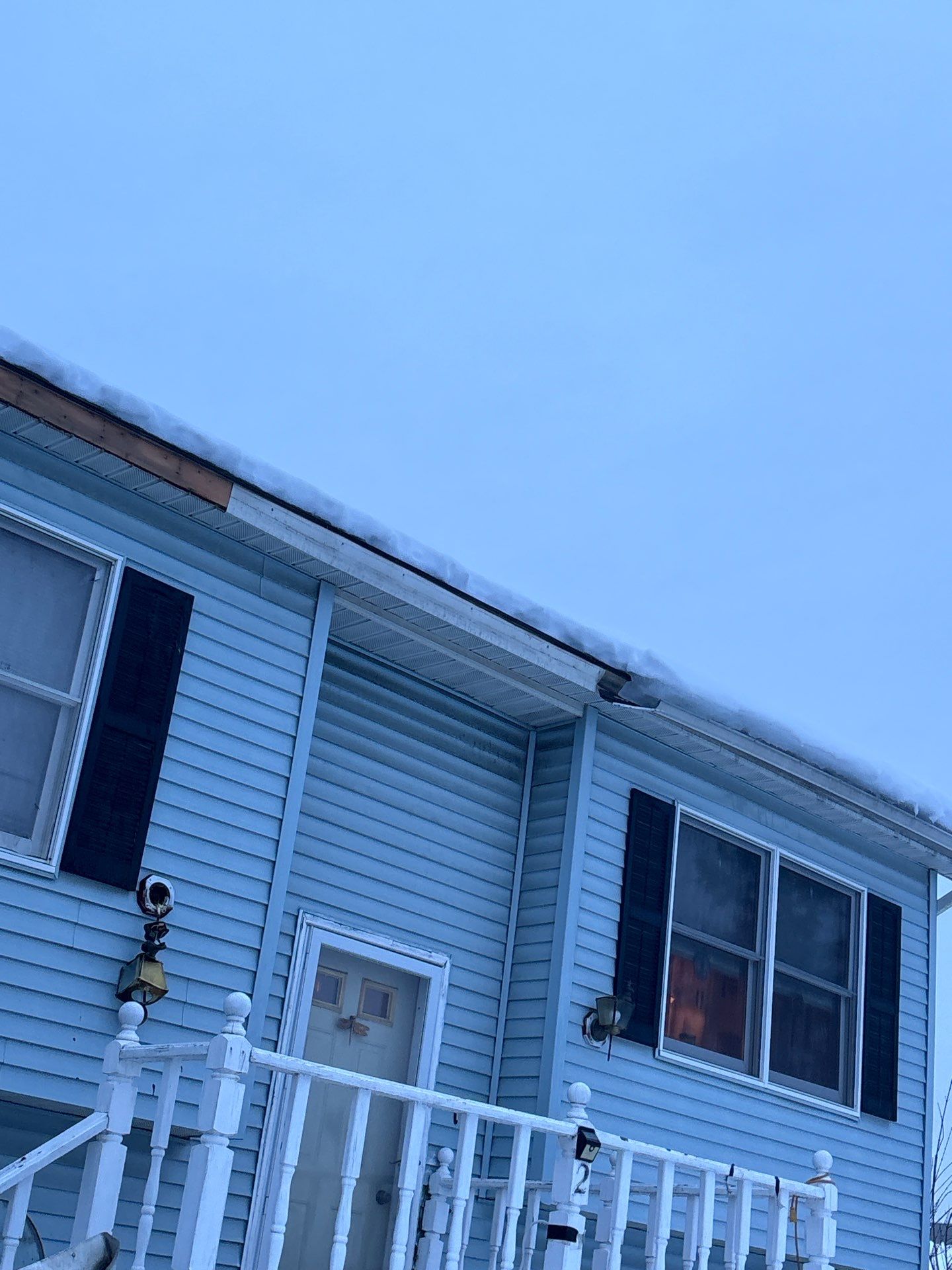
By the time a roof in Moorhead has a visible ridge of ice at the eave, meltwater has already been pooling behind it for several freeze-thaw cycles. As part of our complete Moorhead winter roof services, crews handle water mitigation & dryout across Clay County.
Why Moorhead Roofs Dam Up: Lake-Effect Load and Freeze-Thaw
What makes Clay County roofs dam is not the seasonal total, it is how the snow arrives. Bands dump a heavy, saturated pack in hours, and that pack becomes a water reservoir sitting on a heated surface.

Then the temperature swings. Lake-effect regions cycle hard either side of freezing, and each cycle moves meltwater down to a cold eave and locks it there. The dam grows by a layer every time, and the water behind it rises with it.
Ice-barrier practice in Clay County
What matters on a Moorhead roof is not whether ice barrier exists but how far up it runs. Water backed up behind a foot of ice travels much further than the first course, and a membrane that stops short is a membrane that stops working.
Water Mitigation & Dryout in Moorhead: How The Work Runs
What happens to flooring
Hardwood cups as it absorbs and may flatten out on its own once the subfloor is dry, so it is given the chance before anyone talks about replacement. Laminate and engineered board usually do not recover. Wet Insulation in the Attic.
Carpet and pad are a judgment call on how long they were wet and what the water passed through on the way down.
The sequence
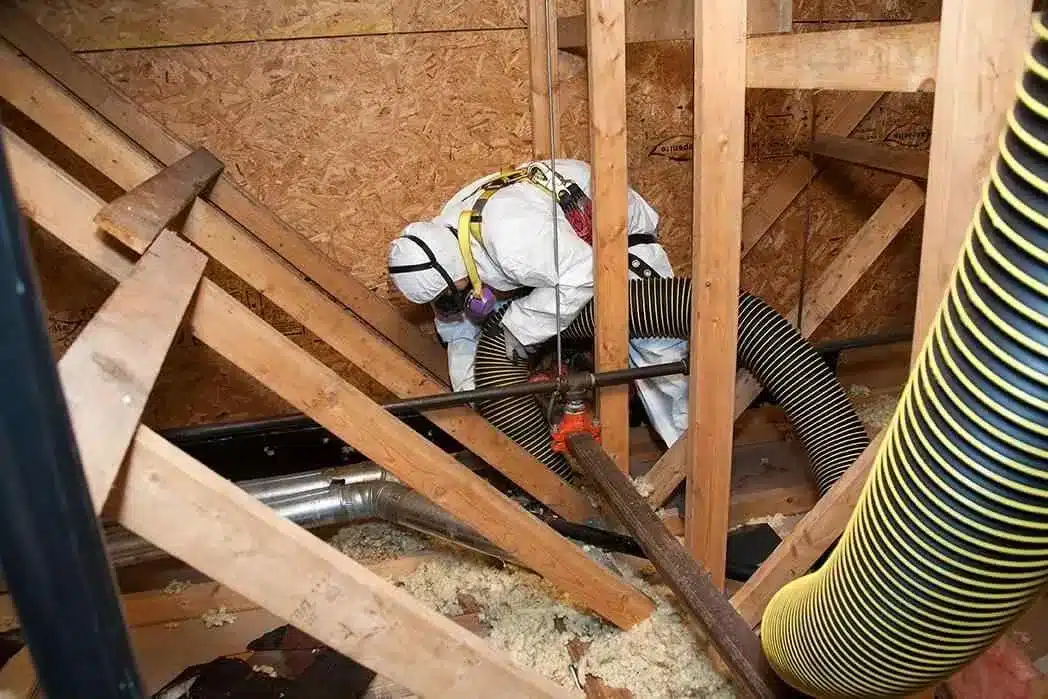
Standing water is extracted first. Saturated insulation comes out, because it cannot be dried in place and it is holding moisture against everything it touches. Containment goes up where tear-out is needed, with HEPA scrubbers running inside it. Dehumidifiers and air movers are placed to the room's volume and load rather than scattered around.
Then the readings get taken daily until they hit standard. In a Moorhead winter, with cold cavities and low ambient humidity outside, that typically takes longer than people expect.
Where the water actually went
Thermal imaging and meters find it, because the visible stain is usually the smallest part. Water tracks along top plates, down stud bays and across ceiling planes, and it collects in places with no stain at all — behind knee walls, above soffits, inside cathedral ceiling cavities with no access.
Where opening up finds mold, the work moves under containment and becomes mold remediation. Either way the same company puts the room back together afterward.
Clean water does not stay clean
Meltwater off a roof starts as category one - essentially clean. It does not stay that way. Passing through old insulation, wall cavities, dust and whatever has accumulated in a ceiling plane for forty years degrades it, and standing more than a day or two degrades it again.
That classification drives what can be dried in place and what has to be removed, and it is the reason a leak dealt with on day one is a smaller job than the identical leak dealt with on day five.
Ceilings: when it comes down and when it stays
A stained ceiling is not automatically a demolished ceiling. Painted drywall that has been wetted once and can be dried from above through the insulation cavity will often flatten out and need nothing but paint.
What does come down is drywall that has lost its bond and gone soft, anything sagging under held water, textured or plaster ceilings that have delaminated, and any ceiling where the cavity above cannot be reached another way. The call is made with a meter, and shown to you before anything is opened.

What you get in Moorhead
- Hidden water mappedThermal imaging and pin meters find what left no stain
- Wet insulation removedIt cannot be dried in place and it holds water against the framing
- Electrical made safeCircuits killed where water reached fixtures, before equipment goes in
| Dispatch window | Same day to 24 hours |
|---|---|
| Coverage area | Moorhead and Clay County |
| Local ice-barrier practice | Eave membrane expected on re-roofs |
| Interior repair | Insulation, drywall, texture, trim and paint, done in-house after drying |
| Primary climate stressor | Lake-effect bands, wet heavy pack |
| Documentation | Dated before and after photos, written scope in Xactimate line items |
| Method | Containment, HEPA filtration and drying to a measured IICRC standard |
Where We Dispatch Around Moorhead
Crews working Moorhead cover the adjoining communities on the same route — Dilworth, Glyndon, Sabin and Comstock — so a storm week usually means one truck handling several addresses in Clay County rather than separate trips.
Nearest hub towns with their own water mitigation pages: Brainerd, St. Cloud, Elk River, Ramsey, Andover, Maple Grove.
Coverage runs across Moorhead and the nearby towns all winter, and capacity is surged into whichever Minnesota market the storm actually hits.
Most jobs do not stop at one service. Water Mitigation in Moorhead often runs alongside ice dam removal in Moorhead, and both get written into one scope rather than billed as separate visits.
Active leak right now? Our 24/7 Moorhead steam ice dam removal crews are dispatched first during a freeze event. Call (888) 561-9664.