
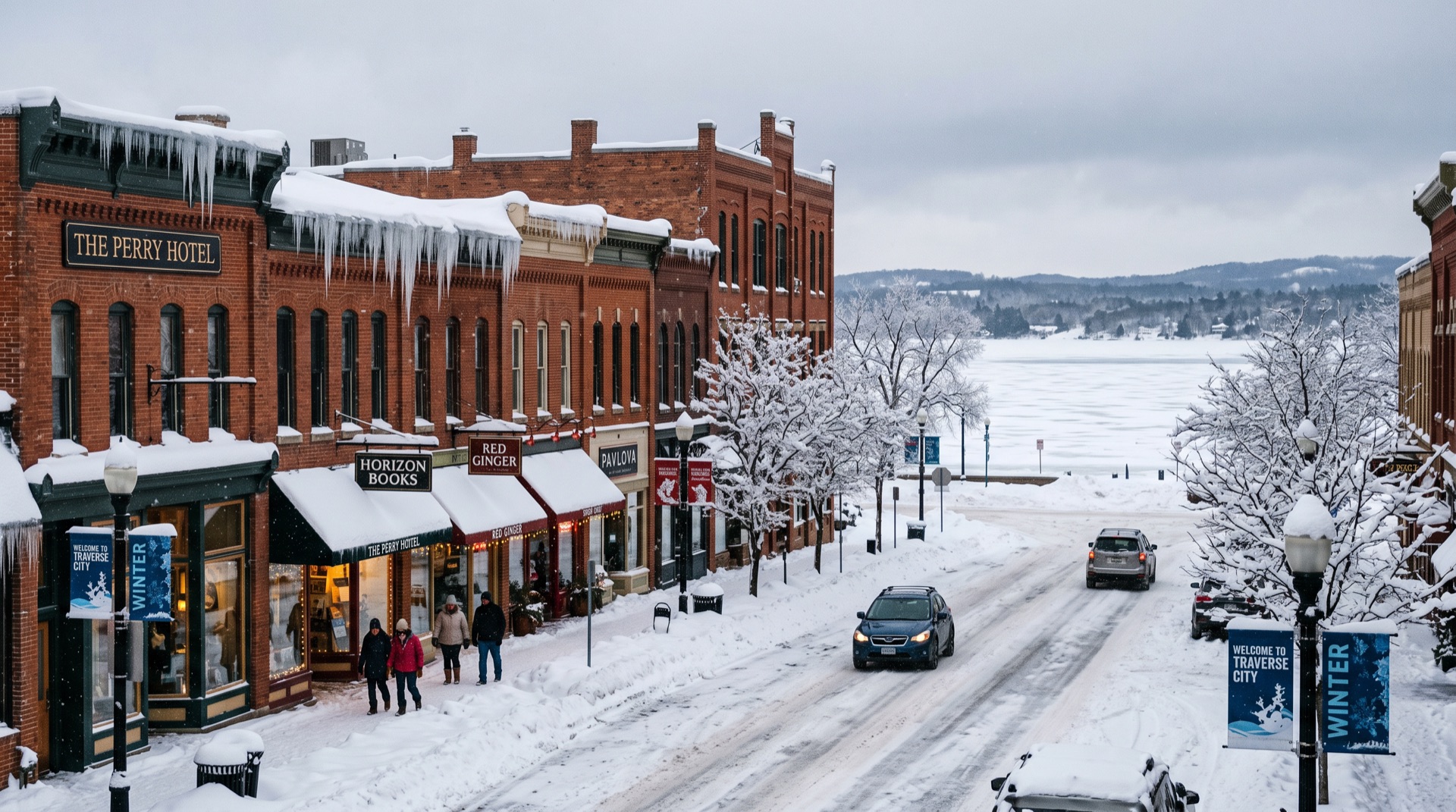
Homeowners across Grand Traverse County call about icicles. Icicles are cosmetic. The dam behind them, holding back standing water, is not. As part of our complete Traverse City winter roof services, crews handle roof snow removal across Grand Traverse County.
Why Traverse City Roofs Dam Up: Lake-Effect Load and Freeze-Thaw
Traverse City sits in the lake-effect belt, where a single band can drop a foot on one side of Grand Traverse County and leave the other side clear. That snow lands wet and heavy, packs down on the upper roof, and sits there as a reservoir.

Melting happens from underneath, not from the sun. Attic heat releases water under the pack, it runs to the overhang where there is no heated space below, and it freezes. That is the engine, and in Traverse City it runs most of the winter.
Ice-barrier practice in Grand Traverse County
What matters on a Traverse City roof is not whether ice barrier exists but how far up it runs. Water backed up behind a foot of ice travels much further than the first course, and a membrane that stops short is a membrane that stops working.
Roof Snow Removal in Traverse City: How The Work Runs
Clearing the eaves is what matters
The first three to six feet above the gutter line is where dams build, because that strip of roof sits past the heated part of the house. Taking the snow off that band removes the meltwater supply before the next thaw-freeze cycle can turn it into ice. Ceiling Sagging or Bulging After Snow.
Crews work from the ground with extended rakes wherever the pitch and height allow, and from the roof with harnesses and anchors when they do not. A cushion layer of snow is always left behind on the surface, because a rake run hard against bare shingle does its own damage.
How much of the roof actually needs clearing
Rarely all of it. The band that matters is the lower three to six feet above the gutter, because that is the strip sitting past the heated envelope where meltwater refreezes.
On a roof in Traverse City with no load concern, clearing that band and the valleys is usually the whole job. Scraping the full plane costs more, takes longer, and buys very little extra.
Clearing before the thaw rather than after
A warm spell is not relief. Meltwater from a deep pack has to go somewhere, and on a roof whose eaves and gutters are still frozen it goes under the shingles. The week a Traverse City forecast turns mild is the week the interior leak calls start.
Taking the snow off ahead of the thaw removes the water before it has a chance to find a way in, which is a far cheaper exercise than mitigating the ceiling it would otherwise come through.
Standing clears for repeat properties
Properties that dam at the same eave every year are better on a schedule than on a phone call. A standing clear-after-every-storm arrangement means the snow comes off before the thaw instead of after it.
It also means an address in Traverse City is on the route rather than in line during the week when everybody calls at once.
When clearing becomes urgent rather than preventive
Deflection visible between rafters, doors inside that suddenly bind, fresh cracks in ceiling drywall and sprinkler lines that have shifted are all load signals, and all late ones.
Say so on the call if any of that is happening at a property in Traverse City. It changes the job from a scheduled clear to a same-day one.

What you get in Traverse City
- Drift points measuredDepth read where snow collects, not in the middle of the field
- Load reductionWeight comes off valleys, dormer pockets and drift zones that collect the most
- Standing schedulesRepeat properties can be cleared automatically after every storm
| Primary climate stressor | Lake-effect bands, wet heavy pack |
|---|---|
| Documentation | Dated before and after photos, written scope in Xactimate line items |
| Removal method | Low-pressure steam only. No chipping, salt or pressure washing. |
| Local ice-barrier practice | Eave membrane expected on re-roofs |
| Typical scope | Steam, 6-12 crew hours typical |
| Dispatch window | Same day to 24 hours |
| Pricing model | Billed by the crew hour, rate quoted before dispatch |
Grand Traverse County Coverage From Traverse City
Crews working Traverse City cover the adjoining communities on the same route — Acme, Grawn, Cedar, Mayfield and Williamsburg — so a storm week usually means one truck handling several addresses in Grand Traverse County rather than separate trips.
Nearest hub towns with their own roof snow removal pages: Petoskey, Mount Pleasant, Escanaba, Midland, Alpena, Muskegon.
Coverage runs across Traverse City and the nearby towns all winter, and capacity is surged into whichever Michigan market the storm actually hits.
Most jobs do not stop at one service. Roof Snow Removal in Traverse City often runs alongside ice dam removal in Traverse City, and both get written into one scope rather than billed as separate visits.
Active leak right now? Our 24/7 Traverse City steam ice dam removal crews are dispatched first during a freeze event. Call (888) 561-9664.


