
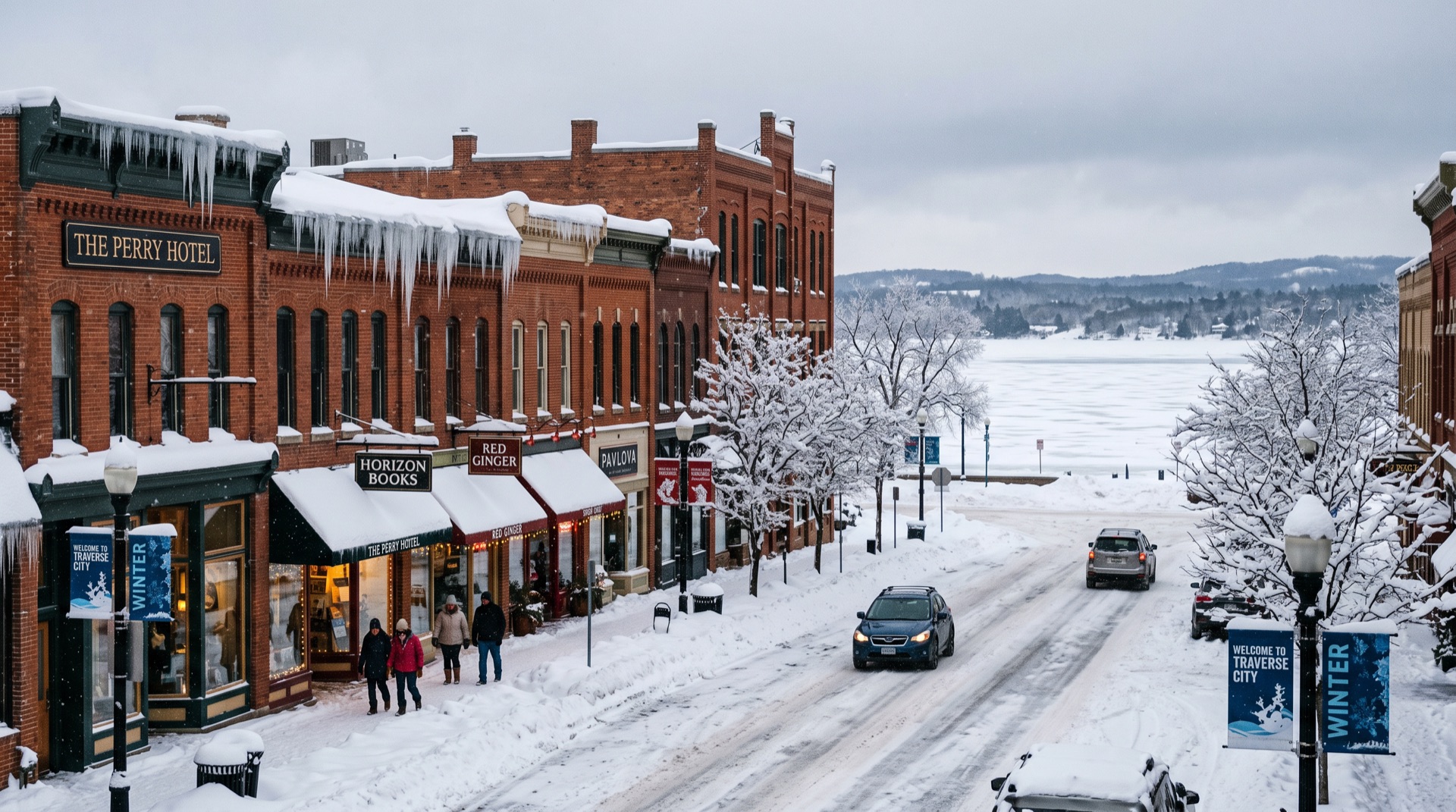
Every Traverse City winter produces the same two calls: the ones who see the ice early, and the ones who see the ceiling stain first. As part of our complete Traverse City winter roof services, crews handle roof shoveling across Grand Traverse County.
Why Traverse City Roofs Dam Up: Lake-Effect Load and Freeze-Thaw
Traverse City sits in the lake-effect belt, where a single band can drop a foot on one side of Grand Traverse County and leave the other side clear. That snow lands wet and heavy, packs down on the upper roof, and sits there as a reservoir.

Melting happens from underneath, not from the sun. Attic heat releases water under the pack, it runs to the overhang where there is no heated space below, and it freezes. That is the engine, and in Traverse City it runs most of the winter.
Ice-barrier practice in Grand Traverse County
What matters on a Traverse City roof is not whether ice barrier exists but how far up it runs. Water backed up behind a foot of ice travels much further than the first course, and a membrane that stops short is a membrane that stops working.
Roof Shoveling in Traverse City: How The Work Runs
Metal roofs and sudden releases
A standing-seam or corrugated roof holds snow until it does not. Warmth from below lubricates the pan, and the whole slab can release at once - several hundred pounds arriving on a driveway, a deck, a parked car or whoever is under it. Ceiling Sagging or Bulging After Snow.
Crews work metal from the ground wherever the pitch allows, clear and mark the drop zone first, and never put a person below a loaded panel. Snow guards get noted where they are missing, because a release will keep happening every winter until something holds it.
Cutting in layers rather than scraping
Crews cut the pack into blocks and lift them, leaving a cushion layer behind. The blade never touches the roof surface. That is the whole technique and it is why a shovelled roof looks untouched afterwards.
Scraping to bare membrane or bare shingle is what damages a roof, and it is what a well-meaning homeowner with a steel shovel does on the first pass.
Shoveling and steaming together
On a roof that already has a dam, shoveling and steaming usually happen in the same visit: the pack comes off first so the crew can see and reach the ice, then the dam gets steamed off the eave. Doing it in that order means less steam time, which usually means a smaller invoice.
Clearing to let the drains work
On anything flat, the job is not finished when the snow is off. Drains, scuppers and overflow outlets have to be opened so the melt that follows has somewhere to go.
A cleared Traverse City deck with blocked drains just ponds and refreezes, and ponded water on a membrane finds seams.
Partial scopes are normal
Plenty of calls are one dead valley, the pocket behind a chimney, or the flat section over an addition. That is a legitimate job and it gets priced as one.
There is no minimum and no pressure to clear a whole Traverse City roof that does not need clearing.

What you get in Traverse City
- Drains openedScuppers and outlets cleared so the melt has somewhere to go
- Harnessed and anchoredRated anchor points on every pitched roof, every time
- Valleys and dormersThe pockets a rake physically cannot reach get cleared properly
| Pricing model | Billed by the crew hour, rate quoted before dispatch |
|---|---|
| Local ice-barrier practice | Eave membrane expected on re-roofs |
| Typical scope | Steam, 6-12 crew hours typical |
| Documentation | Dated before and after photos, written scope in Xactimate line items |
| Coverage area | Traverse City and Grand Traverse County |
| Removal method | Low-pressure steam only. No chipping, salt or pressure washing. |
| Primary climate stressor | Lake-effect bands, wet heavy pack |
Grand Traverse County Coverage From Traverse City
Crews working Traverse City cover the adjoining communities on the same route — Acme, Grawn, Cedar, Mayfield and Williamsburg — so a storm week usually means one truck handling several addresses in Grand Traverse County rather than separate trips.
Nearest hub towns with their own roof shoveling pages: Petoskey, Mount Pleasant, Escanaba, Midland, Alpena, Muskegon.
When a storm hits Grand Traverse County, crews are dispatched by severity rather than by call order — water already inside the house goes first.
Most jobs do not stop at one service. Roof Shoveling in Traverse City often runs alongside roof snow removal in Traverse City, and both get written into one scope rather than billed as separate visits.
Active leak right now? Our 24/7 Traverse City steam ice dam removal crews are dispatched first during a freeze event. Call (888) 561-9664.

