Skip to content
Reading, MA
Structural Snow Load · Middlesex County

Commercial Roof Snow Removal in Reading, MA — Coastal Storm Response

Ice Dam Now handles commercial roof snow removal for Reading, MA properties and the wider Middlesex County. Removal is by low-pressure steam, never mechanical. Dispatch is same day where water is already inside, pricing is by the crew hour quoted before a crew leaves, and every job is photographed before and after for claim purposes. Crews are licensed, insured and harness-certified.

One invoice per site — Multi-building properties scoped and billed together
Drift-point survey — Depth and density measured where it collects, not where it is convenient
Mid-span measured — Depth read over the longest unsupported span, not the average
Overflows opened first — Drains and scuppers cleared before the load comes off

Get Ice Dam Help Reading

A few quick questions, then pick a time. If water is coming in, call instead.

What is the zip code of the home?

Roof leaking right now? Call (888) 561-9664 — that is faster than any form.
Water coming through the ceiling?Every hour an ice dam sits there, more water gets under the shingles.Call (888) 561-9664
24/7
Storm Season Dispatch
No Chipping
Steam Only
Middlesex
County Coverage
Crew Hour
Rate Quoted Up Front
Documented
Photos On Every Job

Every Reading winter produces the same two calls: the ones who see the ice early, and the ones who see the ceiling stain first. As part of our complete Reading winter roof services, crews handle commercial roof snow removal across Middlesex County.

Reading Ice Dams: Wet Snow and a Thermometer That Will Not Settle

Coastal storms deliver the heaviest snow by weight. A single nor'easter can put a wet, dense pack on a roof in Reading in one night, and the maritime air that follows rarely stays on one side of freezing for long.

Diagram showing how ice dams form on roofs due to inadequate insulation and poor ventilation
Heat escaping into the attic melts roof snow; the meltwater refreezes at the cold eave and the dam grows a layer every cycle.

Add the architecture and the problem concentrates. Dormers, ells, knee walls and additions over porches all create pockets where warm air meets cold deck, and those are the eaves that dam first on a roof in Reading.

Ice-barrier practice in Middlesex County

Historic district review in parts of Middlesex County adds a step on materials and sometimes on color, which is worth knowing before a re-roof is scheduled rather than after the permit is refused.

Commercial Roof Snow Removal in Reading: How The Work Runs

Reduction to a threshold, not a bare deck

The goal is bringing the load under the structure's capacity safely, with a cushion layer left on the membrane throughout. Ceiling Sagging or Bulging After Snow.

Scraping a commercial Reading roof to bare membrane costs more, takes longer and risks the roof covering for no structural benefit.

Storm routes and standing contracts

Properties on a standing contract get a scheduled clear after each qualifying snowfall, with a single point of contact and a condition report per visit. For a portfolio, that means the clearing order is decided in advance by risk rather than by whoever calls first during the storm.

Reading the design load off the drawings

Where structural drawings exist they state the design ground snow load and the roof's own capacity, and that number turns the whole question from opinion into arithmetic. Measured depth and density against design capacity gives a percentage rather than an argument.

Where the drawings have been lost - common on older Reading stock - the conservative assumption is the code minimum of the era the building went up, which is usually well below what a modern roof would be built to.

Unbalanced loading is the real hazard

Snow does not settle evenly on a large deck. It piles against parapets, behind rooftop units, in the lee of a higher adjoining roof and in the valleys between bays.

Clearing has to be balanced for the same reason. Taking it all off one bay and none off the next shifts the load rather than removing it.

Ponding after the clear

Taking the snow off a flat roof with frozen drains leaves meltwater with nowhere to go, and water that ponds and refreezes puts load back on a deck that was just relieved.

So drains and overflows are opened as part of the clear rather than afterwards, and the roof is left draining. A clear that stops at the snow is half a job.
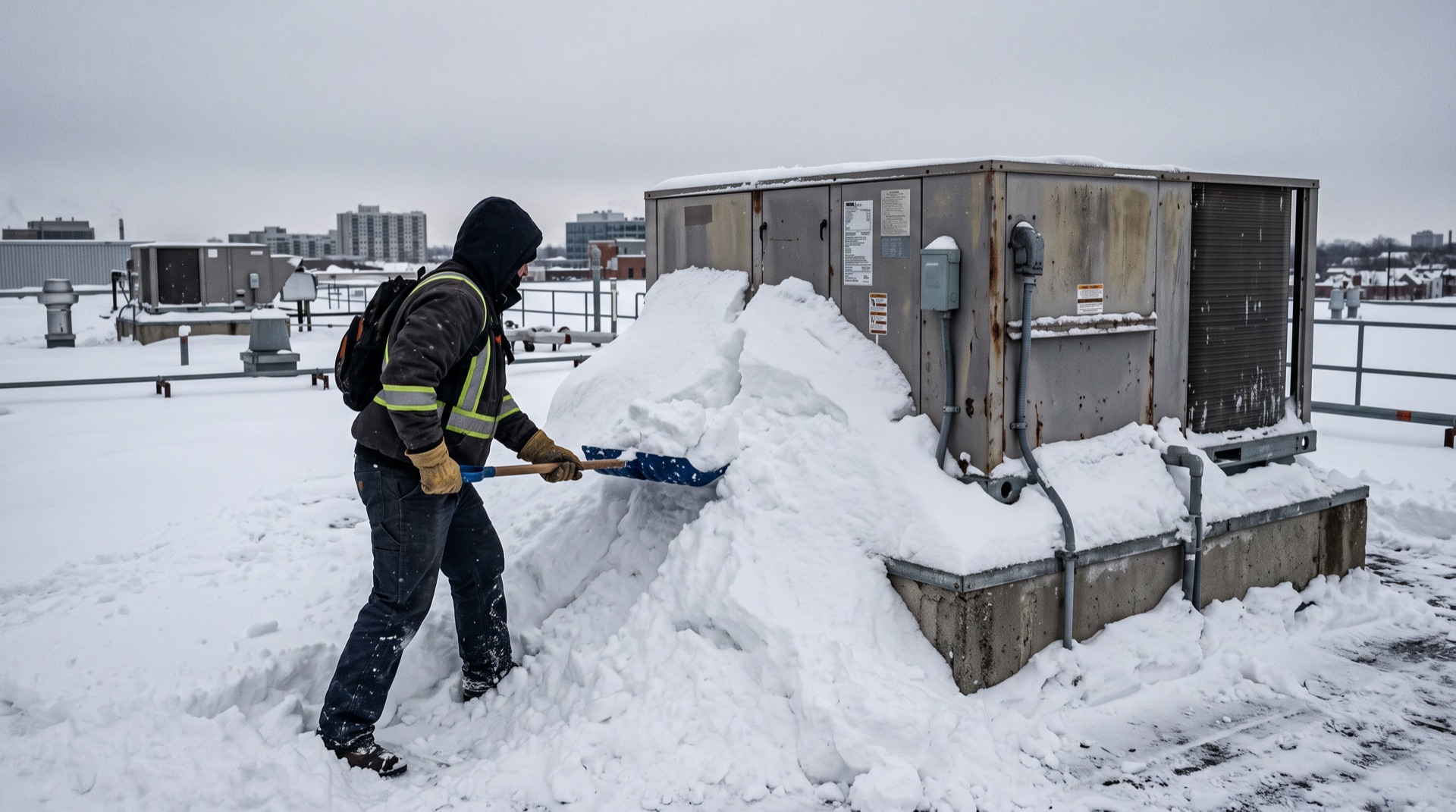
Worker in safety vest shoveling large snow drift from rooftop HVAC unit
A maintenance worker clears a heavy snow drift blocking a commercial rooftop HVAC unit after a winter storm.

What you get in Reading

  • Drains kept openScuppers and internal drains cleared so meltwater has an exit
  • Drift-point surveyDepth and density measured where it collects, not where it is convenient
  • Overflows opened firstDrains and scuppers cleared before the load comes off
Commercial Roof Snow Removal in Reading, MA — specification
Service specification for Reading, MA
Dispatch windowSame day to 24 hours
Typical scopeSteam, 4-10 crew hours typical
Coverage areaReading and Middlesex County
Primary climate stressorNor'easters, rapid thaw-freeze swing
Pricing modelBilled by the crew hour, rate quoted before dispatch
Removal methodLow-pressure steam only. No chipping, salt or pressure washing.
DocumentationDated before and after photos, written scope in Xactimate line items

Reading Coverage and the Adjoining Communities

Crews working Reading cover the adjoining communities on the same route — Wakefield, Stoneham, North Reading, Wilmington and Lynnfield — so a storm week usually means one truck handling several addresses in Middlesex County rather than separate trips.

Nearest hub towns with their own commercial snow pages: Woburn, Burlington, Melrose, Saugus, Malden, Billerica.

During a cold snap Reading gets worked alongside the neighboring Middlesex County towns on the same route, with active interior leaks moved to the front of the list.

Most jobs do not stop at one service. Commercial Snow in Reading often runs alongside crane-assisted snow removal in Reading, and both get written into one scope rather than billed as separate visits.

Active leak right now? Our 24/7 Reading steam ice dam removal crews are dispatched first during a freeze event. Call (888) 561-9664.
Conditions We Work In

Commercial Roof Snow Removal In Practice

Conditions crews work in across Middlesex County. Every job is photographed before and after.

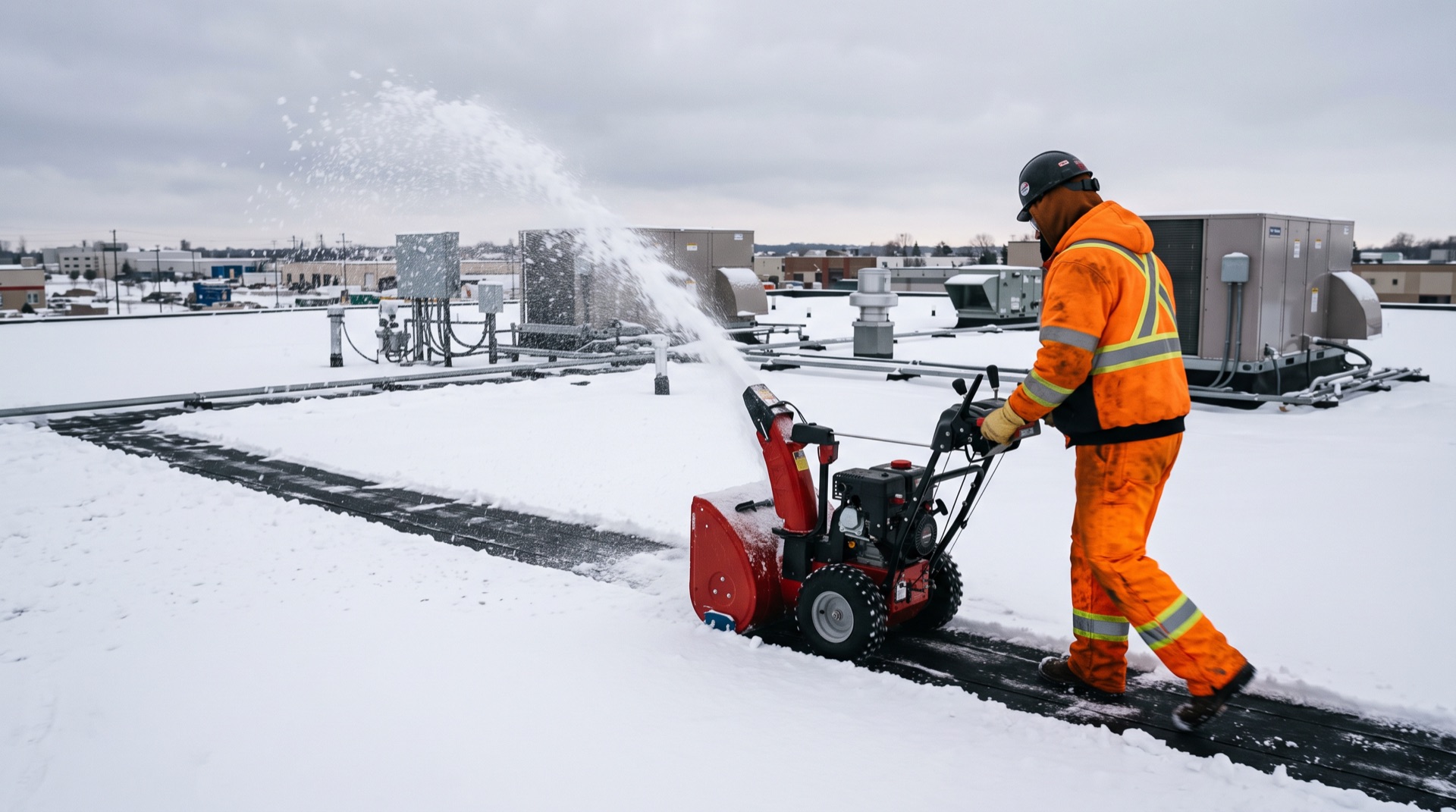
Worker in orange safety gear using snow blower on commercial flat roof
A maintenance worker clears heavy snow from a commercial flat roof using a gas-powered snow blower.
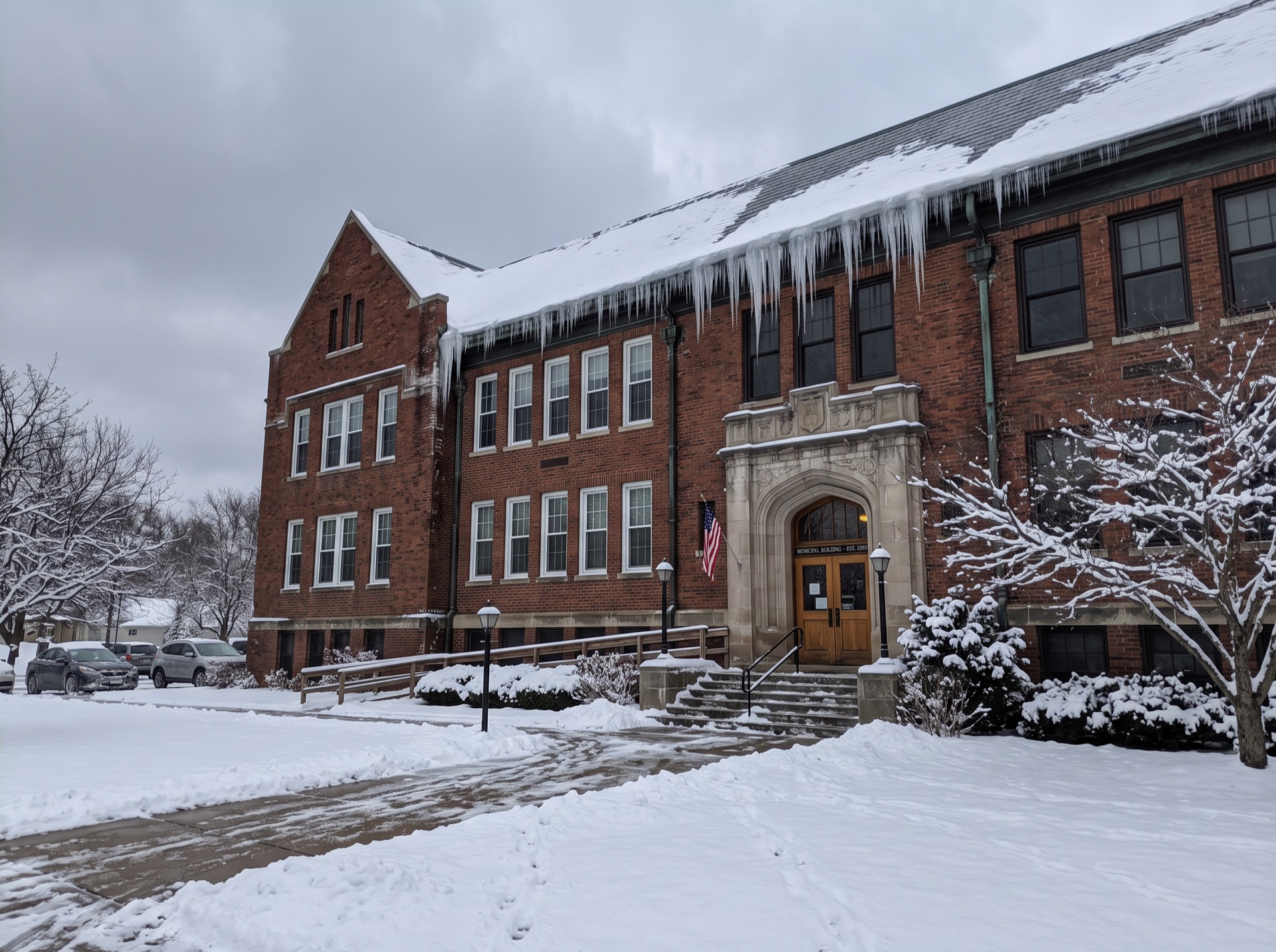
Large icicles hanging from brick municipal building roofline covered in snow
Massive icicles form along the roofline of a historic brick municipal building after a heavy winter snowfall.
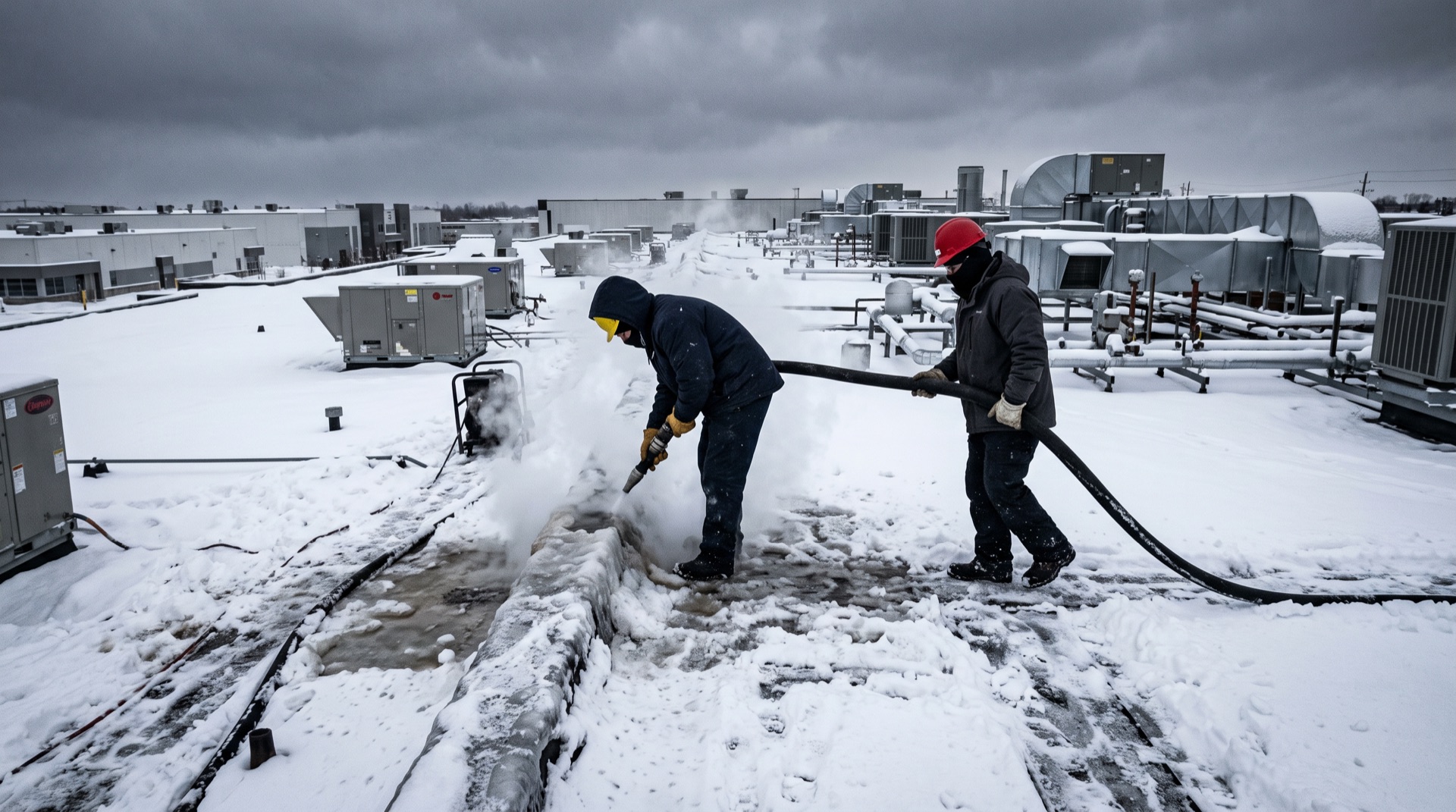
Two workers using steam equipment to clear ice from a snow-covered commercial flat roof
A two-man crew uses steam lancing equipment to remove heavy ice buildup from a large commercial flat roof.
FAQ

Local Questions About Reading Roofs

It is billed by the crew hour, and the rate plus a realistic time estimate are quoted on the phone before anyone is dispatched.

  • Scope drives the hours: length and thickness of the ice, roof pitch and height, and whether the gutters are frozen solid.
  • Access matters too — a three-story Reading roof takes longer to set up on than a ranch.
  • The invoice matches the quote. There are no surprise add-ons written on the tailgate.

More than it looks from the ground - a foot-deep dam across a thirty-foot eave is a few thousand pounds.

  • Depth is measured at the eave rather than estimated from the driveway.
  • The gutter trough underneath is usually frozen solid too and is part of the same mass.
  • That weight is one of the reasons chipping at it from a ladder goes badly.

Yes. Steam is safe on slate, cedar shake, tile and metal as well as asphalt, because it removes ice with heat rather than force.

  • Older Reading housing stock with original slate is exactly where chipping does the most damage.
  • Crews adjust the lance distance and dwell rather than the pressure.
  • Nothing mechanical touches the covering at any point.

The crew hours on site, the equipment and the photo documentation - with the rate and an estimate given on the phone beforehand.

  • Travel to a Reading address inside the normal service area is not an added line.
  • If the roof turns out worse than described, you are told before the extra hours are worked.
  • The invoice matches what was quoted. Nothing gets added on the tailgate.

Because ice dams are made by heat loss, and two houses on the same street rarely leak heat the same way.

  • Attic air leaks around can lights, bath fans and the attic hatch are the usual source.
  • Crushed or missing soffit baffles stop the intake ventilation that would otherwise keep the deck cold.
  • An addition or dormer built over unheated space puts warm air right against a cold eave.
  • Local factor: nor'easters and rapid thaw-freeze swings makes the difference show up faster here than it would further south.

Visible deflection between joists, new cracks in interior finishes, doors or roof hatches that suddenly bind, and sprinkler lines or ceiling grid that have moved are all late signals. The reliable method is measuring depth and density at the drift points and comparing the load to the design capacity.

Yes. Each visit produces depth and load figures, photographs and a written condition report. Preventing an imminent structural failure is treated as loss mitigation by most carriers, and that record is what supports it.

Nearby

Commercial Snow In Towns Around Reading

Same-Day Response

Get A Reading Crew Out

A dam left alone through February is not the same dam in March. It is bigger, and so is the repair behind it.

✓ Licensed & insured✓ Low-pressure steam only✓ Rate quoted up front✓ Photos for your claim
Online Quote(888) 561-9664