Skip to content
Greenwich, CT
IICRC S500 Standard · Fairfield County

Ice Dam Water Mitigation in Greenwich, CT — Nor'easter Storm Response

Ice Dam Now is a licensed and insured restoration contractor covering Greenwich, CT and Fairfield County. Water Mitigation & Dryout follows IICRC standards, is documented with dated photographs and daily readings, and is followed by in-house interior repair, with the whole ice dam event written up as one claim.

Electrical made safe — Circuits killed where water reached fixtures, before equipment goes in
Containment and HEPA — Barriers and air scrubbers wherever tear-out is required
Wet insulation removed — It cannot be dried in place and it holds water against the framing
Documented to standard — Daily moisture readings until the structure meets IICRC S500 dry standard

Get Ice Dam Help Greenwich

A few quick questions, then pick a time. If water is coming in, call instead.

What is the zip code of the home?

Roof leaking right now? Call (888) 561-9664 — that is faster than any form.
Water coming through the ceiling?Every hour an ice dam sits there, more water gets under the shingles.Call (888) 561-9664
24/7
Dispatch All Winter
Steam
Only — No Pressure
Fairfield
County Coverage
Same Day
For Active Leaks
Insured
Licensed & Harness-Certified

By the time a roof in Greenwich has a visible ridge of ice at the eave, meltwater has already been pooling behind it for several freeze-thaw cycles. As part of our complete Greenwich winter roof services, crews handle water mitigation & dryout across Fairfield County.

Why Greenwich Roofs Dam Up: Nor'easter Load and the Maritime Swing

The maritime air is the other half of it. Temperatures in Fairfield County move either side of freezing within the same day far more often than they do inland, and every crossing moves water down the roof and locks it at the eave.

Diagram showing how ice dams form on a roof from heat loss and snow melt
Heat escaping into the attic melts roof snow; the meltwater refreezes at the cold eave and the dam grows a layer every cycle.

Then there is the architecture. Greenwich has a great deal of older housing with shallow eave returns, knee-wall attics and rooms built out over porches, all of which put heated air against cold deck with very little between.

Ice-barrier practice in Fairfield County

Most Fairfield County towns require self-adhering ice barrier at the eaves on a re-roof permit. In a historic district there may be additional review on materials, which is worth checking before work is scheduled.

Water Mitigation & Dryout in Greenwich: How The Work Runs

Why wet insulation comes out rather than dries

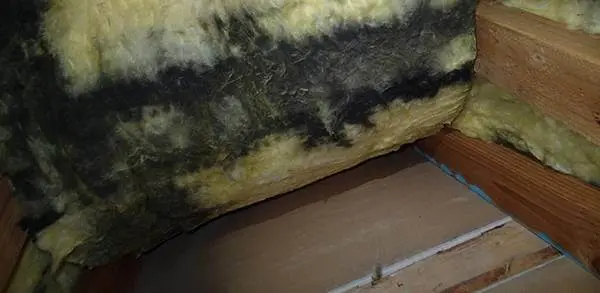
Saturated cellulose and fiberglass hold water against framing and sheathing for weeks, and in a cold attic there is no air movement to carry it off. It also stops insulating, which warms the deck and feeds the next dam. Wet Insulation in the Attic.

So it comes out. On an attic in Greenwich that is usually the single biggest step toward the structure actually drying.

Why a cold attic will not dry itself

Drying is evaporation, and evaporation needs warmth and air movement. A Greenwich attic in February has neither. Wet insulation and damp sheathing sit at near-freezing with no meaningful vapor drive, which is why a leak that stops in January can still be wet in March.

Equipment supplies what the season does not. Without it the structure is not drying slowly - in a cold cavity it is very largely not drying at all.

The sequence

Standing water is extracted first. Saturated insulation comes out, because it cannot be dried in place and it is holding moisture against everything it touches. Containment goes up where tear-out is needed, with HEPA scrubbers running inside it. Dehumidifiers and air movers are placed to the room's volume and load rather than scattered around.

Then the readings get taken daily until they hit standard. In a Greenwich winter, with cold cavities and low ambient humidity outside, that typically takes longer than people expect.

Electrical safety where water reached fixtures

Water running into a ceiling light, a fan box or down inside a wall to a panel is an electrical matter before it is a drying matter. Affected circuits get killed before any equipment goes in.

That is standard on every Greenwich job where water reached a fixture, and it is worth saying out loud because homeowners often reach for a wet fixture first.

Ceilings: when it comes down and when it stays

A stained ceiling is not automatically a demolished ceiling. Painted drywall that has been wetted once and can be dried from above through the insulation cavity will often flatten out and need nothing but paint.

What does come down is drywall that has lost its bond and gone soft, anything sagging under held water, textured or plaster ceilings that have delaminated, and any ceiling where the cavity above cannot be reached another way. The call is made with a meter, and shown to you before anything is opened.

contractor using drill to repair ceiling drywall after ice dam water damage
A contractor drills into a water-damaged ceiling where drywall was removed to expose insulation after ice dam damage.

What you get in Greenwich

  • Electrical made safeCircuits killed where water reached fixtures, before equipment goes in
  • Wet insulation removedIt cannot be dried in place and it holds water against the framing
  • Documented to standardDaily moisture readings until the structure meets IICRC S500 dry standard
Water Mitigation & Dryout in Greenwich, CT — specification
Service specification for Greenwich, CT
Interior repairInsulation, drywall, texture, trim and paint, done in-house after drying
MethodContainment, HEPA filtration and drying to a measured IICRC standard
Primary climate stressorNor'easters, rapid thaw-freeze swing
Dispatch windowSame day to 24 hours
Coverage areaGreenwich and Fairfield County
DocumentationDated before and after photos, written scope in Xactimate line items
BillingXactimate line items on one claim; carrier billed directly where the policy allows

Where We Dispatch Around Greenwich

Crews working Greenwich cover the adjoining communities on the same route — Cos Cob, Riverside and Old Greenwich — so a storm week usually means one truck handling several addresses in Fairfield County rather than separate trips.

Nearest hub towns with their own water mitigation pages: Stamford, Darien, New Canaan, Norwalk, Westport, Ridgefield.

Crews cover Greenwich and the surrounding Fairfield County towns through the whole season, and during a freeze event they run from first light until dark.

Most jobs do not stop at one service. Water Mitigation in Greenwich often runs alongside ice dam removal in Greenwich, and both get written into one scope rather than billed as separate visits.

Active leak right now? Our 24/7 Greenwich steam ice dam removal crews are dispatched first during a freeze event. Call (888) 561-9664.


One Event, One Claim

Everything The Ice Dam Caused In Greenwich, On One Claim

Taking the ice off is usually the cheapest part. The water that already got in, the mold it leaves, the ceiling that has to come down and sometimes the roof itself are one loss event, so they go on one insurance claim, handled by one company.

How it goes on the claim

  • One loss, one claim number. Removal, mitigation, mold, interior repair and roof damage from the same ice dam are reported as one event.
  • Broken out by coverage. Mitigation, mold (often under its own sublimit), interior repair and the roof are written as separate Xactimate sections, so a question on one line does not hold up the rest.
  • Documented the whole way. Dated photographs and moisture readings run from the ice on the roof to the finished room, from one company, in one file.
  • Honest about the limits. Coverage depends on your policy. A roof that was simply old is not storm damage, and you and your carrier make the coverage decision.
Ice Dam Claims In Greenwich
Conditions We Work In

Water Mitigation & Dryout In Practice

Conditions crews work in across Fairfield County. Every job is photographed before and after.

technician in Tyvek suit and respirator removing contaminated pink insulation in attic
A remediation technician removes mold-contaminated insulation from a tight attic space following ice dam damage.
contractor using drill to repair ceiling drywall after ice dam water damage
A contractor drills into a water-damaged ceiling where drywall was removed to expose insulation after ice dam damage.
plastic containment sheeting and air mover set up inside living room after water damage
Plastic containment barriers and a commercial air mover protect the living area during water damage remediation.
FAQ

Greenwich and Fairfield County FAQ

It is billed by the crew hour, and the rate plus a realistic time estimate are quoted on the phone before anyone is dispatched.

  • Scope drives the hours: length and thickness of the ice, roof pitch and height, and whether the gutters are frozen solid.
  • Access matters too — a three-story Greenwich roof takes longer to set up on than a ranch.
  • The invoice matches the quote. There are no surprise add-ons written on the tailgate.

No. Steam removal is maintenance work, not construction, so no building permit is pulled for it anywhere in Fairfield County.

  • A permit does come into it once the work becomes a repair — new decking, a re-roof or structural work.
  • That is handled through the Greenwich building department, or the Fairfield County building authority where the city has no department of its own.
  • Ask before signing anything: a contractor who says a re-roof in Greenwich needs no permit is telling you something useful about how they work.

Because ice dams are made by heat loss, and two houses on the same street rarely leak heat the same way.

  • Attic air leaks around can lights, bath fans and the attic hatch are the usual source.
  • Crushed or missing soffit baffles stop the intake ventilation that would otherwise keep the deck cold.
  • An addition or dormer built over unheated space puts warm air right against a cold eave.
  • Local factor: nor'easters and rapid thaw-freeze swings makes the difference show up faster here than it would further south.

Yes. The dispatch area runs across Fairfield County, and several addresses in one area are usually handled in the same run.

  • Adjoining communities are on the same route rather than treated as a separate trip.
  • Rural addresses outside the normal radius get told the travel position on the call.
  • Capacity is moved into whichever part of Connecticut the storm actually hits.

Yes. Steam is safe on slate, cedar shake, tile and metal as well as asphalt, because it removes ice with heat rather than force.

  • Older Greenwich housing stock with original slate is exactly where chipping does the most damage.
  • Crews adjust the lance distance and dwell rather than the pressure.
  • Nothing mechanical touches the covering at any point.

Air movers and dehumidifiers are noticeable and they do run continuously, because drying stops when they do. Turning them off at night adds days to the job. Placement can be adjusted around bedrooms where the layout allows, and that is worth raising at the start.

Interior water damage from an ice dam is covered under many policies, and mitigation is often treated separately from the repair under a duty to protect property clause. Coverage varies by carrier, so check your policy. Readings, photos and a written scope are documented throughout either way.

Nearby

Water Mitigation In Towns Around Greenwich

Same-Day Response

Get A Greenwich Crew Out

The cost of a steam visit does not change much from one week to the next. The cost of the water damage behind the dam does.

✓ Licensed & insured✓ Low-pressure steam only✓ Rate quoted up front✓ Photos for your claim
Online Quote(888) 561-9664