Skip to content
Denver, CO
Hand Clearing · Denver County

Roof Shoveling in Denver, CO — Mountain Storm Response

Ice Dam Now provides roof shoveling in Denver, CO and the surrounding Denver County, using low-pressure steam only — never chipping, salt or pressure washing. Crews are licensed, insured and harness-certified, dispatch same day for active interior leaks, and bill by the crew hour at a rate quoted before dispatch. Dated photo documentation is supplied for insurance claims.

Flat sections included — Garage, porch and addition roofs that shed nothing on their own
Controlled discharge — Snow lands away from walkways, decks, landscaping and HVAC
Valleys and dormers — The pockets a rake physically cannot reach get cleared properly
Plastic blades only — Cut and lifted in layers, never scraped down to the surface

Get Ice Dam Help Denver

A few quick questions, then pick a time. If water is coming in, call instead.

What is the zip code of the home?

Roof leaking right now? Call (888) 561-9664 — that is faster than any form.
Water coming through the ceiling?Every hour an ice dam sits there, more water gets under the shingles.Call (888) 561-9664
24/7
Dispatch All Winter
Steam
Only — No Pressure
Denver
County Coverage
Same Day
For Active Leaks
Insured
Licensed & Harness-Certified

Ice dams are not a Denver problem so much as a Colorado one, and they show up on the same handful of eaves and valleys year after year. As part of our complete Denver winter roof services, crews handle roof shoveling across Denver County.

Elevation, Aspect and Ice: The Denver County Pattern

The pack at this elevation is deep enough to act as its own insulation, which means the surface melts under sun while the base stays locked. Water released at the top has to travel through and under all of it.

Diagram showing how ice dams form on roofs due to inadequate insulation and poor ventilation
Heat escaping into the attic melts roof snow; the meltwater refreezes at the cold eave and the dam grows a layer every cycle.

Depth makes it worse. A Denver County roof can carry several feet of pack, and all of that is a reservoir sitting above an eave that never sees sun.

Ice-barrier practice in Denver County

Design snow loads up here are among the highest in the country, and the membrane and retention details that come with them are not paperwork. On an older Denver cabin neither is likely to be present.

Roof Shoveling in Denver: How The Work Runs

Anchors, rope and why this is not a DIY job

Every crew member on a pitched roof is tied to a rated anchor. On ice over shingle, footing is unreliable in a way that is hard to appreciate from the ground. Ceiling Sagging or Bulging After Snow.

Roof falls are the most common serious winter injury in this trade and they happen to people who have done it for years. A Denver homeowner in work boots on a January roof is taking a risk out of all proportion to the money saved.

Access when the ground is buried too

Ladder footing is the quiet half of this job. Setting a ladder on a packed drift that is going to soften by noon, or against a gutter already loaded with ice, is how people end up in hospital.

Crews dig and level ladder footings, use standoffs so no weight goes on the gutter, and tie off at the top. Where no safe setting exists, the work goes through a lift instead and that gets said rather than improvised around.

Working around what is up there

Rooftop units, exhaust fans, conduit runs, gas lines, solar racking, skylights and safety railing all have to be cleared around rather than over. The drift shadow behind a unit is usually the deepest snow on the roof.

Skylights in particular get flagged and worked around deliberately — a shovel through cold glass is a bad afternoon for everyone.

Timing a clear against the forecast

Clearing a roof the day before eight more inches arrive is money spent twice. Clearing it the day before a thaw, or ahead of a rain-on-snow event, is money that prevents a claim.

Scheduling in Denver is built around the forecast rather than the order calls came in, and a job gets moved - with a reason - when the weather makes a different day obviously better.

Metal roofs and sudden releases

A standing-seam or corrugated roof holds snow until it does not. Warmth from below lubricates the pan, and the whole slab can release at once - several hundred pounds arriving on a driveway, a deck, a parked car or whoever is under it.

Crews work metal from the ground wherever the pitch allows, clear and mark the drop zone first, and never put a person below a loaded panel. Snow guards get noted where they are missing, because a release will keep happening every winter until something holds it.

Worker in safety harness shoveling heavy snow off a residential roof
A roofing professional uses a safety harness and blue shovel to clear heavy snow accumulation from a residential roof.

What you get in Denver

  • Plastic blades onlyCut and lifted in layers, never scraped down to the surface
  • Valleys and dormersThe pockets a rake physically cannot reach get cleared properly
  • Harnessed and anchoredRated anchor points on every pitched roof, every time
Roof Shoveling in Denver, CO — specification
Service specification for Denver, CO
ServiceRoof Shoveling in Denver, CO
DocumentationDated before and after photos, written scope in Xactimate line items
Primary climate stressorSolar melt on deep pack, shaded eaves
Dispatch window24 to 48 hours in mountain terrain
Pricing modelBilled by the crew hour, rate quoted before dispatch
Coverage areaDenver and Denver County
Local ice-barrier practiceExtended membrane plus snow retention

Neighborhoods and Towns We Reach From Denver

Crews working Denver cover the adjoining communities on the same route — Dupont, Henderson, Eastlake and Morrison — so a storm week usually means one truck handling several addresses in Denver County rather than separate trips.

Nearest hub towns with their own roof shoveling pages: Lakewood, Wheat Ridge, Arvada, Commerce City, Englewood, Westminster.

Coverage runs across Denver and the nearby towns all winter, and capacity is surged into whichever Colorado market the storm actually hits.

Most jobs do not stop at one service. Roof Shoveling in Denver often runs alongside roof snow removal in Denver, and both get written into one scope rather than billed as separate visits.

Active leak right now? Our 24/7 Denver steam ice dam removal crews are dispatched first during a freeze event. Call (888) 561-9664.

Conditions We Work In

Roof Shoveling In Practice

Conditions crews work in across Denver County. Every job is photographed before and after.

Large sheet of snow sliding off residential roof during winter removal
A heavy slab of accumulated snow breaks free and cascades off a residential rooftop during a winter storm.
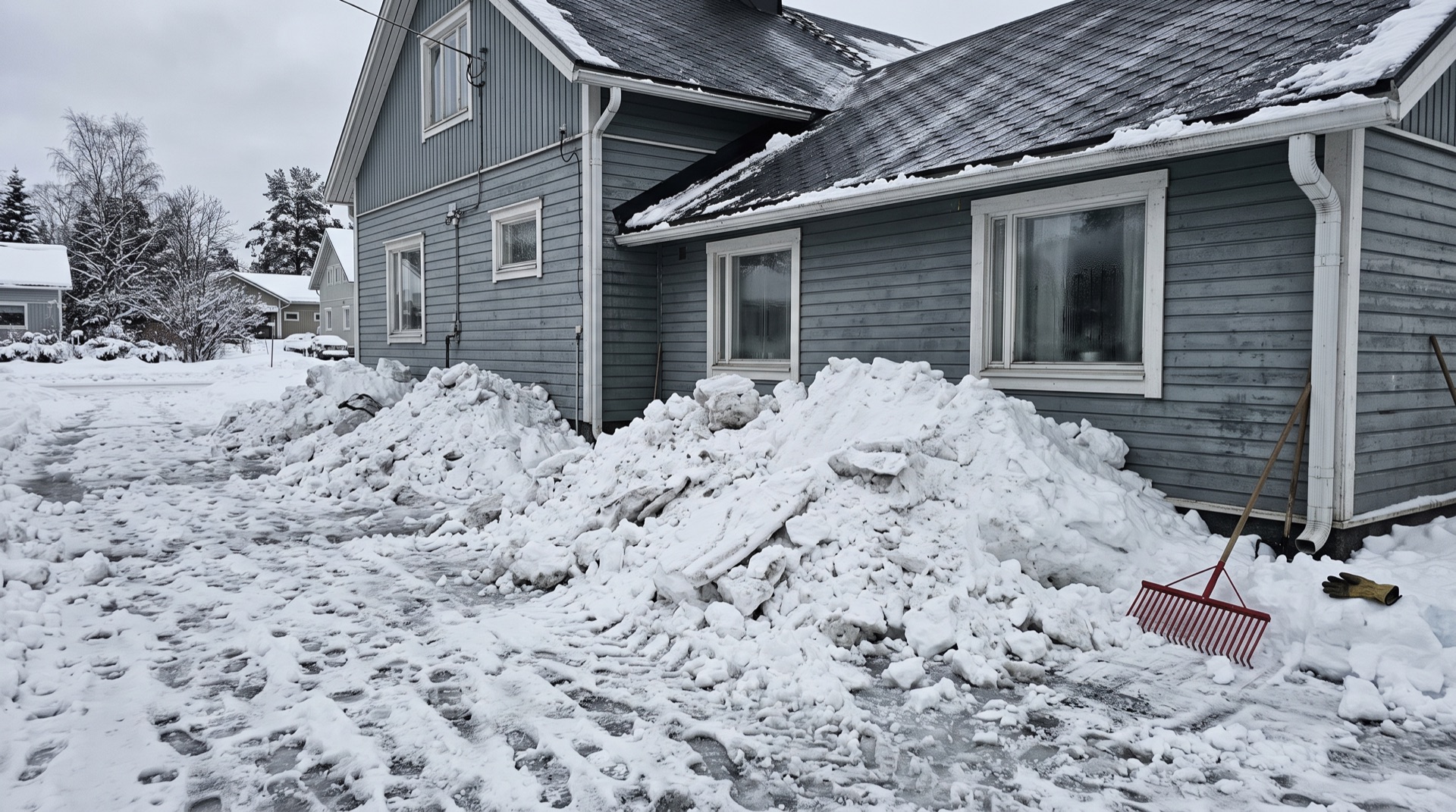
Large piles of raked snow beside a gray clapboard house in winter
Heavy snow raked from the roof sits piled against the side of a gray house.
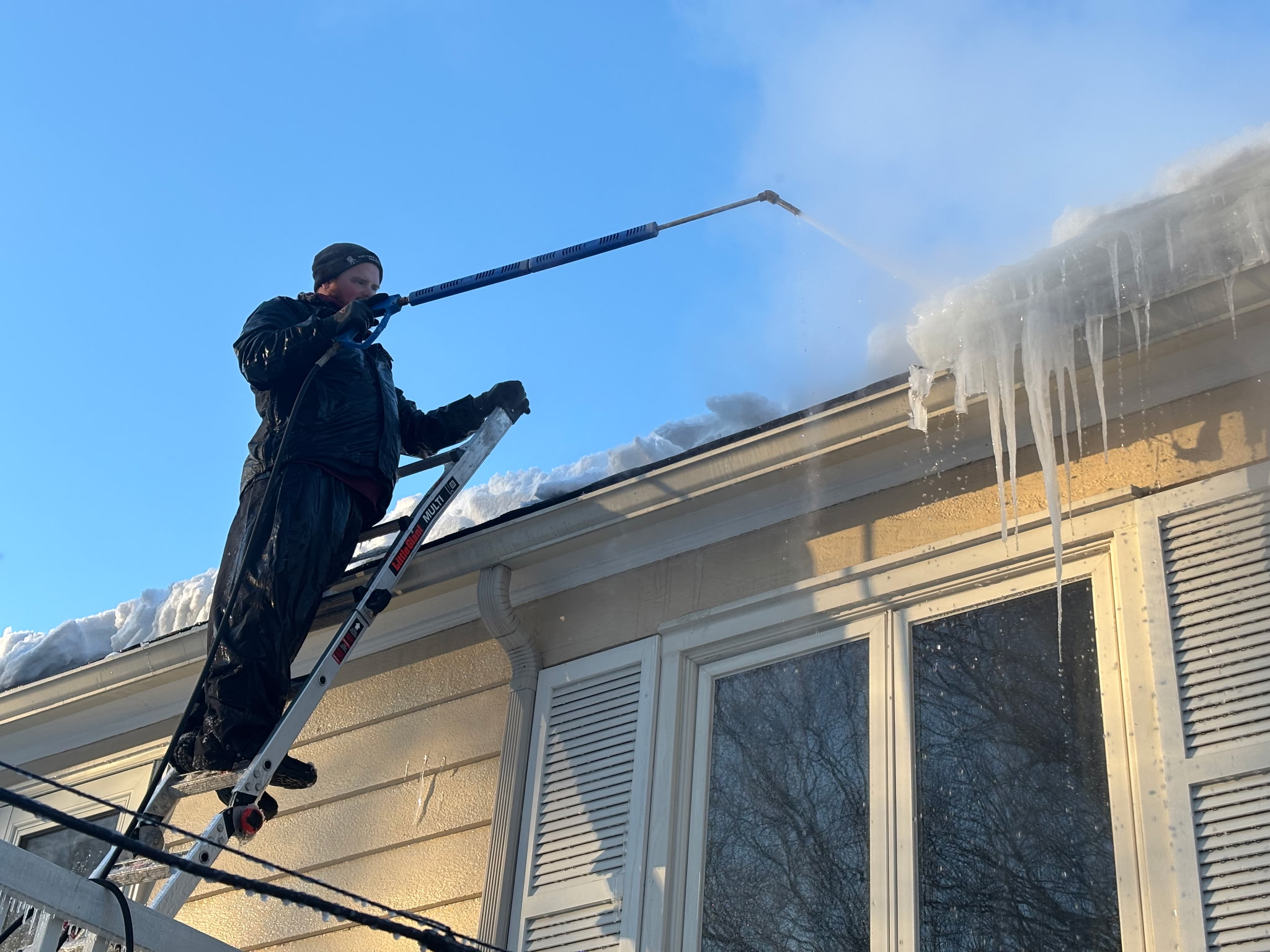
Worker on ladder using steam wand to remove ice dams and icicles from residential roof
A technician uses a high-pressure steam wand to melt ice dams and icicles from a home's roofline.
FAQ

Denver Questions We Actually Get Asked

It is billed by the crew hour, and the rate plus a realistic time estimate are quoted on the phone before anyone is dispatched.

  • Scope drives the hours: length and thickness of the ice, roof pitch and height, and whether the gutters are frozen solid.
  • Access matters too — a three-story Denver roof takes longer to set up on than a ranch.
  • The invoice matches the quote. There are no surprise add-ons written on the tailgate.

More than it looks from the ground - a foot-deep dam across a thirty-foot eave is a few thousand pounds.

  • Depth is measured at the eave rather than estimated from the driveway.
  • The gutter trough underneath is usually frozen solid too and is part of the same mass.
  • That weight is one of the reasons chipping at it from a ladder goes badly.

Yes. Steam is safe on slate, cedar shake, tile and metal as well as asphalt, because it removes ice with heat rather than force.

  • Older Denver housing stock with original slate is exactly where chipping does the most damage.
  • Crews adjust the lance distance and dwell rather than the pressure.
  • Nothing mechanical touches the covering at any point.

The crew hours on site, the equipment and the photo documentation - with the rate and an estimate given on the phone beforehand.

  • Travel to a Denver address inside the normal service area is not an added line.
  • If the roof turns out worse than described, you are told before the extra hours are worked.
  • The invoice matches what was quoted. Nothing gets added on the tailgate.

Clear a path to the affected side, move vehicles off the driveway and unlock any side gate.

  • Put something under an active interior drip and move what you can out of the way.
  • Photograph the interior damage yourself as well - more evidence is never a problem.
  • Do not go on the roof or up a ladder. That is the part that sends people to hospital.

A rake reaches the first few feet of a single-story eave and nothing beyond it. Anything higher, anything low-slope, anything with valleys or dormers and anything where the pack has hardened needs a crew on the roof with the right tools. Where a rake genuinely would do, that gets said.

For a harnessed crew with rated anchors and the right footwear, yes. For a homeowner in boots on an icy pitch, no — roof falls are the most common serious winter injury in this trade, and they happen to experienced people too.

Nearby

Roof Shoveling In Towns Around Denver

Same-Day Response

Get A Denver Crew Out

A dam left alone through February is not the same dam in March. It is bigger, and so is the repair behind it.

✓ Licensed & insured✓ Low-pressure steam only✓ Rate quoted up front✓ Photos for your claim
Online Quote(888) 561-9664