
Skip to content
Gillette, WY
Hand Clearing · Campbell County

Roof Shoveling in Gillette, WY — High‑Altitude Response

Ice Dam Now handles roof shoveling for Gillette, WY properties and the wider Campbell County. Removal is by low-pressure steam, never mechanical. Dispatch is same day where water is already inside, pricing is by the crew hour quoted before a crew leaves, and every job is photographed before and after for claim purposes. Crews are licensed, insured and harness-certified.

Plastic blades only — Cut and lifted in layers, never scraped down to the surface
Valleys and dormers — The pockets a rake physically cannot reach get cleared properly
Skylights worked around — Flagged and avoided rather than cleared over
Flat sections included — Garage, porch and addition roofs that shed nothing on their own

Get Ice Dam Help Gillette

A few quick questions, then pick a time. If water is coming in, call instead.

What is the zip code of the home?

Roof leaking right now? Call (888) 561-9664 — that is faster than any form.
Water coming through the ceiling?Every hour an ice dam sits there, more water gets under the shingles.Call (888) 561-9664
Same Day
For Water Already Inside
Steam
Safe On Every Covering
Campbell
County Coverage
Insured
Harness-Certified On Every Roof
Written
Scope Before Work Starts

Every Gillette winter produces the same two calls: the ones who see the ice early, and the ones who see the ceiling stain first. As part of our complete Gillette winter roof services, crews handle roof shoveling across Campbell County.

Sun on Cold Snow: The Gillette Pattern

Thin air at altitude means intense direct sun even in deep cold. A Gillette roof can be melting on its south face at midday in air that never gets near freezing, and all of that water has to go somewhere.

Diagram showing how ice dams form on a roof from heat loss and snow melt
Heat escaping into the attic melts roof snow; the meltwater refreezes at the cold eave and the dam grows a layer every cycle.

Depth makes it worse. A Campbell County roof can carry several feet of pack, and all of that is a reservoir sitting above an eave that never sees sun.

Ice-barrier practice in Campbell County

Design snow loads up here are among the highest in the country, and the membrane and retention details that come with them are not paperwork. On an older Gillette cabin neither is likely to be present.

Roof Shoveling in Gillette: How The Work Runs

Cutting in layers rather than scraping

Crews cut the pack into blocks and lift them, leaving a cushion layer behind. The blade never touches the roof surface. That is the whole technique and it is why a shovelled roof looks untouched afterwards. Ceiling Sagging or Bulging After Snow.

Scraping to bare membrane or bare shingle is what damages a roof, and it is what a well-meaning homeowner with a steel shovel does on the first pass.

Working around what is up there

Rooftop units, exhaust fans, conduit runs, gas lines, solar racking, skylights and safety railing all have to be cleared around rather than over. The drift shadow behind a unit is usually the deepest snow on the roof.

Skylights in particular get flagged and worked around deliberately — a shovel through cold glass is a bad afternoon for everyone.

Clearing to let the drains work

On anything flat, the job is not finished when the snow is off. Drains, scuppers and overflow outlets have to be opened so the melt that follows has somewhere to go.

A cleared Gillette deck with blocked drains just ponds and refreezes, and ponded water on a membrane finds seams.

Shoveling and steaming together

On a roof that already has a dam, shoveling and steaming usually happen in the same visit: the pack comes off first so the crew can see and reach the ice, then the dam gets steamed off the eave. Doing it in that order means less steam time, which usually means a smaller invoice.

Access when the ground is buried too

Ladder footing is the quiet half of this job. Setting a ladder on a packed drift that is going to soften by noon, or against a gutter already loaded with ice, is how people end up in hospital.

Crews dig and level ladder footings, use standoffs so no weight goes on the gutter, and tie off at the top. Where no safe setting exists, the work goes through a lift instead and that gets said rather than improvised around.

Man using a roof rake to pull heavy snow off house eaves in winter
A homeowner uses a long-handled roof rake to clear heavy snow and ice from roof eaves after a winter storm.

What you get in Gillette

  • Plastic blades onlyCut and lifted in layers, never scraped down to the surface
  • Flat sections includedGarage, porch and addition roofs that shed nothing on their own
  • Skylights worked aroundFlagged and avoided rather than cleared over
Roof Shoveling in Gillette, WY — specification
Service specification for Gillette, WY
Local ice-barrier practiceExtended membrane plus snow retention
ServiceRoof Shoveling in Gillette, WY
Typical scopeSteam, 8-16 crew hours typical
Removal methodLow-pressure steam only. No chipping, salt or pressure washing.
DocumentationDated before and after photos, written scope in Xactimate line items
Primary climate stressorSolar melt on deep pack, shaded eaves
Pricing modelBilled by the crew hour, rate quoted before dispatch

Gillette Coverage and the Adjoining Communities

Crews working Gillette cover the adjoining communities on the same route — Rozet — so a storm week usually means one truck handling several addresses in Campbell County rather than separate trips.

Nearest hub towns with their own roof shoveling pages: Sheridan, Douglas, Casper, Powell, Riverton, Cody.

When a storm hits Campbell County, crews are dispatched by severity rather than by call order — water already inside the house goes first.

Most jobs do not stop at one service. Roof Shoveling in Gillette often runs alongside roof snow removal in Gillette, and both get written into one scope rather than billed as separate visits.

Active leak right now? Our 24/7 Gillette steam ice dam removal crews are dispatched first during a freeze event. Call (888) 561-9664.

Conditions We Work In

Roof Shoveling In Practice

Conditions crews work in across Campbell County. Every job is photographed before and after.

Worker in safety harness shoveling snow off a residential roof in winter
A roofing professional clears heavy snow from a residential roof while wearing a safety harness.
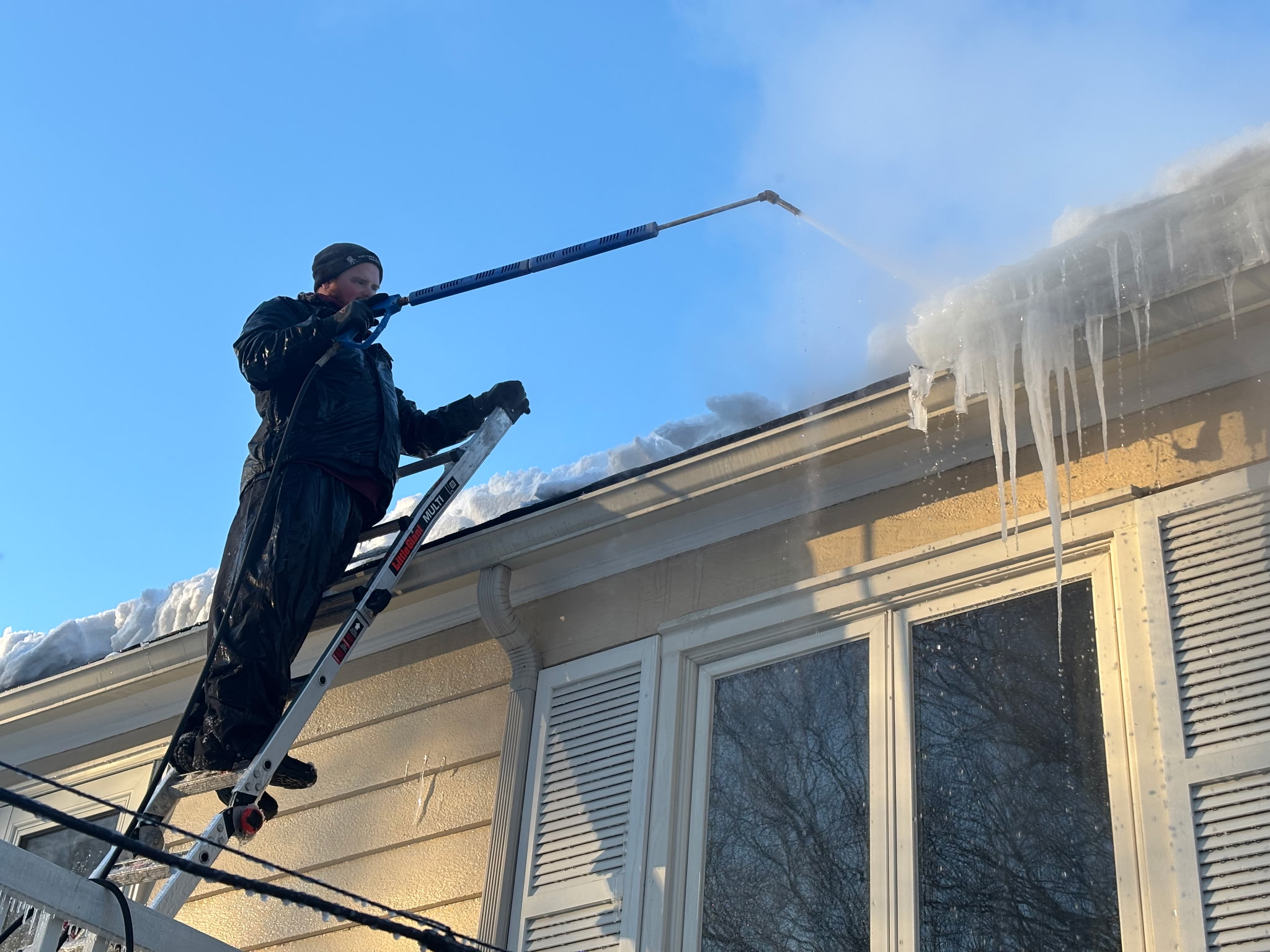
Worker on ladder using steam wand to remove ice dams and icicles from residential roof
A technician uses a high-pressure steam wand to melt ice dams and icicles from a home's roofline.
Worker in safety harness shoveling heavy snow off a residential roof
A roofing professional uses a safety harness and blue shovel to clear heavy snow accumulation from a residential roof.
FAQ

What Gillette Homeowners Ask First

It is billed by the crew hour, and the rate plus a realistic time estimate are quoted on the phone before anyone is dispatched.

  • Scope drives the hours: length and thickness of the ice, roof pitch and height, and whether the gutters are frozen solid.
  • Access matters too — a three-story Gillette roof takes longer to set up on than a ranch.
  • The invoice matches the quote. There are no surprise add-ons written on the tailgate.

Only where there is interior damage to document or dry. Pure exterior removal happens entirely from outside.

  • If water has come in, seeing it is what makes the claim documentation worth anything.
  • Attic access helps identify the heat source but is not required for removal.
  • Nobody needs to be home for exterior-only work, provided access and payment are arranged.

Often for the interior water damage, sometimes for the removal itself, but it depends entirely on your carrier and policy wording.

  • Many policies treat emergency mitigation separately under a duty to protect property clause.
  • Denials usually cite the maintenance exclusion, which dated photographs taken during the event are the direct counter to.
  • Crews photograph the dam, the entry points and the interior damage, and write the scope in Xactimate line items.
  • The coverage decision is between you and your carrier — no contractor can promise an outcome there.

Before the thaw rather than after it. The leak happens when the ice has water behind it, which is a day or two after the snow stops.

  • Calling during the storm is fine and often gets an earlier slot.
  • The expensive version is waiting until water appears on a ceiling.
  • Crews run across Campbell County from first light through a freeze event.

Yes. The dispatch area runs across Campbell County, and several addresses in one area are usually handled in the same run.

  • Adjoining communities are on the same route rather than treated as a separate trip.
  • Rural addresses outside the normal radius get told the travel position on the call.
  • Capacity is moved into whichever part of Wyoming the storm actually hits.

For a harnessed crew with rated anchors and the right footwear, yes. For a homeowner in boots on an icy pitch, no — roof falls are the most common serious winter injury in this trade, and they happen to experienced people too.

Yes, and they are often the most urgent ones because they shed nothing on their own. Membrane roofs get the same treatment — plastic only, cushion layer kept, drains and scuppers cleared so the melt has somewhere to go.

Nearby

Roof Shoveling In Towns Around Gillette

Same-Day Response

Get A Gillette Crew Out

A dam left alone through February is not the same dam in March. It is bigger, and so is the repair behind it.

✓ Licensed & insured✓ Low-pressure steam only✓ Rate quoted up front✓ Photos for your claim
Online Quote(888) 561-9664
