
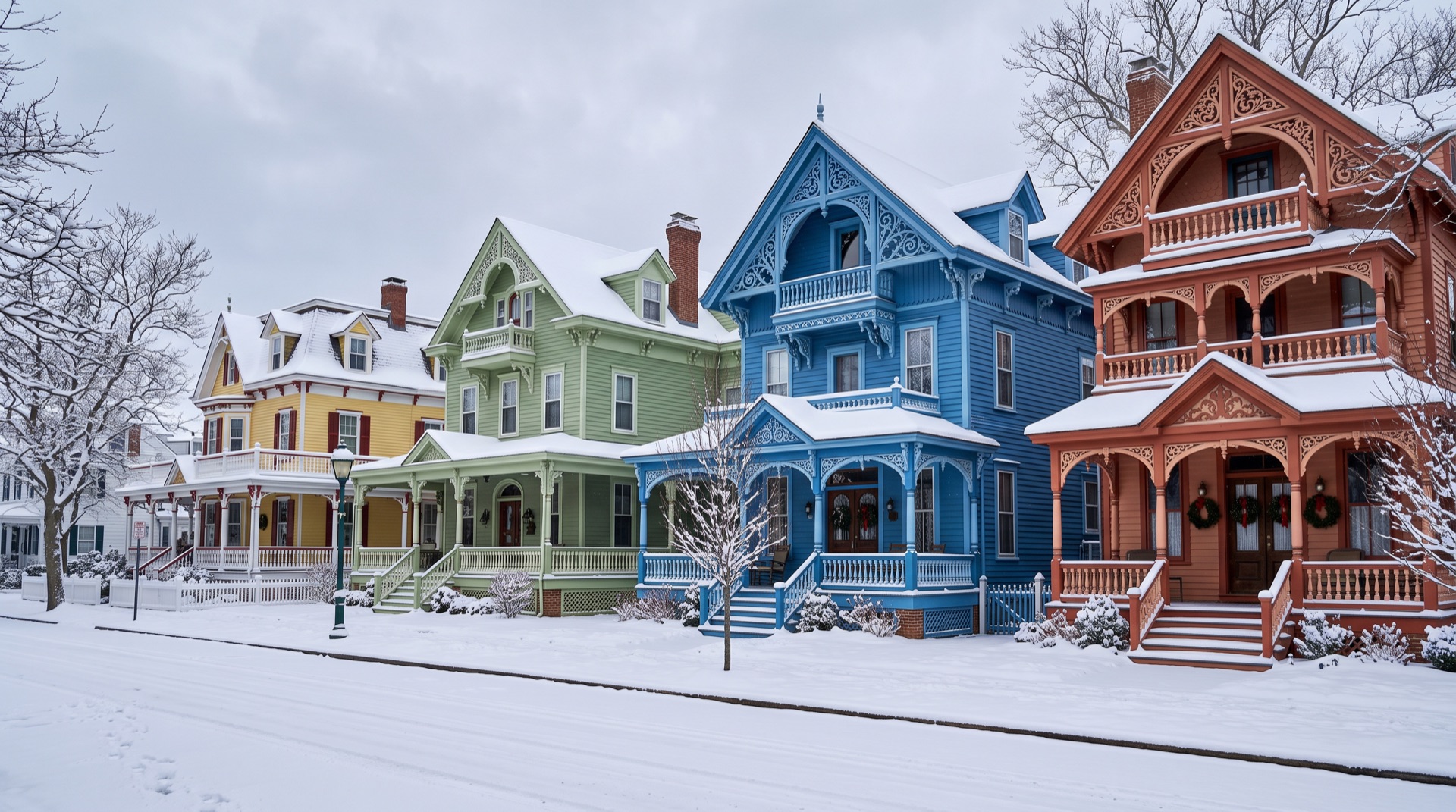
Bergen County sees the same pattern every winter: snow on the roof, warm air in the attic, and a line of ice building along the eave where the two meet. As part of our complete Hackensack winter roof services, crews handle roof snow removal across Bergen County.
Why a Hackensack Roof Dams Between Storms
The maritime air is the other half of it. Temperatures in Bergen County move either side of freezing within the same day far more often than they do inland, and every crossing moves water down the roof and locks it at the eave.

Then there is the architecture. Hackensack has a great deal of older housing with shallow eave returns, knee-wall attics and rooms built out over porches, all of which put heated air against cold deck with very little between.
Ice-barrier practice in Bergen County
In most coastal New Jersey towns the eave membrane requirement extends past the interior wall line rather than stopping at the first course. On a roof in Hackensack with a deep overhang, that is further up than it sounds.
Roof Snow Removal in Hackensack: How The Work Runs
Rake from the ground or crew on the roof
Ground work is safer, cheaper and enough for most single-story and story-and-a-half Hackensack homes. The limit is reach: a rake handles the first several feet and nothing past it. Ceiling Sagging or Bulging After Snow.
Above that, or where the pitch makes a rake useless, somebody goes up harnessed. The call is made on arrival and the rate reflects which it turned out to be.
Snow load is a structural question too
Snow is not weightless. Wet pack and drifted snow can carry serious weight per square foot, and it collects unevenly — behind dormers, against parapets, in valleys and on the lee side of a ridge. Older framing and low-slope roofs are where that shows up first as deflection.
If a roof in Hackensack is already groaning, sagging between rafters or showing new cracks in interior drywall, that is a load problem and not a cosmetic one. Say so on the call and the crew treats it as urgent.
Why the second storm is the dangerous one
A roof usually carries the first storm without trouble. The problem is that the first pack settles, hardens and stops sliding, so the second storm lands on a base that is not going anywhere and the third has nowhere to go at all.
That is why clearing between storms is worth more than clearing after the whole sequence: each clear resets the base, and the roof never gets to the compounded load in the first place.
Wet snow, dry snow and what the weight actually is
Depth tells you very little on its own. Light powder runs around seven pounds per cubic foot; old settled snow two or three times that; the saturated layer sitting at the bottom of a pack after a thaw can approach the weight of standing water. Two roofs in Hackensack under the same twenty inches can be carrying loads that differ by a factor of four.
Crews take a core and weigh it rather than guessing from the ruler, because that measurement is what decides whether a roof is near its limit or nowhere close.
Clearing before the thaw rather than after
A warm spell is not relief. Meltwater from a deep pack has to go somewhere, and on a roof whose eaves and gutters are still frozen it goes under the shingles. The week a Hackensack forecast turns mild is the week the interior leak calls start.
Taking the snow off ahead of the thaw removes the water before it has a chance to find a way in, which is a far cheaper exercise than mitigating the ceiling it would otherwise come through.

What you get in Hackensack
- Load reductionWeight comes off valleys, dormer pockets and drift zones that collect the most
- Eave-first clearingThe lower roof band where dams form gets cleared first, not last
- Paths cleared behind usDriveways and walks are not left buried when the crew leaves
| Local ice-barrier practice | Eave membrane standard on re-roofs |
|---|---|
| Documentation | Dated before and after photos, written scope in Xactimate line items |
| Primary climate stressor | Nor'easters, rapid thaw-freeze swing |
| Typical scope | Steam, 4-10 crew hours typical |
| Dispatch window | Same day to 24 hours |
| Coverage area | Hackensack and Bergen County |
| Removal method | Low-pressure steam only. No chipping, salt or pressure washing. |
Where We Dispatch Around Hackensack
Crews working Hackensack cover the adjoining communities on the same route — Maywood, Bogota, South Hackensack, Teterboro and Lodi — so a storm week usually means one truck handling several addresses in Bergen County rather than separate trips.
Nearest hub towns with their own roof snow removal pages: Paramus, Passaic, Fair Lawn, Fort Lee, Clifton, Paterson.
Scheduling for Hackensack tightens up during a freeze event, which is exactly when the phone beats the form. Water coming in means a call, not an email.
Most jobs do not stop at one service. Roof Snow Removal in Hackensack often runs alongside ice dam removal in Hackensack, and both get written into one scope rather than billed as separate visits.
Active leak right now? Our 24/7 Hackensack steam ice dam removal crews are dispatched first during a freeze event. Call (888) 561-9664.


