Ice dams are not a Blue Springs problem so much as a Missouri one, and they show up on the same handful of eaves and valleys year after year. As part of our complete Blue Springs winter roof services, crews handle ice dam removal across Jackson County.
Blue Springs Ice Dams: Why a Few Inches Is Enough
Blue Springs does not need a blizzard to get an ice dam. A few inches that melts by afternoon and refreezes overnight builds one just as effectively, and it does it over and over through the season.

The expectation is the problem. Nobody in Blue Springs re-roofs with ice dams in mind, so when a cycling stretch arrives the houses with the least margin all leak in the same week.
Ice-barrier practice in Jackson County
The residential code Missouri follows calls for eave ice barrier on new work. Enforcement in Jackson County is real but recent, so the age of the roof is what decides whether it is there.
Ice Dam Removal in Blue Springs: How The Work Runs
What the dam has already done to the gutter and fascia
Ice expands as it forms, and a trough packed solid pushes the gutter away from the fascia a little more every cycle. By the time the dam is thick enough to leak, the hangers are often pulled, the back of the trough has lifted, and the fascia board behind it has been wet for weeks. Water Stain on the Ceiling in Winter.
None of that is visible until the ice is off. It gets photographed when it appears, because a bent gutter found in February is a great deal easier to argue about with a carrier than one discovered in May.
What gets photographed, and why it matters later
Before the lance comes out, the crew shoots the dam from the ground and from the roof, the icicle line, any staining visible inside, and the specific courses where water is tracking under the shingles. Timestamps are on every frame.
That record is the whole case if a claim follows. An adjuster arriving in March sees a dry roof and a stained ceiling; the photographs are what connect the two, and they are what a maintenance-exclusion denial runs into.
Access, ladders and what the crew needs on site
Steam equipment needs somewhere to park within hose reach, and ladders need footing that is not a buried flower bed or a sheet of ice. Clearing a path to the affected eave, moving vehicles off the driveway and unlocking a side gate takes ten minutes and saves considerably more than that on the clock.
Where the only access is through a neighbor's property, that conversation is worth having before the crew is in the street rather than while it waits.
How long a removal actually takes
A single-story eave with a thin dam and clear gutters is often an hour or two. A two-story Blue Springs house with ice standing a foot deep across the front, frozen downspouts and a valley packed solid is most of a day for a two-man crew. The honest answer on the phone is a range and the reason for it, not a number designed to win the booking.
The estimate is revised out loud if the roof turns out worse than it looked from the ground, before the extra hours are worked rather than after they appear on the invoice.
Why the dam formed in the first place
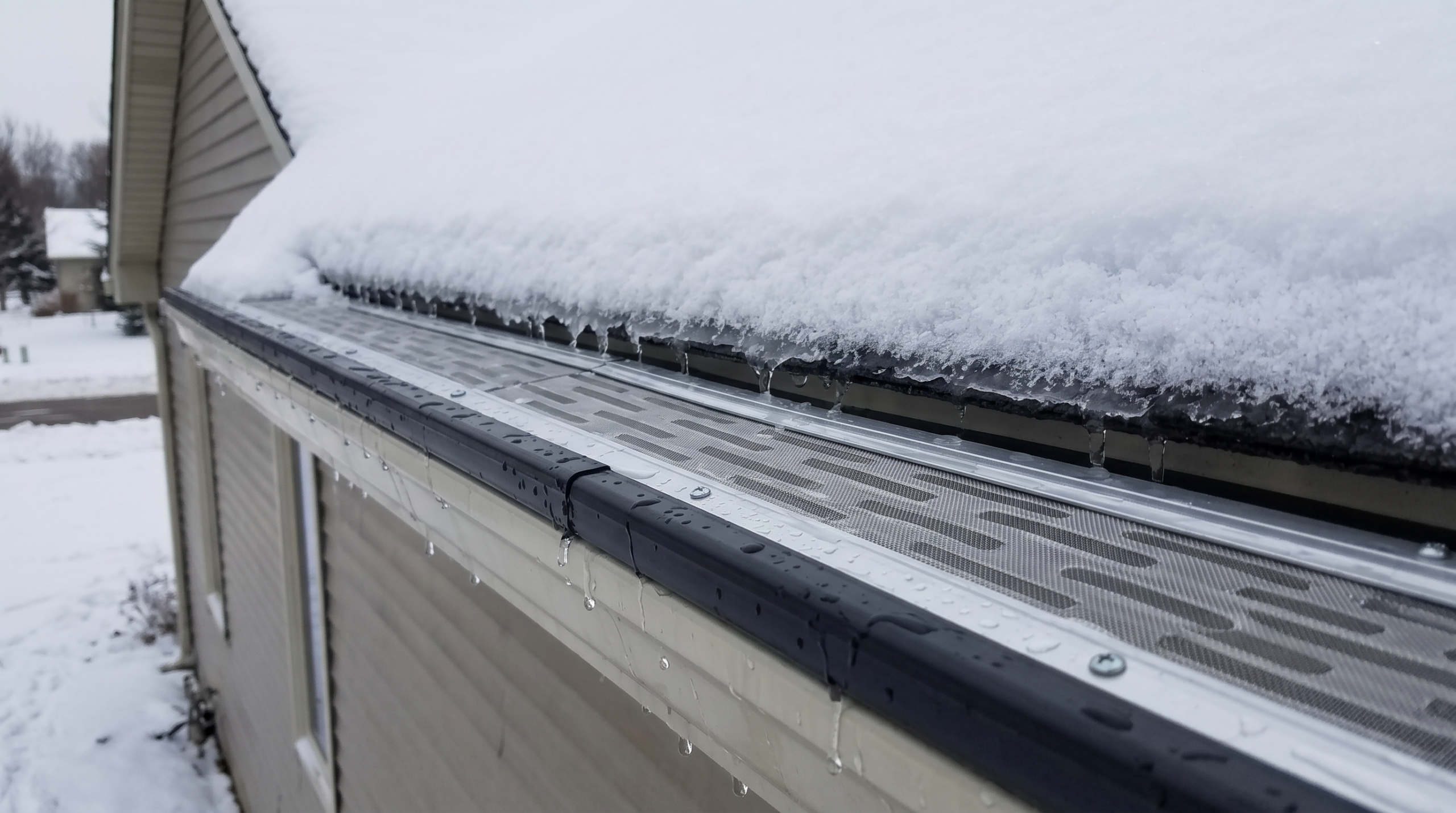
Ice dams are a heat problem wearing a weather costume. Warm air escaping into the attic melts snow on the upper roof; that meltwater runs to the eave, which hangs past the heated envelope and stays below freezing; it refreezes there, and the ridge of ice grows a layer every cycle. Removal is the emergency fix. Before the crew leaves you will know which part of your attic is feeding it.

What you get in Blue Springs
- Gutters cleared tooTrough and downspout steamed through to daylight in the same visit
- No salt, no chippingNothing corrosive and nothing mechanical touches the covering
- Steam onlySafe on asphalt, cedar, slate, tile and metal — no chipping, no pressure, no salt
| Documentation | Dated before and after photos, written scope in Xactimate line items |
|---|---|
| Pricing model | Billed by the crew hour, rate quoted before dispatch |
| Local ice-barrier practice | Eave membrane on new work, often absent |
| Removal method | Low-pressure steam only. No chipping, salt or pressure washing. |
| Service | Ice Dam Removal in Blue Springs, MO |
| Primary climate stressor | Repeated thaw-freeze cycling |
| Coverage area | Blue Springs and Jackson County |
Jackson County Coverage From Blue Springs
Crews working Blue Springs cover the adjoining communities on the same route — Grain Valley, Oak Grove, Buckner, Lone Jack and Bates City — so a storm week usually means one truck handling several addresses in Jackson County rather than separate trips.
Nearest hub towns with their own ice dam removal pages: Lee's Summit, Independence, Kansas City, St. Joseph, Columbia, Jefferson City.
Crews cover Blue Springs and the surrounding Jackson County towns through the whole season, and during a freeze event they run from first light until dark.
Most jobs do not stop at one service. Ice Dam Removal in Blue Springs often runs alongside water mitigation & dryout in Blue Springs, and both get written into one scope rather than billed as separate visits.
Active leak right now? Our 24/7 Blue Springs steam ice dam removal crews are dispatched first during a freeze event. Call (888) 561-9664.