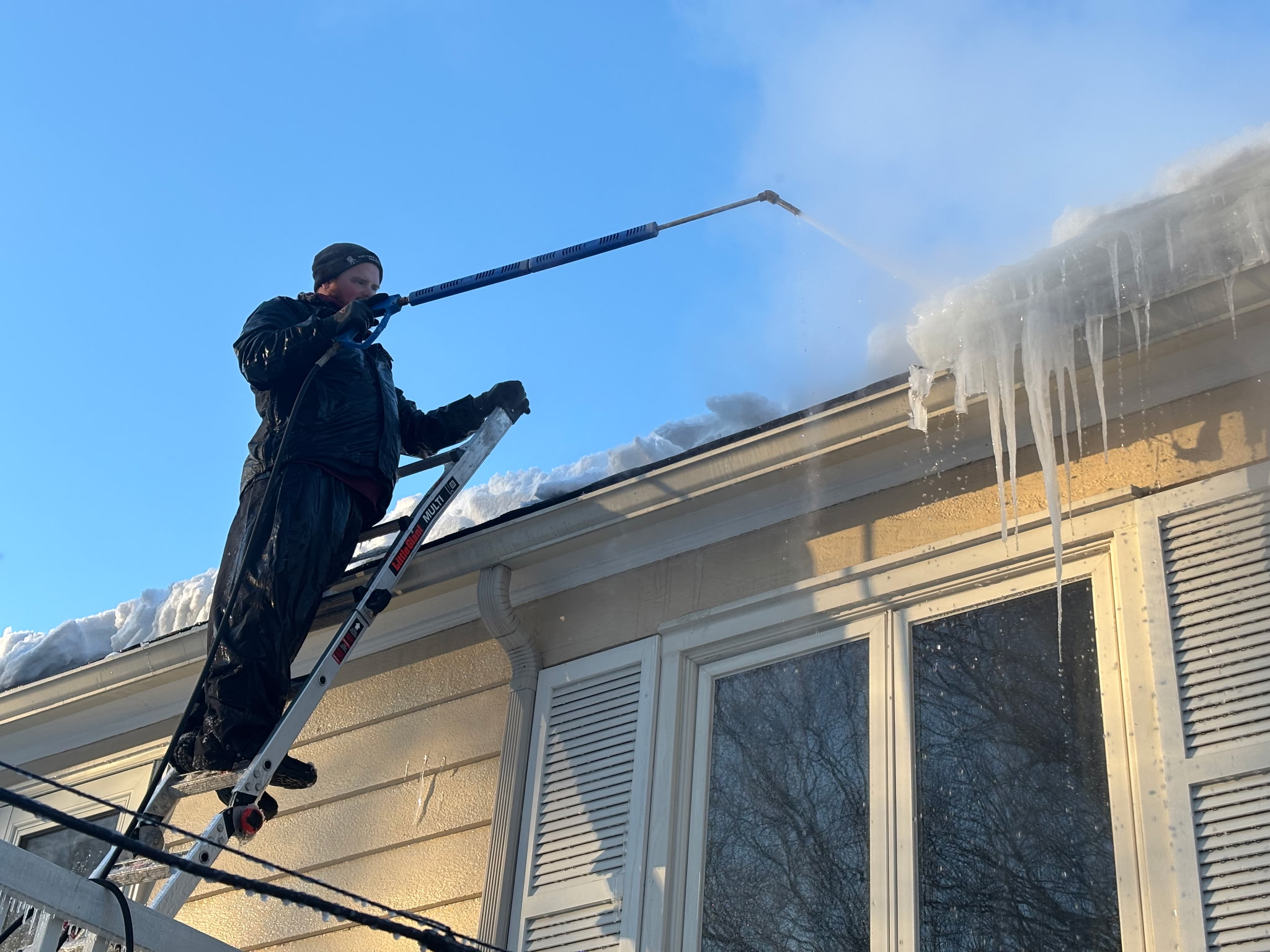
The ice along a roof in Minneapolisline is the symptom. The cause is warm air escaping into the attic, and it is still running right now. As part of our complete Minneapolis winter roof services, crews handle roof snow removal across Hennepin County.
The Hennepin County Pattern: Heavy Bands, Fast Thaws
The lake keeps producing snow long after a front has passed, so a roof in Hennepin County rarely gets the clear stretch it needs to shed. One band follows another and the pack simply deepens.

Melting happens from underneath, not from the sun. Attic heat releases water under the pack, it runs to the overhang where there is no heated space below, and it freezes. That is the engine, and in Minneapolis it runs most of the winter.
Ice-barrier practice in Hennepin County
Lake-belt jurisdictions in Minnesota have enforced eave membrane on re-roof permits for a long time. The roofs that leak are, almost without exception, the ones that have not been touched since before that.
Roof Snow Removal in Minneapolis: How The Work Runs
How much of the roof actually needs clearing
Rarely all of it. The band that matters is the lower three to six feet above the gutter, because that is the strip sitting past the heated envelope where meltwater refreezes. Ceiling Sagging or Bulging After Snow.
On a roof in Minneapolis with no load concern, clearing that band and the valleys is usually the whole job. Scraping the full plane costs more, takes longer, and buys very little extra.
Where the snow goes
Down is the easy part; where it lands matters. Crews work out the drop zones before starting so the pile does not end up on a deck, across a walkway, on top of shrubs, or against a basement window well.
Driveways and paths get cleared behind the work rather than left buried, which on a corner lot in Minneapolis is often the difference between a tidy job and a complaint.
Wet snow, dry snow and what the weight actually is
Depth tells you very little on its own. Light powder runs around seven pounds per cubic foot; old settled snow two or three times that; the saturated layer sitting at the bottom of a pack after a thaw can approach the weight of standing water. Two roofs in Minneapolis under the same twenty inches can be carrying loads that differ by a factor of four.
Crews take a core and weigh it rather than guessing from the ruler, because that measurement is what decides whether a roof is near its limit or nowhere close.
Clearing the eaves is what matters
The first three to six feet above the gutter line is where dams build, because that strip of roof sits past the heated part of the house. Taking the snow off that band removes the meltwater supply before the next thaw-freeze cycle can turn it into ice.
Crews work from the ground with extended rakes wherever the pitch and height allow, and from the roof with harnesses and anchors when they do not. A cushion layer of snow is always left behind on the surface, because a rake run hard against bare shingle does its own damage.
Drift zones collect what the open roof sheds
Wind moves snow off exposed planes and dumps it in the lee — behind dormers, against parapets and chimneys, in valleys between bays, and on the low side of any roof that steps down.
A Minneapolis roof can read as mostly clear from the curb and be carrying two feet of pack in those pockets. Crews measure where it collects, not where it is convenient.

What you get in Minneapolis
- Drop zones plannedSnow lands clear of decks, walkways, shrubs and window wells
- Surface never touchedA cushion layer is left so the rake never rides on bare shingle
- Load reductionWeight comes off valleys, dormer pockets and drift zones that collect the most
| Dispatch window | Same day to 24 hours |
|---|---|
| Local ice-barrier practice | Eave membrane expected on re-roofs |
| Coverage area | Minneapolis and Hennepin County |
| Primary climate stressor | Lake-effect bands, wet heavy pack |
| Pricing model | Billed by the crew hour, rate quoted before dispatch |
| Removal method | Low-pressure steam only. No chipping, salt or pressure washing. |
| Typical scope | Steam, 6-12 crew hours typical |
Neighborhoods and Towns We Reach From Minneapolis
Crews working Minneapolis cover the adjoining communities on the same route — Saint Louis Park, Mendota, Saint Paul, Wayzata and South Saint Paul — so a storm week usually means one truck handling several addresses in Hennepin County rather than separate trips.
Nearest hub towns with their own roof snow removal pages: Golden Valley, Roseville, New Brighton, Richfield, Fridley, St. Louis Park.
Scheduling for Minneapolis tightens up during a freeze event, which is exactly when the phone beats the form. Water coming in means a call, not an email.
Most jobs do not stop at one service. Roof Snow Removal in Minneapolis often runs alongside ice dam removal in Minneapolis, and both get written into one scope rather than billed as separate visits.
Active leak right now? Our 24/7 Minneapolis steam ice dam removal crews are dispatched first during a freeze event. Call (888) 561-9664.