Skip to content
Farmington, MN
Deep Drifts & Big Roofs · Dakota County

Crane-Assisted Snow Removal in Farmington, MN — Snow‑Belt Storm Response

Crane-Assisted Snow Removal in Farmington, MN from Ice Dam Now: low-pressure steam only, across Dakota County. No chipping, no salt, no pressure washing. Crews carry licensing, insurance and fall-protection certification, bill by the crew hour at a rate quoted on the phone, prioritize active interior leaks the same day, and document the work for insurance.

Lift planned first — Access, swing radius, overhead lines and drop zone walked before scheduling
Rip-stop tarp picks — Rated tarps and rigging, with lifts planned around the swing radius
Weights documented — Depths, densities and loads recorded for the carrier
Outrigger pads — Bearing pads sized and placed for frozen and uneven ground

Get Ice Dam Help Farmington

A few quick questions, then pick a time. If water is coming in, call instead.

What is the zip code of the home?

Roof leaking right now? Call (888) 561-9664 — that is faster than any form.
Water coming through the ceiling?Every hour an ice dam sits there, more water gets under the shingles.Call (888) 561-9664
Same Day
For Water Already Inside
Steam
Safe On Every Covering
Dakota
County Coverage
Insured
Harness-Certified On Every Roof
Written
Scope Before Work Starts

Dakota County sees the same pattern every winter: snow on the roof, warm air in the attic, and a line of ice building along the eave where the two meet. As part of our complete Farmington winter roof services, crews handle crane-assisted snow removal across Dakota County.

Why Farmington Roofs Dam Up: Lake-Effect Load and Freeze-Thaw

Lake-effect snow arrives in bands rather than fronts, which is why Farmington can take a foot overnight while a town twenty miles inland takes two inches. It falls wet, it compacts fast, and it does not blow off.

Diagram showing how ice dams form on roofs due to inadequate insulation and poor ventilation
Heat escaping into the attic melts roof snow; the meltwater refreezes at the cold eave and the dam grows a layer every cycle.

Each band is followed by a clearance and a cold night, and that is the cycle doing the damage. Meltwater released during the day sets at the eave after dark, and the ridge at the gutter line gains a layer every time.

Ice-barrier practice in Dakota County

What matters on a Farmington roof is not whether ice barrier exists but how far up it runs. Water backed up behind a foot of ice travels much further than the first course, and a membrane that stops short is a membrane that stops working.

Crane-Assisted Snow Removal in Farmington: How The Work Runs

Outriggers on frozen and uneven ground

Frozen ground is not automatically good bearing. Frost heave, buried utilities, septic fields, soft fill under a lawn and anything that thaws mid-job all change what the pads are sitting on. Ceiling Sagging or Bulging After Snow.

Pads are sized for the load and placed deliberately. It is the least visible part of a pick in Farmington and the part with the least margin for improvisation.

What happens if the crane cannot get close enough

Overhead power, a narrow alley, soft ground that will not take outrigger loads, or a neighboring building in the swing path can all rule out a setup after a site visit.

That gets found on the walk rather than on the day. Where a crane genuinely will not work, the honest answer is a larger hand crew over more days with the cost difference laid out - not a pick that was never going to fit.

Planning the lift before anything moves

Site access, the swing radius, overhead lines, ground bearing for the outriggers and the ground drop zone all get walked first. On a site in Farmington that walk often determines where the crane can physically sit, which determines everything else.

Permits get pulled where the municipality requires them for a street setup, and that lead time is built into the schedule rather than discovered on the day.

How a pick actually works

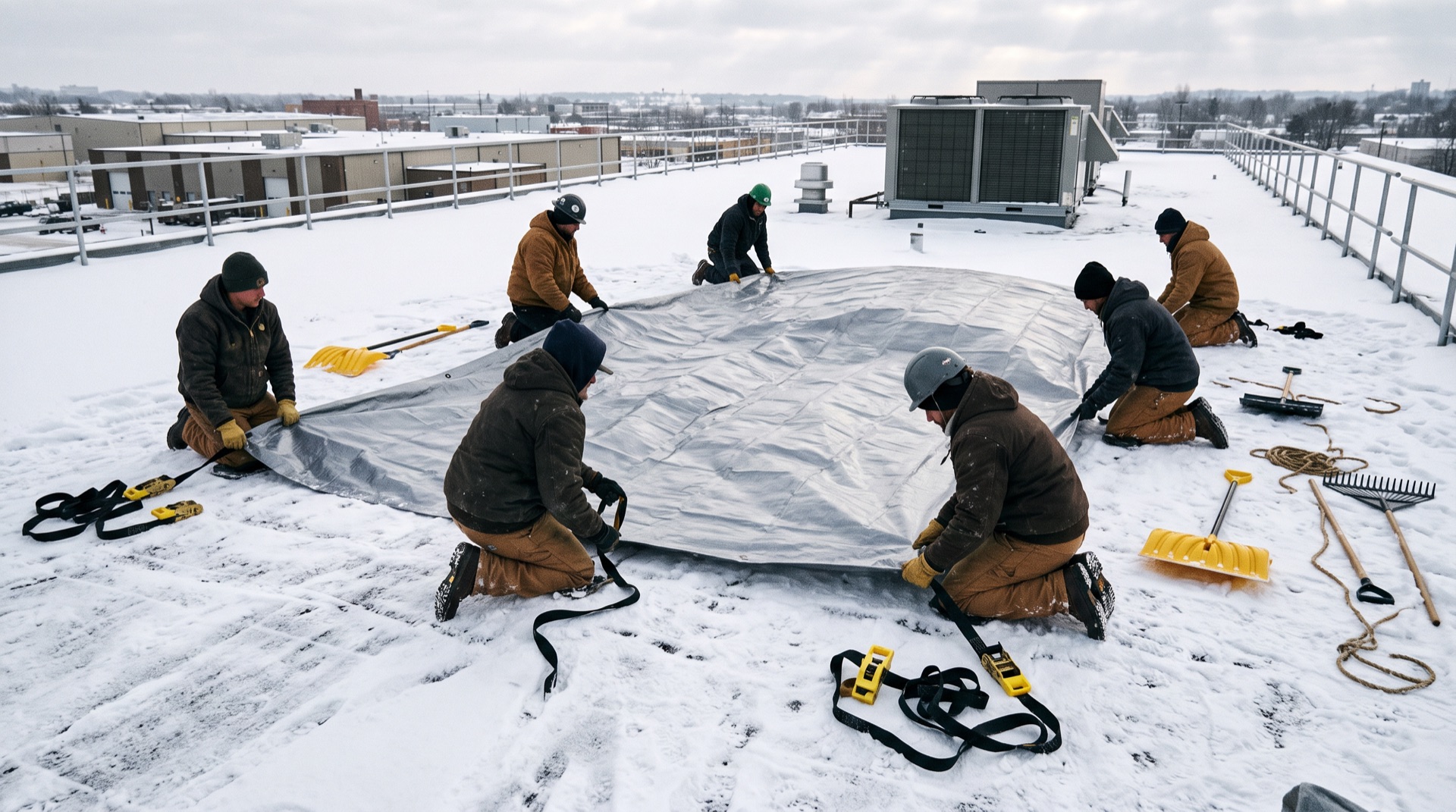
Rip-stop tarps are laid out and anchored on the deck, crews load them, and the boom lifts each loaded tarp clear and sets it down in a designated drop zone on the ground. Outrigger pads are placed on frozen ground rated for the load, and a pedestrian exclusion zone is set and marshalled for the whole operation.

It is a planned lift, not an improvisation. Site access, swing radius, overhead lines, drop zone and ground bearing all get walked before the first tarp goes down.

Documenting the load for the carrier

Depths, densities, calculated loads and dated photographs are recorded through the operation. Most carriers treat preventing an imminent structural failure as loss mitigation, which is a very different claim from one filed after a deck comes down.

That record is what supports it, and it only exists if somebody took the readings at the time.
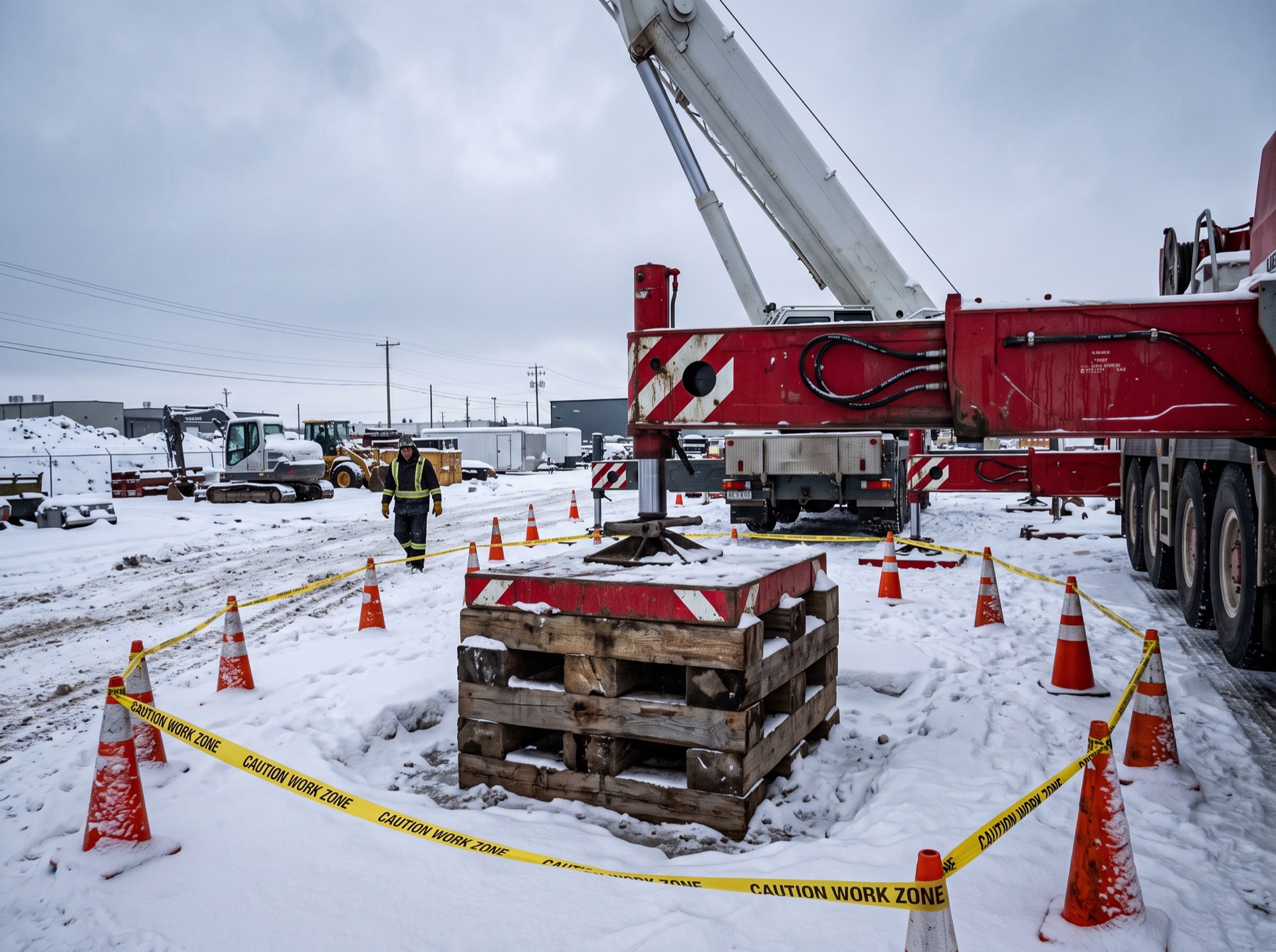
crane outrigger pad set on wood cribbing in snowy work zone
A crane outrigger rests on stacked wood cribbing surrounded by caution tape and traffic cones in winter conditions.

What you get in Farmington

  • Outrigger padsBearing pads sized and placed for frozen and uneven ground
  • Permits handledPulled where the municipality requires them for a street setup
  • Rip-stop tarp picksRated tarps and rigging, with lifts planned around the swing radius
Crane-Assisted Snow Removal in Farmington, MN — specification
Service specification for Farmington, MN
Coverage areaFarmington and Dakota County
Removal methodLow-pressure steam only. No chipping, salt or pressure washing.
Pricing modelBilled by the crew hour, rate quoted before dispatch
Primary climate stressorLake-effect bands, wet heavy pack
Local ice-barrier practiceEave membrane expected on re-roofs
ServiceCrane-Assisted Snow Removal in Farmington, MN
Typical scopeSteam, 6-12 crew hours typical

Neighborhoods and Towns We Reach From Farmington

Crews working Farmington cover the adjoining communities on the same route — Castle Rock, Vermillion, Hampton, Randolph and New Market — so a storm week usually means one truck handling several addresses in Dakota County rather than separate trips.

Nearest hub towns with their own crane snow removal pages: Rosemount, Lakeville, Apple Valley, Burnsville, Eagan, Savage.

During a cold snap Farmington gets worked alongside the neighboring Dakota County towns on the same route, with active interior leaks moved to the front of the list.

Most jobs do not stop at one service. Crane Snow Removal in Farmington often runs alongside commercial roof snow removal in Farmington, and both get written into one scope rather than billed as separate visits.

Active leak right now? Our 24/7 Farmington steam ice dam removal crews are dispatched first during a freeze event. Call (888) 561-9664.
Conditions We Work In

Crane-Assisted Snow Removal In Practice

Conditions crews work in across Dakota County. Every job is photographed before and after.

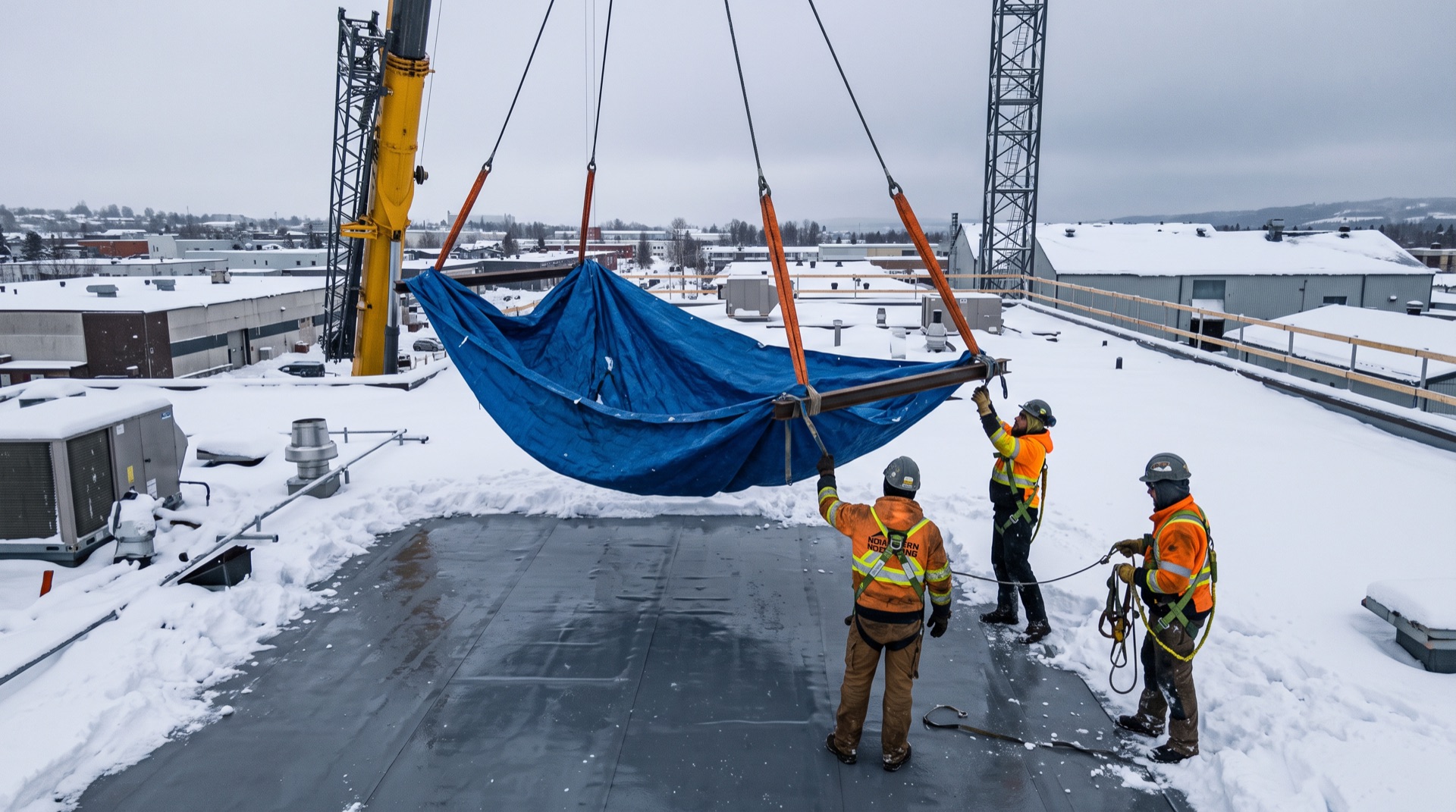
Three construction workers on snowy rooftop guiding empty blue tarp lowered by crane
Workers guide an empty blue tarp back onto the roof using a crane during winter roofing operations.
Six workers spreading a silver tarp across a snow-covered commercial rooftop
A six-person crew works together to secure a protective tarp over a snow-covered flat commercial roof.
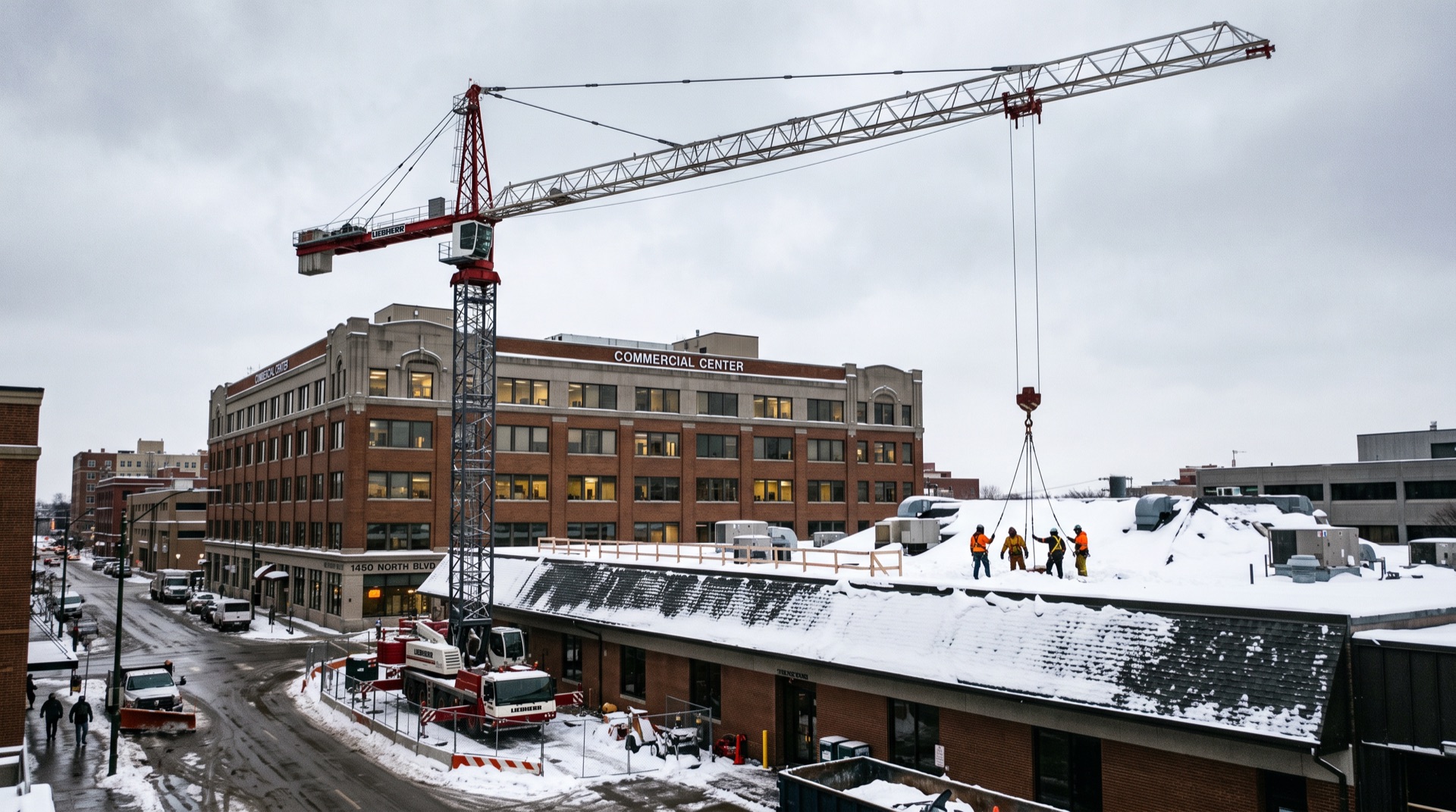
Liebherr tower crane boom extended over snow-covered building roof with workers below
Workers guide a Liebherr tower crane lifting operation on a snow-covered rooftop near the Commercial Center building.
FAQ

What Farmington Homeowners Ask First

It is billed by the crew hour, and the rate plus a realistic time estimate are quoted on the phone before anyone is dispatched.

  • Scope drives the hours: length and thickness of the ice, roof pitch and height, and whether the gutters are frozen solid.
  • Access matters too — a three-story Farmington roof takes longer to set up on than a ranch.
  • The invoice matches the quote. There are no surprise add-ons written on the tailgate.

Please do not. Salt corrodes flashing, fasteners, gutters and anything metal it drains across, and it damages whatever is planted below.

  • Calcium chloride is less aggressive than rock salt but still ends up in the soil at the drip line.
  • A puck melts a hole, not a drainage path, so the water simply refreezes a few inches further on.
  • Crews use heat and nothing else - no salt, no chemicals, nothing corrosive.

Because ice dams are made by heat loss, and two houses on the same street rarely leak heat the same way.

  • Attic air leaks around can lights, bath fans and the attic hatch are the usual source.
  • Crushed or missing soffit baffles stop the intake ventilation that would otherwise keep the deck cold.
  • An addition or dormer built over unheated space puts warm air right against a cold eave.
  • Local factor: lake-effect snow makes the difference show up faster here than it would further south.

No, but there is a worse one: after the thaw, when the evidence has melted and the damage is all that is left.

  • Mid-storm calls are fine — crews work through freeze events.
  • An evening call for a leak that started that afternoon usually gets a next-morning slot.
  • Waiting for a weekend to pass is the most common and most expensive delay.

Same day or next morning for most Farmington calls, with active interior leaks moved to the front of the schedule.

  • During a freeze event crews run from first light until dark across Dakota County.
  • The same route covers Castle Rock, Vermillion, Hampton, so several addresses are usually handled in one run.
  • Call rather than using the form if water is coming in — the phone is always faster.

Setup and breakdown are a fixed cost of several hours whatever the roof. The lifting itself depends on how much material there is and how quickly the crew can cut it into liftable sections. A large deck that would be several crew-days by hand is commonly an afternoon once the crane is rigged.

Enough to set outriggers fully, which is wider than the machine looks, plus clearance to the building and a unobstructed swing path. That is established on a site walk before anything is booked rather than discovered on the morning. Overhead power lines are frequently the deciding factor.

Nearby

Crane Snow Removal In Towns Around Farmington

Same-Day Response

Get A Farmington Crew Out

The cost of a steam visit does not change much from one week to the next. The cost of the water damage behind the dam does.

✓ Licensed & insured✓ Low-pressure steam only✓ Rate quoted up front✓ Photos for your claim
Online Quote(888) 561-9664