Every Monroe winter produces the same two calls: the ones who see the ice early, and the ones who see the ceiling stain first. As part of our complete Monroe winter roof services, crews handle water mitigation & dryout across Monroe County.
Why Monroe Roofs Dam Up: Cycling, Not Snowfall Totals
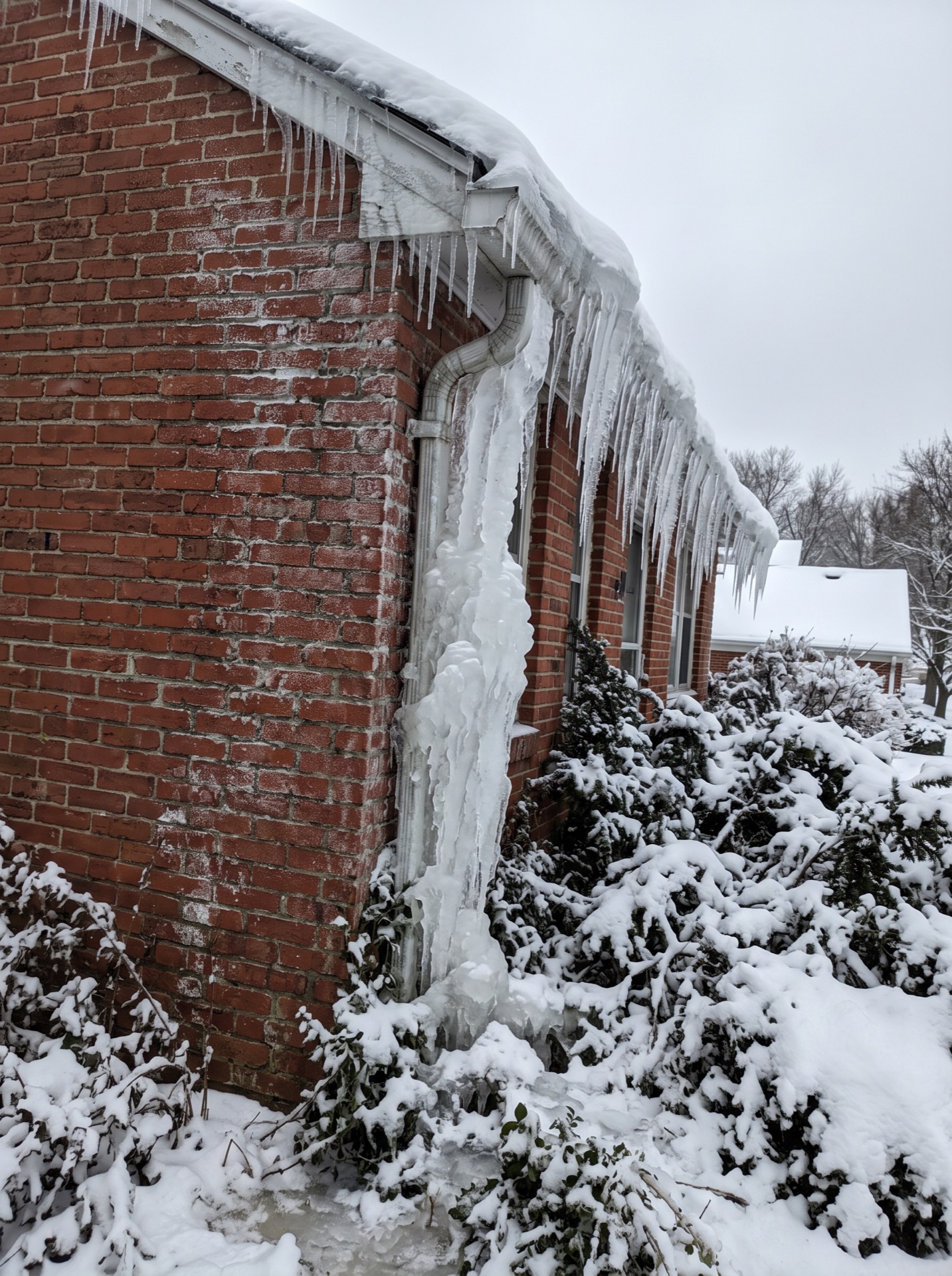
The snow totals here are unremarkable, which is exactly why Monroe roofs get caught out. An ice dam needs meltwater and a cold eave, not a record storm.

The building stock has no margin for it. Because the winters here read as mild, attics tend to be under-insulated, eave details are less considered, and ice barrier is as often absent as present on a roof in Monroe.
Ice-barrier practice in Monroe County
Ice-barrier membrane at the eaves is required on new work under the residential code Michigan follows, but on a roof built before that it is frequently absent — and this is the region where it is most often skipped.
Water Mitigation & Dryout in Monroe: How The Work Runs
Where the water actually went
Thermal imaging and meters find it, because the visible stain is usually the smallest part. Water tracks along top plates, down stud bays and across ceiling planes, and it collects in places with no stain at all — behind knee walls, above soffits, inside cathedral ceiling cavities with no access. Wet Insulation in the Attic.
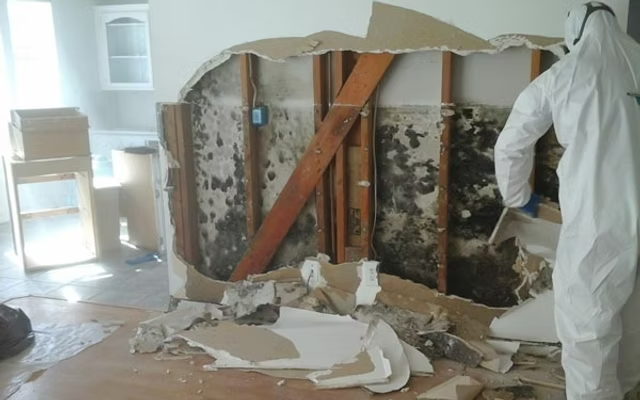
Where opening up finds mold, the work moves under containment and becomes mold remediation. Either way the same company puts the room back together afterward.
Why a cold attic will not dry itself
Drying is evaporation, and evaporation needs warmth and air movement. A Monroe attic in February has neither. Wet insulation and damp sheathing sit at near-freezing with no meaningful vapor drive, which is why a leak that stops in January can still be wet in March.
Equipment supplies what the season does not. Without it the structure is not drying slowly - in a cold cavity it is very largely not drying at all.
Containment before tear-out
Where drywall or insulation has to come out, barriers go up and HEPA scrubbers run inside them. That keeps the dust and whatever is growing in the wet material out of the rest of the house.
It also keeps the job to one room rather than the whole floor, which on an occupied Monroe home is the difference between staying and moving out.
Finding the water that left no stain
The visible mark on a ceiling is the smallest part of the problem. Water tracks along top plates, runs down stud bays, and spreads across a ceiling plane well past where it finally shows.
Thermal imaging and pin meters find it. On a job in Monroe the mapped wet area is routinely several times the size of the stain, and drying the stain alone leaves the rest to go moldy quietly.
Why wet insulation comes out rather than dries
Saturated cellulose and fiberglass hold water against framing and sheathing for weeks, and in a cold attic there is no air movement to carry it off. It also stops insulating, which warms the deck and feeds the next dam.
So it comes out. On an attic in Monroe that is usually the single biggest step toward the structure actually drying.

What you get in Monroe
- Hidden water mappedThermal imaging and pin meters find what left no stain
- Electrical made safeCircuits killed where water reached fixtures, before equipment goes in
- Wet insulation removedIt cannot be dried in place and it holds water against the framing
| Billing | Xactimate line items on one claim; carrier billed directly where the policy allows |
|---|---|
| Documentation | Dated before and after photos, written scope in Xactimate line items |
| Dispatch window | Same day to 24 hours |
| Method | Containment, HEPA filtration and drying to a measured IICRC standard |
| Service | Water Mitigation & Dryout in Monroe, MI |
| Local ice-barrier practice | Eave membrane on new work, often absent |
| Coverage area | Monroe and Monroe County |
Monroe County Coverage From Monroe
Crews working Monroe cover the adjoining communities on the same route — La Salle, Newport, Luna Pier, Carleton and Maybee — so a storm week usually means one truck handling several addresses in Monroe County rather than separate trips.
Nearest hub towns with their own water mitigation pages: Southgate, Taylor, Ypsilanti, Lincoln Park, Dearborn Heights, Westland.
During a cold snap Monroe gets worked alongside the neighboring Monroe County towns on the same route, with active interior leaks moved to the front of the list.
Most jobs do not stop at one service. Water Mitigation in Monroe often runs alongside ice dam removal in Monroe, and both get written into one scope rather than billed as separate visits.
Active leak right now? Our 24/7 Monroe steam ice dam removal crews are dispatched first during a freeze event. Call (888) 561-9664.