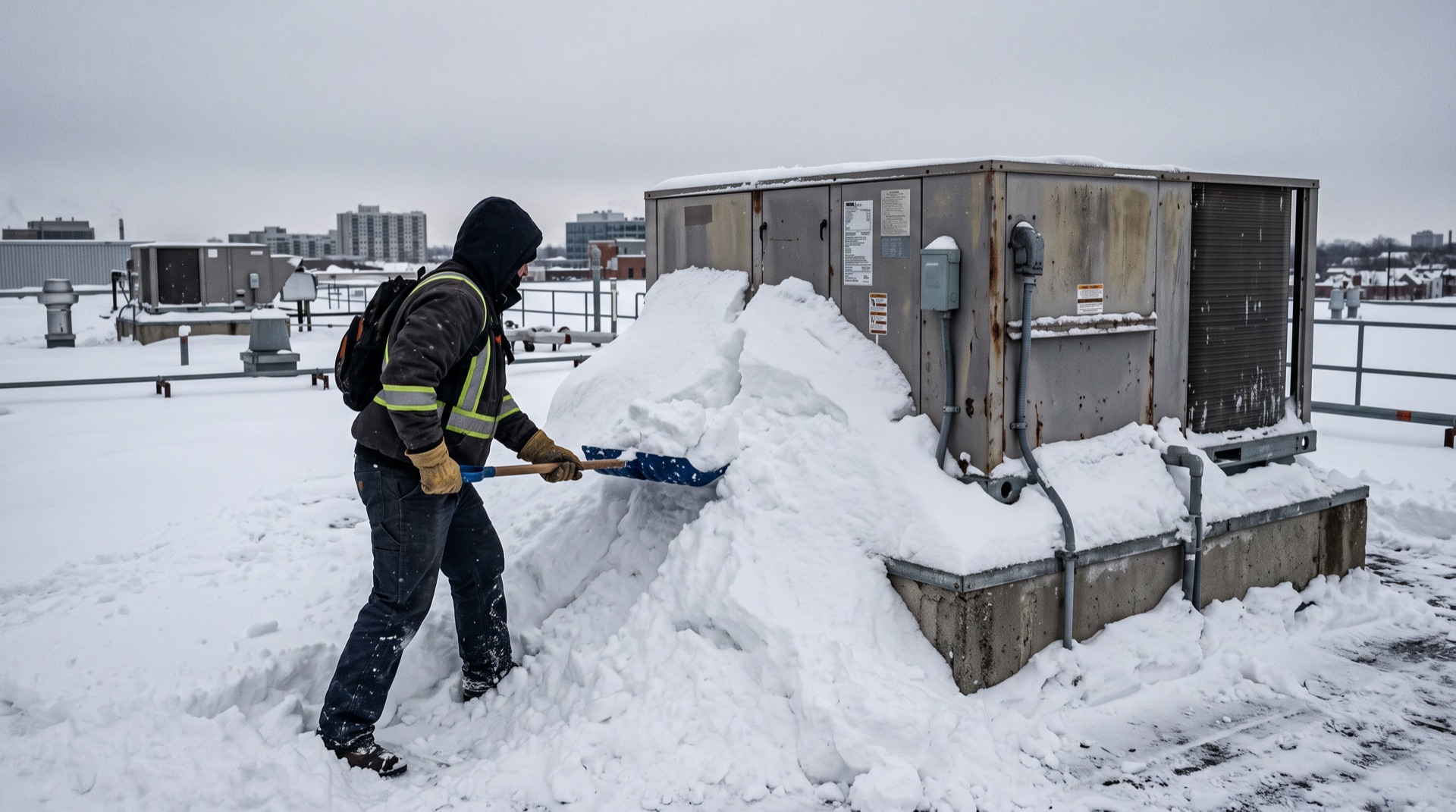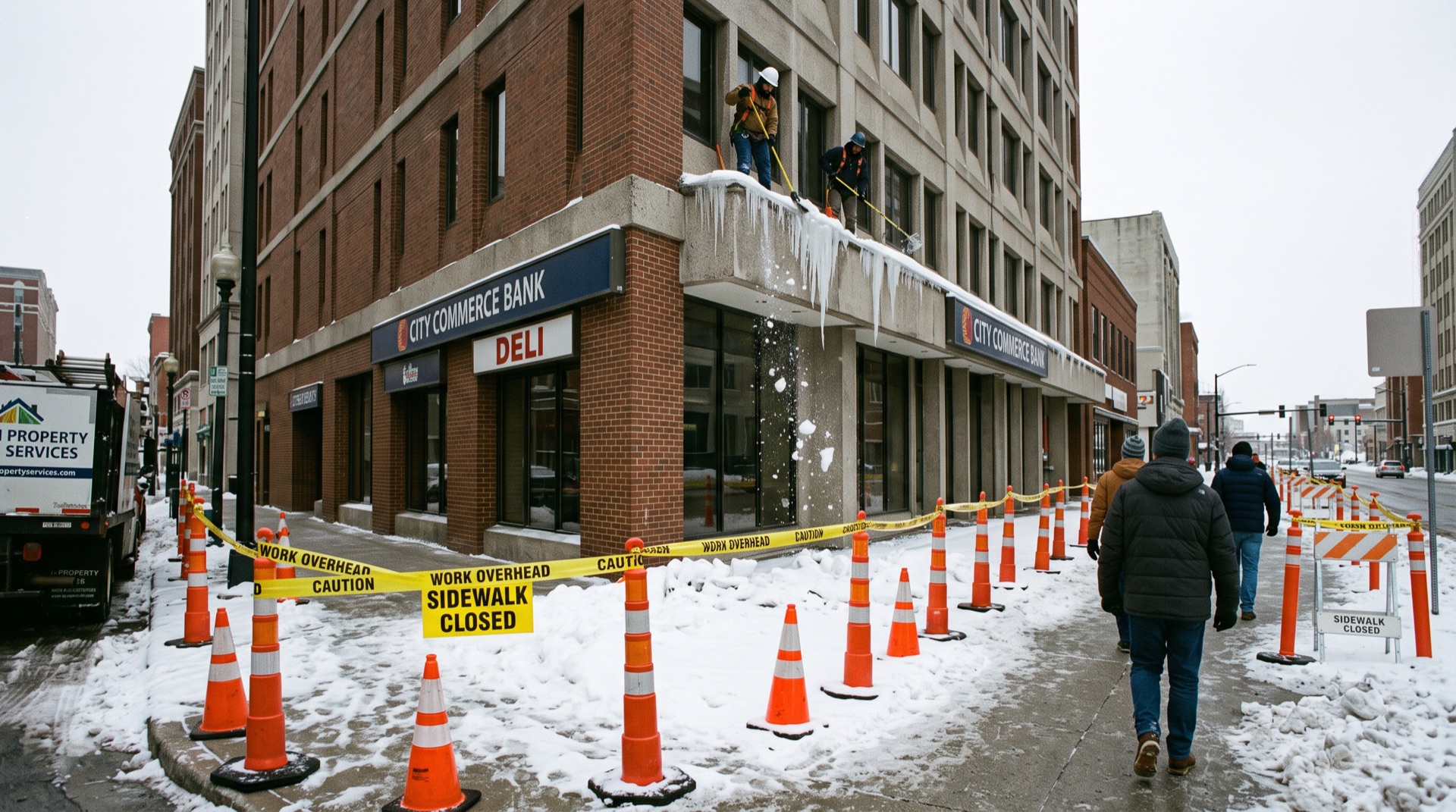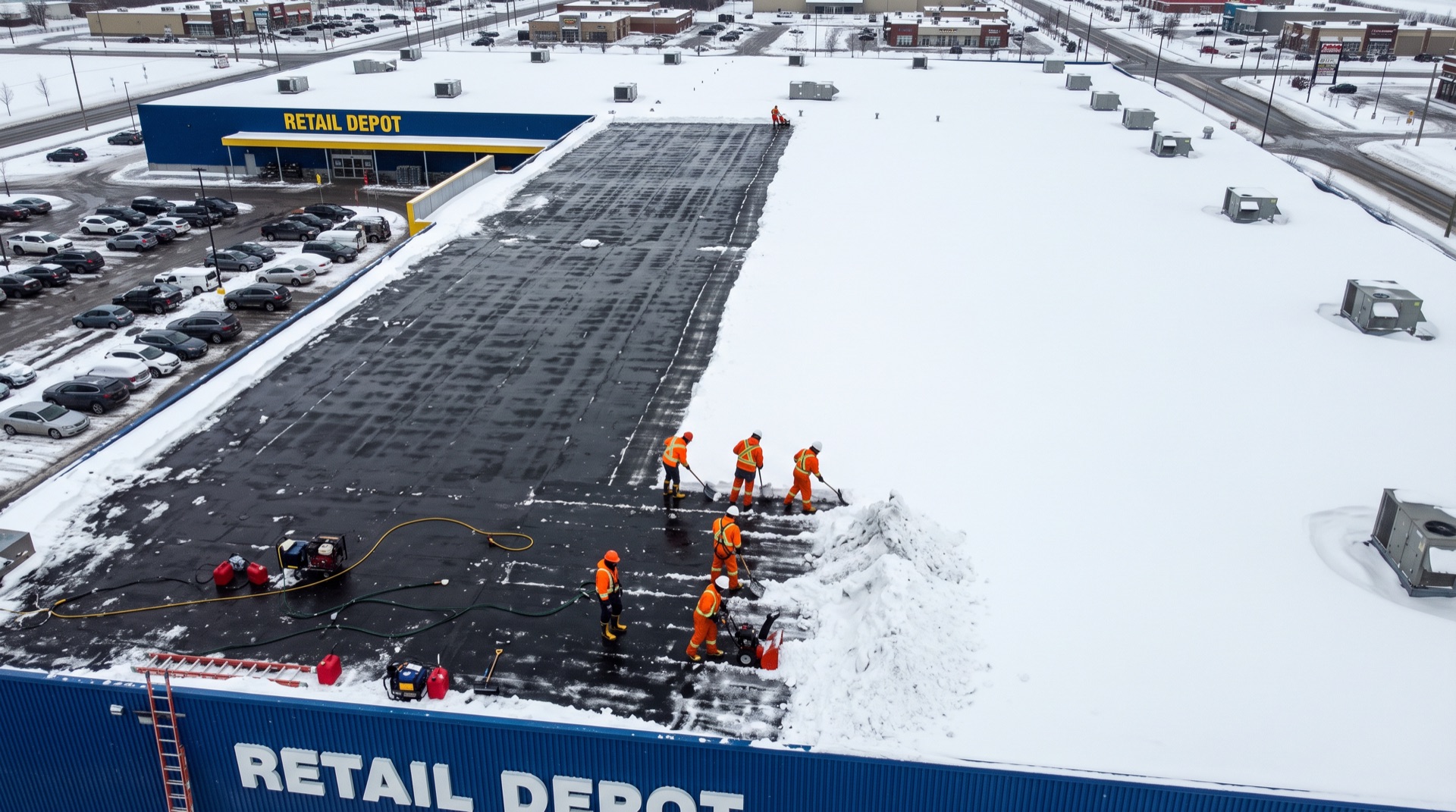
Most Peabody homeowners find out about an ice dam from the inside — a damp patch on a bedroom ceiling, or water tracking down the inside of a window frame. As part of our complete Peabody winter roof services, crews handle commercial roof snow removal across Essex County.
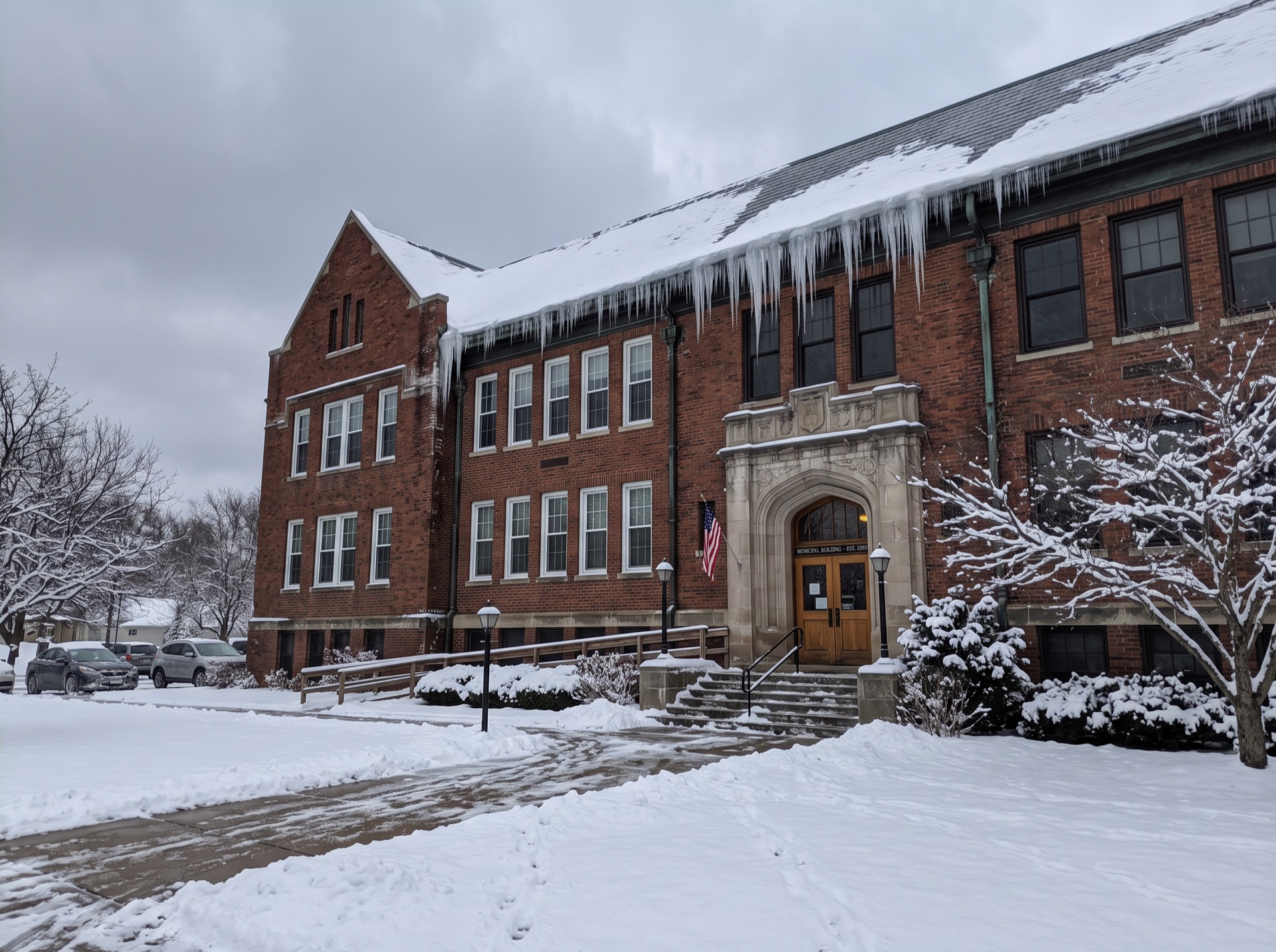
Wet Snow, Swinging Air: Peabody Ice Dams
Coastal storms deliver the heaviest snow by weight. A single nor'easter can put a wet, dense pack on a roof in Peabody in one night, and the maritime air that follows rarely stays on one side of freezing for long.

Then there is the architecture. Peabody has a great deal of older housing with shallow eave returns, knee-wall attics and rooms built out over porches, all of which put heated air against cold deck with very little between.
Ice-barrier practice in Essex County
Historic district review in parts of Essex County adds a step on materials and sometimes on color, which is worth knowing before a re-roof is scheduled rather than after the permit is refused.
Commercial Roof Snow Removal in Peabody: How The Work Runs
Reduction, not bare deck
The goal is to bring the load under threshold safely, not to scrape a roof in Peabody clean. Clearing is balanced across the deck so load is not shifted onto one bay, drains and scuppers are opened so melt has an exit, and a cushion layer always stays on the membrane. Ceiling Sagging or Bulging After Snow.
Where the figures call for it, crews bring in crane-assisted picks instead of adding bodies to a roof that is already carrying too much.
Ponding after the clear
Taking the snow off a flat roof with frozen drains leaves meltwater with nowhere to go, and water that ponds and refreezes puts load back on a deck that was just relieved.
So drains and overflows are opened as part of the clear rather than afterwards, and the roof is left draining. A clear that stops at the snow is half a job.
Reduction to a threshold, not a bare deck
The goal is bringing the load under the structure's capacity safely, with a cushion layer left on the membrane throughout.
Scraping a commercial Peabody roof to bare membrane costs more, takes longer and risks the roof covering for no structural benefit.
Reading the design load off the drawings
Where structural drawings exist they state the design ground snow load and the roof's own capacity, and that number turns the whole question from opinion into arithmetic. Measured depth and density against design capacity gives a percentage rather than an argument.
Where the drawings have been lost - common on older Peabody stock - the conservative assumption is the code minimum of the era the building went up, which is usually well below what a modern roof would be built to.
The cost of a shutdown against the cost of a clear
Clearing a large deck is a real number and it is easy to defer. The comparison that matters is not clearing against nothing, it is clearing against the day the building is closed while an engineer inspects it - lost trade, displaced tenants, and an insurer asking what was done beforehand.
The load reading is what makes that decision for you rather than a feeling about how deep the snow looks.
What you get in Peabody
- Portfolio routesStanding storm schedules with per-visit condition reports
- Drift-point surveyDepth and density measured where it collects, not where it is convenient
- Overflows opened firstDrains and scuppers cleared before the load comes off
| Removal method | Low-pressure steam only. No chipping, salt or pressure washing. |
|---|---|
| Typical scope | Steam, 4-10 crew hours typical |
| Dispatch window | Same day to 24 hours |
| Pricing model | Billed by the crew hour, rate quoted before dispatch |
| Local ice-barrier practice | Eave membrane standard on re-roofs |
| Documentation | Dated before and after photos, written scope in Xactimate line items |
| Coverage area | Peabody and Essex County |
Essex County Coverage From Peabody
Crews working Peabody cover the adjoining communities on the same route — Lynnfield, Hathorne, Swampscott, Middleton and Marblehead — so a storm week usually means one truck handling several addresses in Essex County rather than separate trips.
Nearest hub towns with their own commercial snow pages: Danvers, Salem, Beverly, Lynn, Saugus, Melrose.
When a storm hits Essex County, crews are dispatched by severity rather than by call order — water already inside the house goes first.
Most jobs do not stop at one service. Commercial Snow in Peabody often runs alongside crane-assisted snow removal in Peabody, and both get written into one scope rather than billed as separate visits.
Active leak right now? Our 24/7 Peabody steam ice dam removal crews are dispatched first during a freeze event. Call (888) 561-9664.