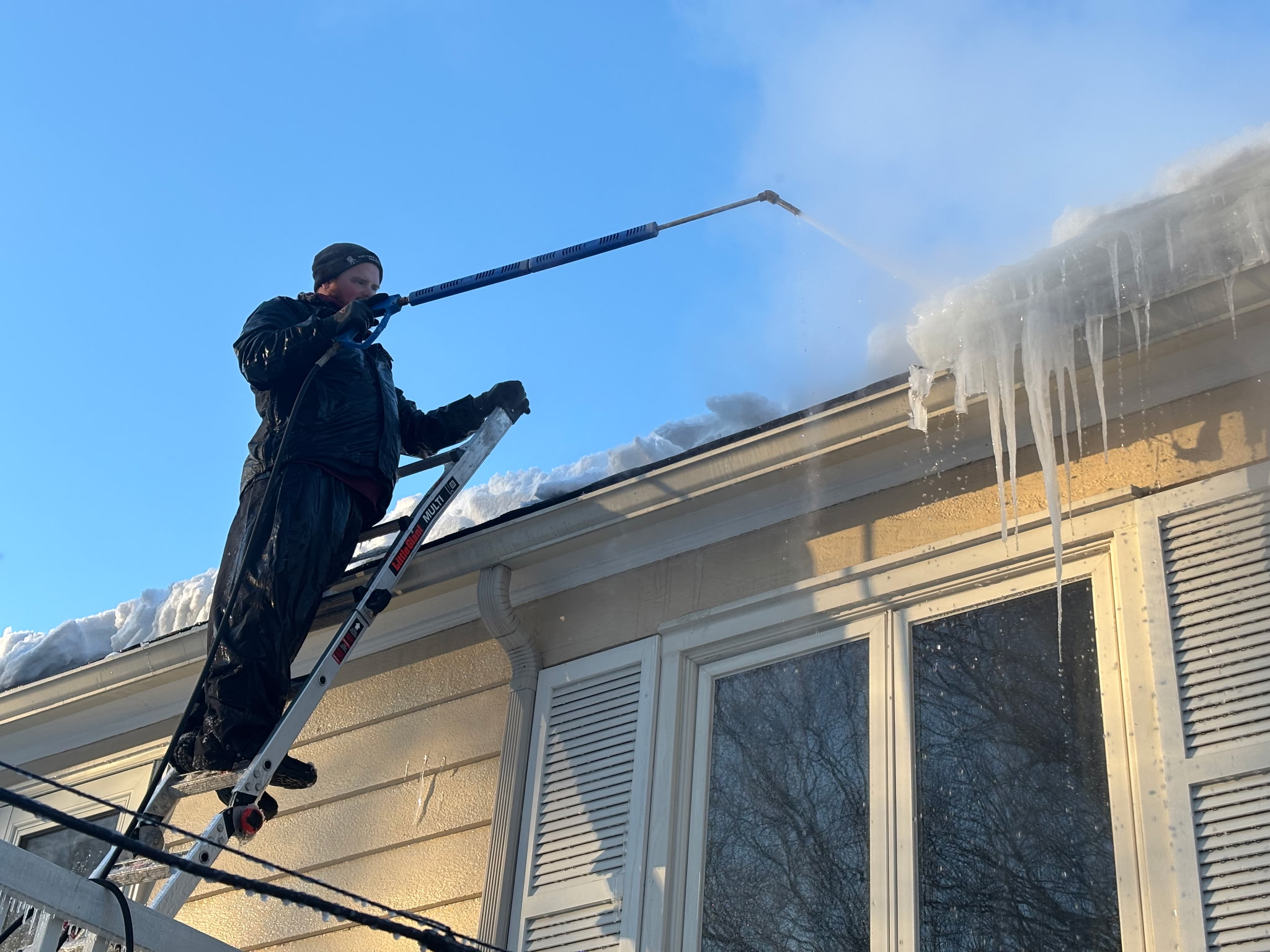
A Lowell roof can look fine from the driveway and still be backing water under the shingles at the eave, where nobody can see it. As part of our complete Lowell winter roof services, crews handle roof snow removal across Middlesex County.
Why a Lowell Roof Dams Between Storms
Middlesex County gets the worst combination for ice: snow with high water content, followed by temperatures that oscillate rather than settle. The pack does not stay frozen and it does not drain.

Older Middlesex County housing stock makes it worse. Shallow eave returns, knee-wall attics and additions built over unheated space all put warm air against a cold roof deck with very little insulation in between.
Ice-barrier practice in Middlesex County
Most Middlesex County towns require self-adhering ice barrier at the eaves on a re-roof permit. In a historic district there may be additional review on materials, which is worth checking before work is scheduled.
Roof Snow Removal in Lowell: How The Work Runs
Clearing the eaves is what matters
The first three to six feet above the gutter line is where dams build, because that strip of roof sits past the heated part of the house. Taking the snow off that band removes the meltwater supply before the next thaw-freeze cycle can turn it into ice. Ceiling Sagging or Bulging After Snow.
Crews work from the ground with extended rakes wherever the pitch and height allow, and from the roof with harnesses and anchors when they do not. A cushion layer of snow is always left behind on the surface, because a rake run hard against bare shingle does its own damage.
How much of the roof actually needs clearing
Rarely all of it. The band that matters is the lower three to six feet above the gutter, because that is the strip sitting past the heated envelope where meltwater refreezes.
On a roof in Lowell with no load concern, clearing that band and the valleys is usually the whole job. Scraping the full plane costs more, takes longer, and buys very little extra.
Wet snow, dry snow and what the weight actually is
Depth tells you very little on its own. Light powder runs around seven pounds per cubic foot; old settled snow two or three times that; the saturated layer sitting at the bottom of a pack after a thaw can approach the weight of standing water. Two roofs in Lowell under the same twenty inches can be carrying loads that differ by a factor of four.
Crews take a core and weigh it rather than guessing from the ruler, because that measurement is what decides whether a roof is near its limit or nowhere close.
Rain on top of snow
A warm rain onto a deep pack is the loading case that puts roofs on the news. The snow absorbs the rain instead of shedding it, the drains and gutters are still frozen, and the load can climb sharply within hours while the depth barely changes.
When that forecast appears over Middlesex the priority order changes: large flat spans and anything already carrying a deep pack get cleared ahead of the line, before the rain rather than after it.
Why the second storm is the dangerous one
A roof usually carries the first storm without trouble. The problem is that the first pack settles, hardens and stops sliding, so the second storm lands on a base that is not going anywhere and the third has nowhere to go at all.
That is why clearing between storms is worth more than clearing after the whole sequence: each clear resets the base, and the roof never gets to the compounded load in the first place.

What you get in Lowell
- Paths cleared behind usDriveways and walks are not left buried when the crew leaves
- Surface never touchedA cushion layer is left so the rake never rides on bare shingle
- Drift points measuredDepth read where snow collects, not in the middle of the field
| Removal method | Low-pressure steam only. No chipping, salt or pressure washing. |
|---|---|
| Coverage area | Lowell and Middlesex County |
| Primary climate stressor | Nor'easters, rapid thaw-freeze swing |
| Pricing model | Billed by the crew hour, rate quoted before dispatch |
| Local ice-barrier practice | Eave membrane standard on re-roofs |
| Typical scope | Steam, 4-10 crew hours typical |
| Documentation | Dated before and after photos, written scope in Xactimate line items |
Neighborhoods and Towns We Reach From Lowell
Crews working Lowell cover the adjoining communities on the same route — North Chelmsford, North Billerica, Tyngsboro, Westford and Nutting Lake — so a storm week usually means one truck handling several addresses in Middlesex County rather than separate trips.
Nearest hub towns with their own roof snow removal pages: Dracut, Chelmsford, Tewksbury, Andover, Billerica, Lawrence.
During a cold snap Lowell gets worked alongside the neighboring Middlesex County towns on the same route, with active interior leaks moved to the front of the list.
Most jobs do not stop at one service. Roof Snow Removal in Lowell often runs alongside ice dam removal in Lowell, and both get written into one scope rather than billed as separate visits.
Active leak right now? Our 24/7 Lowell steam ice dam removal crews are dispatched first during a freeze event. Call (888) 561-9664.