Winter in Auburn does not need a record storm to put water inside a house. It needs a roof with snow on it, an attic leaking heat, and one cold night. As part of our complete Auburn winter roof services, crews handle water mitigation & dryout across Androscoggin County.
Why Auburn Roofs Dam Up: Deep Cold and a Long Snow Season
Snow that falls on a roof in Auburn in December tends to stay there. A pack that never fully clears is a pack that keeps feeding meltwater to the same eave for months on end.

A long season is not a safer one. It means more freeze-thaw cycles, and each one adds a layer to the dam. By late winter the ice at an Androscoggin County eave can be a foot deep and locked to the shingle, with standing water sitting behind it.
Ice-barrier practice in Androscoggin County
Because the ice here does not stay near the edge, the Maine requirement generally runs the membrane well up the roof plane. On a house in Auburn roofed a few decades ago it is frequently missing entirely.
Water Mitigation & Dryout in Auburn: How The Work Runs
When the dryout finds mold
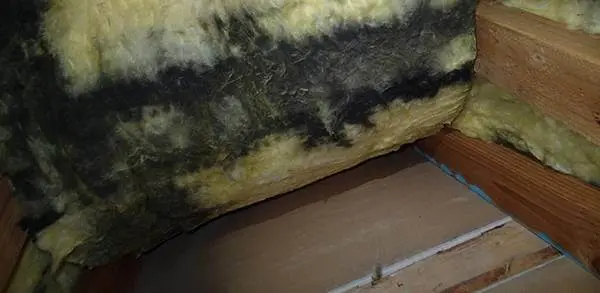
Opening a ceiling or a wall below an ice dam leak often finds growth that was not visible from the room: on the back of the drywall, on the top plate, or on the roof sheathing above. Wet Insulation in the Attic.
When it does, the work moves under containment and becomes mold remediation, written into the same claim. It is far cheaper to find it now than after the room has been closed up and repainted.
Why a cold attic will not dry itself
Drying is evaporation, and evaporation needs warmth and air movement. A Auburn attic in February has neither. Wet insulation and damp sheathing sit at near-freezing with no meaningful vapor drive, which is why a leak that stops in January can still be wet in March.
Equipment supplies what the season does not. Without it the structure is not drying slowly - in a cold cavity it is very largely not drying at all.
Contents, storage and what moves out of the way
Mitigation needs the room. Furniture gets blocked up or moved, stored boxes come out of the affected area, and in a finished basement the contents usually have to leave entirely before tear-out starts.
What is already wet gets photographed and listed as it is moved, because contents are a separate part of most policies and the list is considerably harder to assemble once everything has been shifted.
Containment before tear-out
Where drywall or insulation has to come out, barriers go up and HEPA scrubbers run inside them. That keeps the dust and whatever is growing in the wet material out of the rest of the house.
It also keeps the job to one room rather than the whole floor, which on an occupied Auburn home is the difference between staying and moving out.
Where the water actually went
Thermal imaging and meters find it, because the visible stain is usually the smallest part. Water tracks along top plates, down stud bays and across ceiling planes, and it collects in places with no stain at all — behind knee walls, above soffits, inside cathedral ceiling cavities with no access.
Where opening up finds mold, the work moves under containment and becomes mold remediation. Either way the same company puts the room back together afterward.

What you get in Auburn
- Hidden water mappedThermal imaging and pin meters find what left no stain
- Documented to standardDaily moisture readings until the structure meets IICRC S500 dry standard
- Interior repair in-houseDrywall, insulation, texture, trim and paint put back by the same company
| Method | Containment, HEPA filtration and drying to a measured IICRC standard |
|---|---|
| Service | Water Mitigation & Dryout in Auburn, ME |
| Local ice-barrier practice | Eave membrane required on new work |
| Dispatch window | Same day to 24 hours |
| Billing | Xactimate line items on one claim; carrier billed directly where the policy allows |
| Interior repair | Insulation, drywall, texture, trim and paint, done in-house after drying |
| Coverage area | Auburn and Androscoggin County |
Where We Dispatch Around Auburn
Crews working Auburn cover the adjoining communities on the same route — Minot, Danville, East Poland, Mechanic Falls and Lisbon — so a storm week usually means one truck handling several addresses in Androscoggin County rather than separate trips.
Nearest hub towns with their own water mitigation pages: Lewiston, Brunswick, Windham, Bath, Augusta, Westbrook.
Coverage runs across Auburn and the nearby towns all winter, and capacity is surged into whichever Maine market the storm actually hits.
Most jobs do not stop at one service. Water Mitigation in Auburn often runs alongside ice dam removal in Auburn, and both get written into one scope rather than billed as separate visits.
Active leak right now? Our 24/7 Auburn steam ice dam removal crews are dispatched first during a freeze event. Call (888) 561-9664.