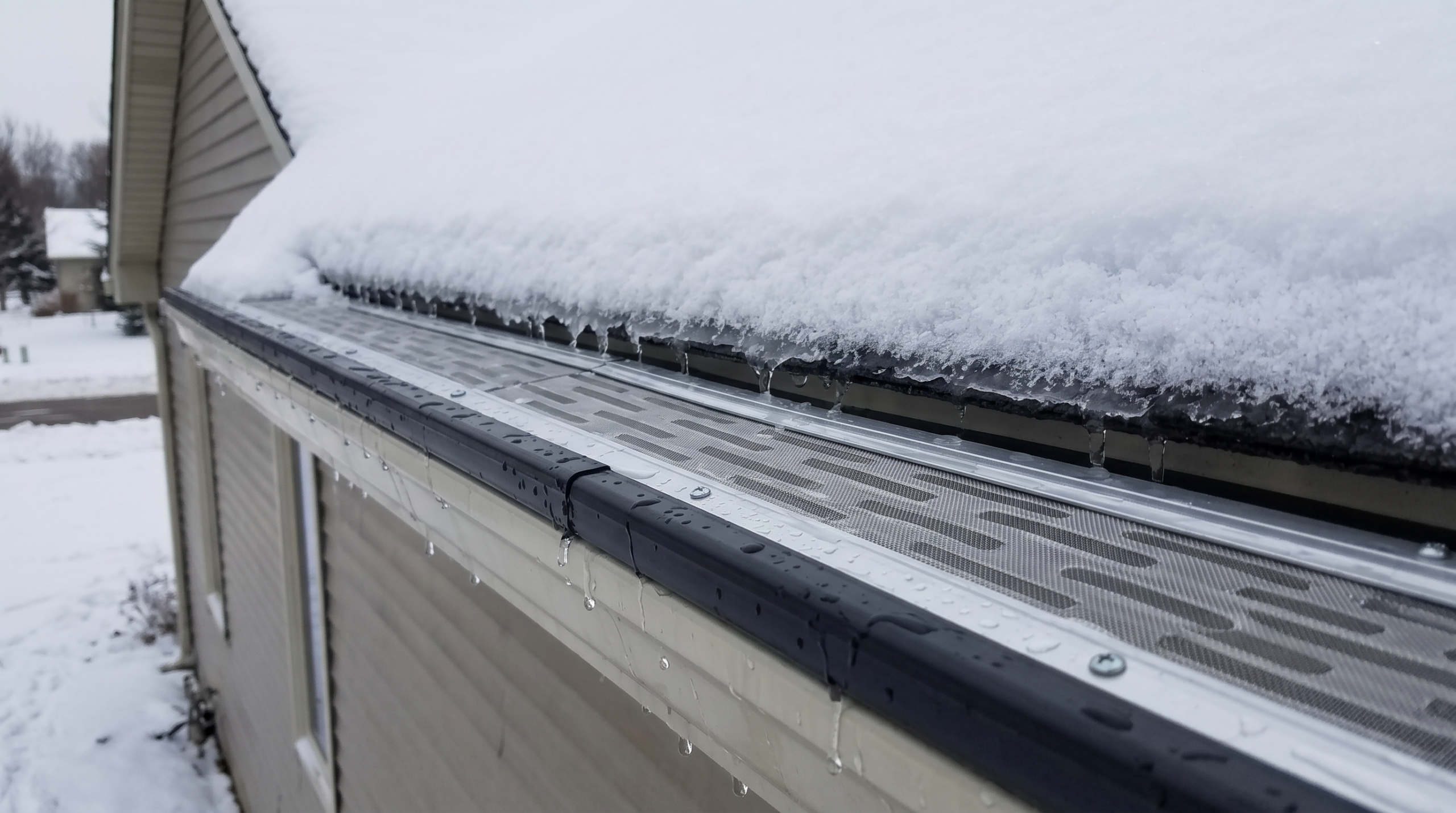
Lake County sees the same pattern every winter: snow on the roof, warm air in the attic, and a line of ice building along the eave where the two meet. As part of our complete North Chicago winter roof services, crews handle ice dam removal across Lake County.
Why North Chicago Roofs Dam Up: Cycling, Not Snowfall Totals
An ice dam needs meltwater and a cold eave, and North Chicago supplies both on an ordinary week. A thin cover that melts by lunchtime and sets again after dark is a perfectly good dam factory.

Because the winters read as mild, the building stock is not built for ice. Attic insulation is thinner, eave details are less considered, and ice barrier is more often absent than present on a roof in North Chicago.
Ice-barrier practice in Lake County
Ice-barrier membrane at the eaves is required on new work under the residential code Illinois follows, but on a roof built before that it is frequently absent — and this is the region where it is most often skipped.
Ice Dam Removal in North Chicago: How The Work Runs
Why the gutter has to be cleared in the same visit
A dam sitting above a gutter packed solid with ice is only half the problem. Clear the eave and leave the trough frozen, and the next day's meltwater has nowhere to run — it backs up onto the roof and the dam rebuilds from the bottom. Water Stain on the Ceiling in Winter.
Crews steam the trough and the downspout through to daylight on the same visit. It adds time, which is why the hour estimate given on the phone accounts for it, and it is the difference between a fix and a repeat visit in North Chicago the following week.
Dormers, valleys and dead spots
Ice does not distribute evenly. It concentrates where two roof planes meet, behind dormers, in dead valleys that drain nowhere, and along the north face that never sees sun. Those pockets hold water deepest and leak first.
A crew working a roof in North Chicago clears the full eave line and then goes back through the valleys and dormer pockets specifically, because clearing the easy straight run and calling it done is how a roof leaks again a week later.
What happens after the ice is off
Once the eave is clear and water is draining, the crew walks the interior with you where there is visible damage and says plainly whether it needs drying. Wet insulation and a damp ceiling cavity do not resolve themselves in a cold North Chicago February.
If it does, that is a separate scope and it gets written separately — nobody is upsold a dryout on the strength of one damp patch.
How long a removal actually takes
A single-story eave with a thin dam and clear gutters is often an hour or two. A two-story North Chicago house with ice standing a foot deep across the front, frozen downspouts and a valley packed solid is most of a day for a two-man crew. The honest answer on the phone is a range and the reason for it, not a number designed to win the booking.
The estimate is revised out loud if the roof turns out worse than it looked from the ground, before the extra hours are worked rather than after they appear on the invoice.
Why salt and ice melt make it worse
Calcium chloride opens a narrow channel and leaves the dam standing. The channel refreezes, the dam does not go anywhere, and in the meantime the runoff corrodes gutter seams, fasteners, flashing and anything growing underneath.
It is a stopgap at best. On a roof in North Chicago with an active leak it buys hours, not days, and it adds a corrosion problem to the water problem.

What you get in North Chicago
- Valleys and dormersThe dead spots that hold the deepest ice get worked specifically
- No salt, no chippingNothing corrosive and nothing mechanical touches the covering
- Gutters cleared tooTrough and downspout steamed through to daylight in the same visit
| Primary climate stressor | Repeated thaw-freeze cycling |
|---|---|
| Local ice-barrier practice | Eave membrane on new work, often absent |
| Pricing model | Billed by the crew hour, rate quoted before dispatch |
| Dispatch window | Same day to 24 hours |
| Coverage area | North Chicago and Lake County |
| Service | Ice Dam Removal in North Chicago, IL |
| Typical scope | Steam, 4-8 crew hours typical |
Neighborhoods and Towns We Reach From North Chicago
Crews working North Chicago cover the adjoining communities on the same route — Great Lakes, Lake Bluff, Lake Forest, Libertyville and Fort Sheridan — so a storm week usually means one truck handling several addresses in Lake County rather than separate trips.
Nearest hub towns with their own ice dam removal pages: Waukegan, Gurnee, Mundelein, Highland Park, Deerfield, Buffalo Grove.
During a cold snap North Chicago gets worked alongside the neighboring Lake County towns on the same route, with active interior leaks moved to the front of the list.
Most jobs do not stop at one service. Ice Dam Removal in North Chicago often runs alongside water mitigation & dryout in North Chicago, and both get written into one scope rather than billed as separate visits.
Active leak right now? Our 24/7 North Chicago steam ice dam removal crews are dispatched first during a freeze event. Call (888) 561-9664.