Skip to content
Boulder, CO
Structural Snow Load · Boulder County

Commercial Roof Snow Removal in Boulder, CO — Mountain Storm Response

Ice Dam Now is a licensed and insured winter roof contractor covering Boulder, CO and Boulder County. Commercial Roof Snow Removal is performed with low-pressure steam, which removes ice by heat rather than force. Same-day dispatch for active leaks, crew-hour billing at a rate quoted beforehand, and dated before-and-after photographs on every job.

Portfolio routes — Standing storm schedules with per-visit condition reports
Overflows opened first — Drains and scuppers cleared before the load comes off
Mid-span measured — Depth read over the longest unsupported span, not the average
One invoice per site — Multi-building properties scoped and billed together

Get Ice Dam Help Boulder

A few quick questions, then pick a time. If water is coming in, call instead.

What is the zip code of the home?

Roof leaking right now? Call (888) 561-9664 — that is faster than any form.
Water coming through the ceiling?Every hour an ice dam sits there, more water gets under the shingles.Call (888) 561-9664
Same Day
For Water Already Inside
Steam
Safe On Every Covering
Boulder
County Coverage
Insured
Harness-Certified On Every Roof
Written
Scope Before Work Starts

A Boulder roof can look fine from the driveway and still be backing water under the shingles at the eave, where nobody can see it. As part of our complete Boulder winter roof services, crews handle commercial roof snow removal across Boulder County.

Why Boulder Roofs Dam on Days It Never Thaws

The pack at this elevation is deep enough to act as its own insulation, which means the surface melts under sun while the base stays locked. Water released at the top has to travel through and under all of it.

Diagram showing how ice dams form on a roof from heat loss and snow melt
Heat escaping into the attic melts roof snow; the meltwater refreezes at the cold eave and the dam grows a layer every cycle.

Aspect decides everything here. The sunny plane sheds water that the shaded plane and the shaded eave then lock up, so one side of a roof in Boulder is clear while the other carries a wall of ice.

Ice-barrier practice in Boulder County

Design snow loads in Boulder County are among the highest anywhere, and the membrane and retention requirements that go with them are not formalities. On an older Boulder cabin or chalet neither may be present.

Commercial Roof Snow Removal in Boulder: How The Work Runs

Why large decks carry the most risk

A long-span steel or open-web joist roof has the least margin exactly where the drift is deepest — mid-span. Snow does not settle evenly either: it piles against parapets, behind rooftop units, in the lee of higher adjoining roofs, and in valleys between bays. The average depth across the roof is not the number that matters. Ceiling Sagging or Bulging After Snow.

Crews survey depth and density at the drift points rather than the middle of the field, and calculate the working load from that against the structure's design capacity.

Storm routes for a portfolio

Properties on a standing contract get cleared on a scheduled route after each qualifying snowfall, in a priority order agreed in advance by risk rather than by who calls first.

For anyone managing several Boulder buildings that is the difference between a plan and a scramble.

Ponding after the clear

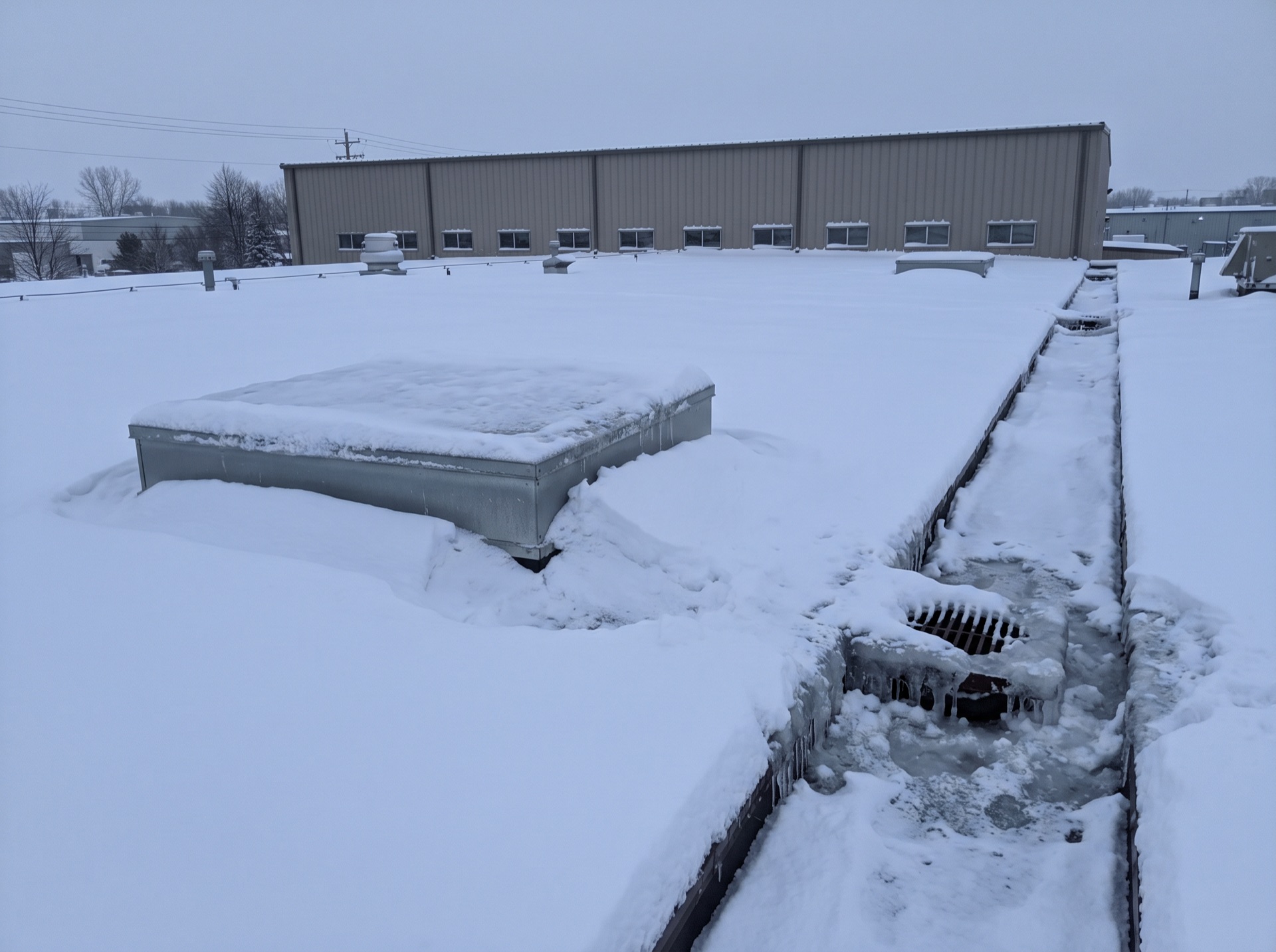
Taking the snow off a flat roof with frozen drains leaves meltwater with nowhere to go, and water that ponds and refreezes puts load back on a deck that was just relieved.

So drains and overflows are opened as part of the clear rather than afterwards, and the roof is left draining. A clear that stops at the snow is half a job.

Fall protection on a deck with no anchors

Most commercial roofs have no permanent anchor points and a parapet too low to count as a guard. Working near an unprotected edge legally requires a system, and improvising one is where people get hurt.

Crews bring mobile anchors, warning lines and whatever the layout actually needs. Where the roof cannot be worked safely at all, that gets reported to the Boulder property manager as a finding, because it will be just as true during the next storm.

What the documentation covers

Depth and density readings, calculated load, dated photographs and a written condition report per visit.

Preventing an imminent failure is treated as loss mitigation by most carriers, and that record is what supports the position if it is ever tested.
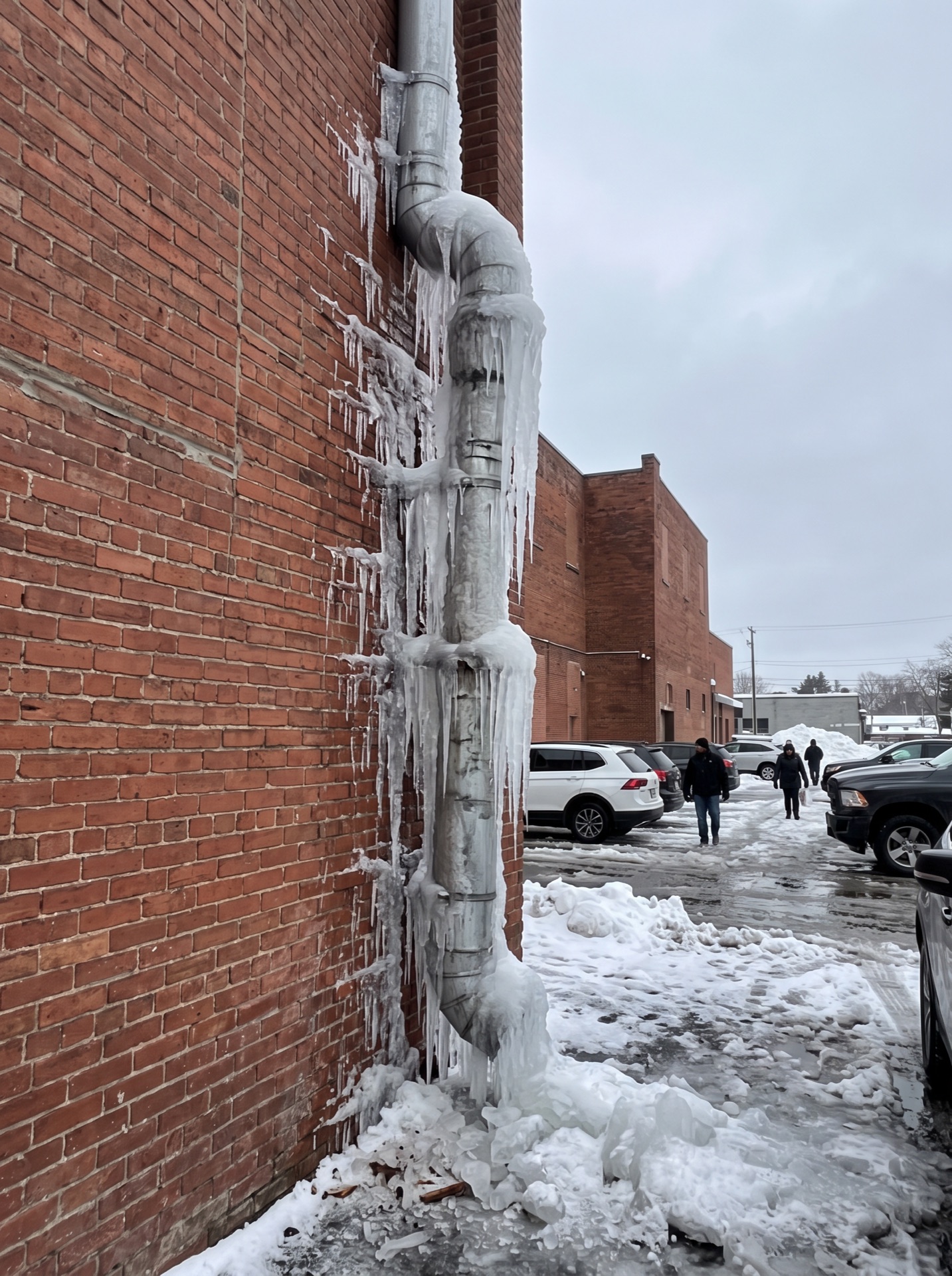
Frozen downspout covered in large icicles on brick commercial building in winter
A heavily iced-over downspout on a brick building shows the effects of extreme winter cold.

What you get in Boulder

  • Mid-span measuredDepth read over the longest unsupported span, not the average
  • Drift-point surveyDepth and density measured where it collects, not where it is convenient
  • One invoice per siteMulti-building properties scoped and billed together
Commercial Roof Snow Removal in Boulder, CO — specification
Service specification for Boulder, CO
Primary climate stressorSolar melt on deep pack, shaded eaves
Pricing modelBilled by the crew hour, rate quoted before dispatch
Typical scopeSteam, 8-16 crew hours typical
Dispatch window24 to 48 hours in mountain terrain
Local ice-barrier practiceExtended membrane plus snow retention
Coverage areaBoulder and Boulder County
Removal methodLow-pressure steam only. No chipping, salt or pressure washing.

Boulder County Coverage From Boulder

Crews working Boulder cover the adjoining communities on the same route — Niwot, Eldorado Springs, Hygiene, Pinecliffe and Jamestown — so a storm week usually means one truck handling several addresses in Boulder County rather than separate trips.

Nearest hub towns with their own commercial snow pages: Louisville, Lafayette, Erie, Longmont, Broomfield, Westminster.

During a cold snap Boulder gets worked alongside the neighboring Boulder County towns on the same route, with active interior leaks moved to the front of the list.

Most jobs do not stop at one service. Commercial Snow in Boulder often runs alongside crane-assisted snow removal in Boulder, and both get written into one scope rather than billed as separate visits.

Active leak right now? Our 24/7 Boulder steam ice dam removal crews are dispatched first during a freeze event. Call (888) 561-9664.
Conditions We Work In

Commercial Roof Snow Removal In Practice

Conditions crews work in across Boulder County. Every job is photographed before and after.

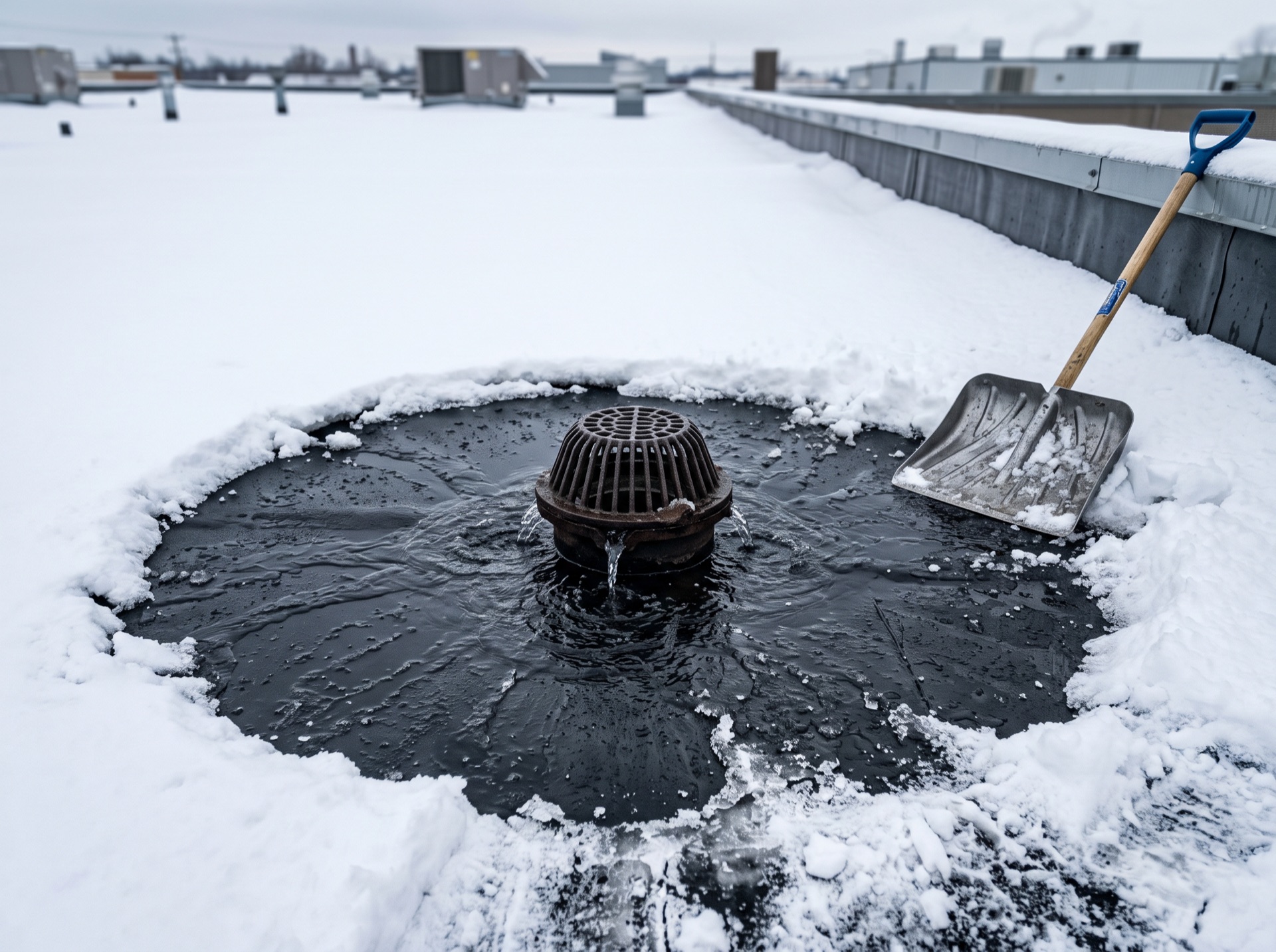
Cleared roof drain surrounded by melting snow on a flat commercial rooftop in winter
A roof drain cleared of snow and ice on a flat commercial rooftop, with a snow shovel resting nearby.
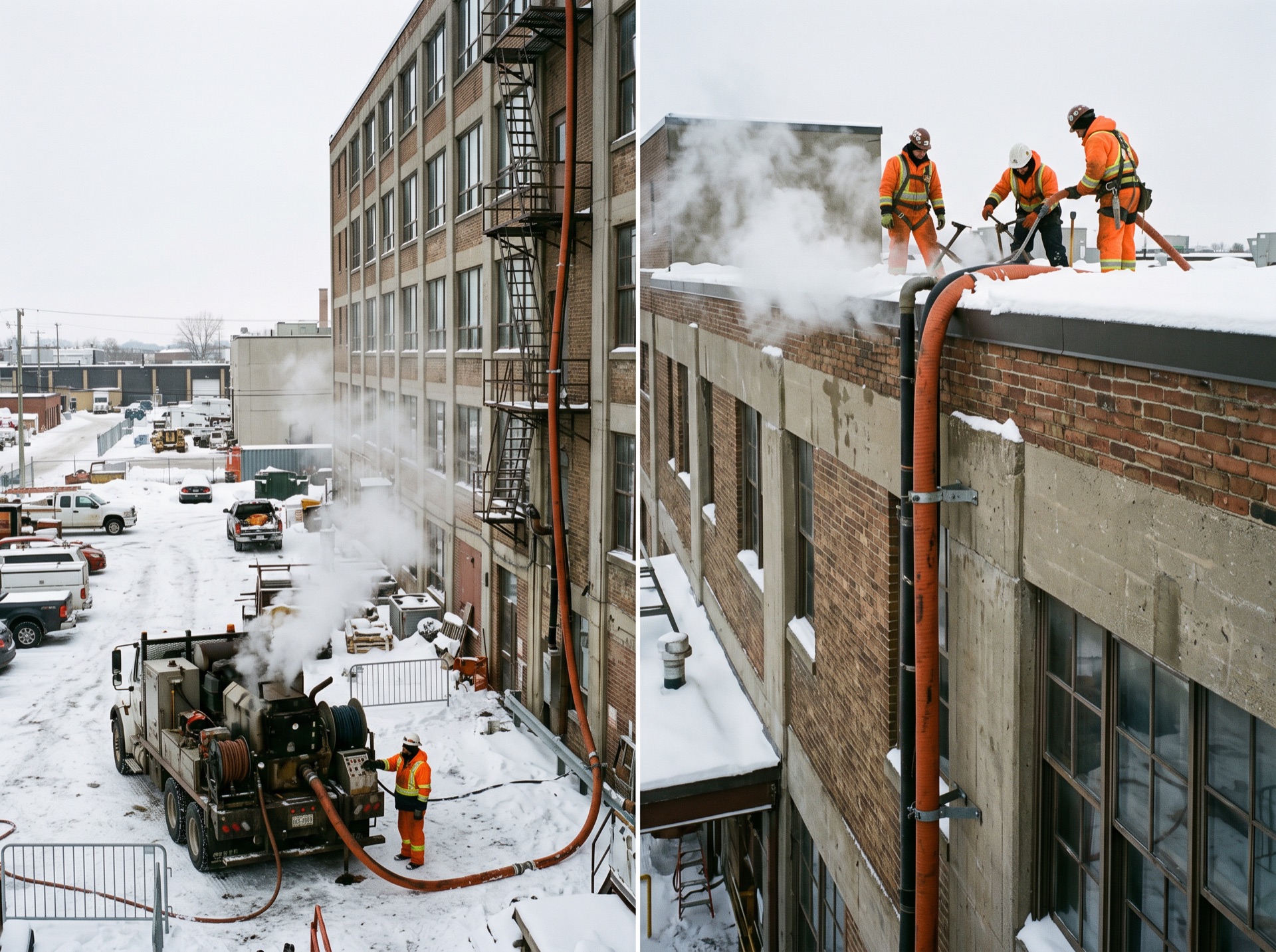
Workers in orange safety gear using steam hose to clear snow from rooftop
A crew uses a steam-powered hose system to remove heavy snow accumulation from a multi-story brick building's rooftop.
Heavy snow load on flat commercial warehouse roof with frozen drain and icicles
A flat commercial warehouse roof bears heavy snow accumulation with a completely frozen interior drain.
FAQ

Local Questions About Boulder Roofs

It is billed by the crew hour, and the rate plus a realistic time estimate are quoted on the phone before anyone is dispatched.

  • Scope drives the hours: length and thickness of the ice, roof pitch and height, and whether the gutters are frozen solid.
  • Access matters too — a three-story Boulder roof takes longer to set up on than a ranch.
  • The invoice matches the quote. There are no surprise add-ons written on the tailgate.

No, but there is a worse one: after the thaw, when the evidence has melted and the damage is all that is left.

  • Mid-storm calls are fine — crews work through freeze events.
  • An evening call for a leak that started that afternoon usually gets a next-morning slot.
  • Waiting for a weekend to pass is the most common and most expensive delay.

Yes. Steam is safe on slate, cedar shake, tile and metal as well as asphalt, because it removes ice with heat rather than force.

  • Older Boulder housing stock with original slate is exactly where chipping does the most damage.
  • Crews adjust the lance distance and dwell rather than the pressure.
  • Nothing mechanical touches the covering at any point.

Not for exterior removal, provided access and payment are arranged in advance.

  • Somebody being home helps where there is interior damage to look at or document.
  • Photographs go to you either way, timestamped as the work happens.
  • A gate code or an unlocked side gate is usually all a crew needs on a Boulder property.

Often for the interior water damage, sometimes for the removal itself, but it depends entirely on your carrier and policy wording.

  • Many policies treat emergency mitigation separately under a duty to protect property clause.
  • Denials usually cite the maintenance exclusion, which dated photographs taken during the event are the direct counter to.
  • Crews photograph the dam, the entry points and the interior damage, and write the scope in Xactimate line items.
  • The coverage decision is between you and your carrier — no contractor can promise an outcome there.

Depth and density readings, the calculated load per square foot and dated photographs, yes - taken across the roof rather than at one convenient spot. Certifying a structure against those numbers is a structural engineer's signature, and where the readings warrant one that gets said plainly.

When the measured load approaches a meaningful fraction of design capacity, when rain is forecast onto an existing pack, when drifting has loaded one area far more than the rest, or when the drains have stopped taking water. Depth alone is a poor trigger - density is what matters, and that needs measuring.

Nearby

Commercial Snow In Towns Around Boulder

Same-Day Response

Get A Boulder Crew Out

Every freeze-thaw cycle adds another layer to the dam and pushes a little more water under the shingles. That clock is already running.

✓ Licensed & insured✓ Low-pressure steam only✓ Rate quoted up front✓ Photos for your claim
Online Quote(888) 561-9664