Homeowners across Cabell County call about icicles. Icicles are cosmetic. The dam behind them, holding back standing water, is not. As part of our complete Huntington winter roof services, crews handle commercial ice dam removal across Cabell County.
Small Snow, Repeated Cycles: Huntington Ice Dams
Huntington does not need a blizzard to get an ice dam. A few inches that melts by afternoon and refreezes overnight builds one just as effectively, and it does it over and over through the season.

The building stock has no margin for it. Because the winters here read as mild, attics tend to be under-insulated, eave details are less considered, and ice barrier is as often absent as present on a roof in Huntington.
Ice-barrier practice in Cabell County
Because ice is not the first thing a homeowner in Huntington thinks about, the eave membrane is the detail most often value-engineered out of a re-roof quote. It is worth asking for by name.
Commercial Ice Dam Removal in Huntington: How The Work Runs
Insulation above the deck changes the melt pattern
A modern commercial assembly puts most of its insulation above the deck, so very little building heat reaches the membrane. That is good for energy and it means the snow that lands mostly stays - the roof does not self-clear the way an under-insulated one does.
Where dams do form on those roofs it is almost always at a thermal bridge: a parapet, a curb, a drain bowl or a line of fasteners. Those are the spots crews work first.
Roof warranties and who is allowed up there
Most commercial membranes carry a manufacturer's warranty with conditions about who may work on the roof and what methods are permitted. Snow removal is generally fine; mechanical ice removal very often is not, and the wrong contractor with the wrong tool can void cover worth considerably more than the clearing.
The warranty gets read before the roof is walked, and the method used is one the document permits.
Internal drains fail differently from gutters
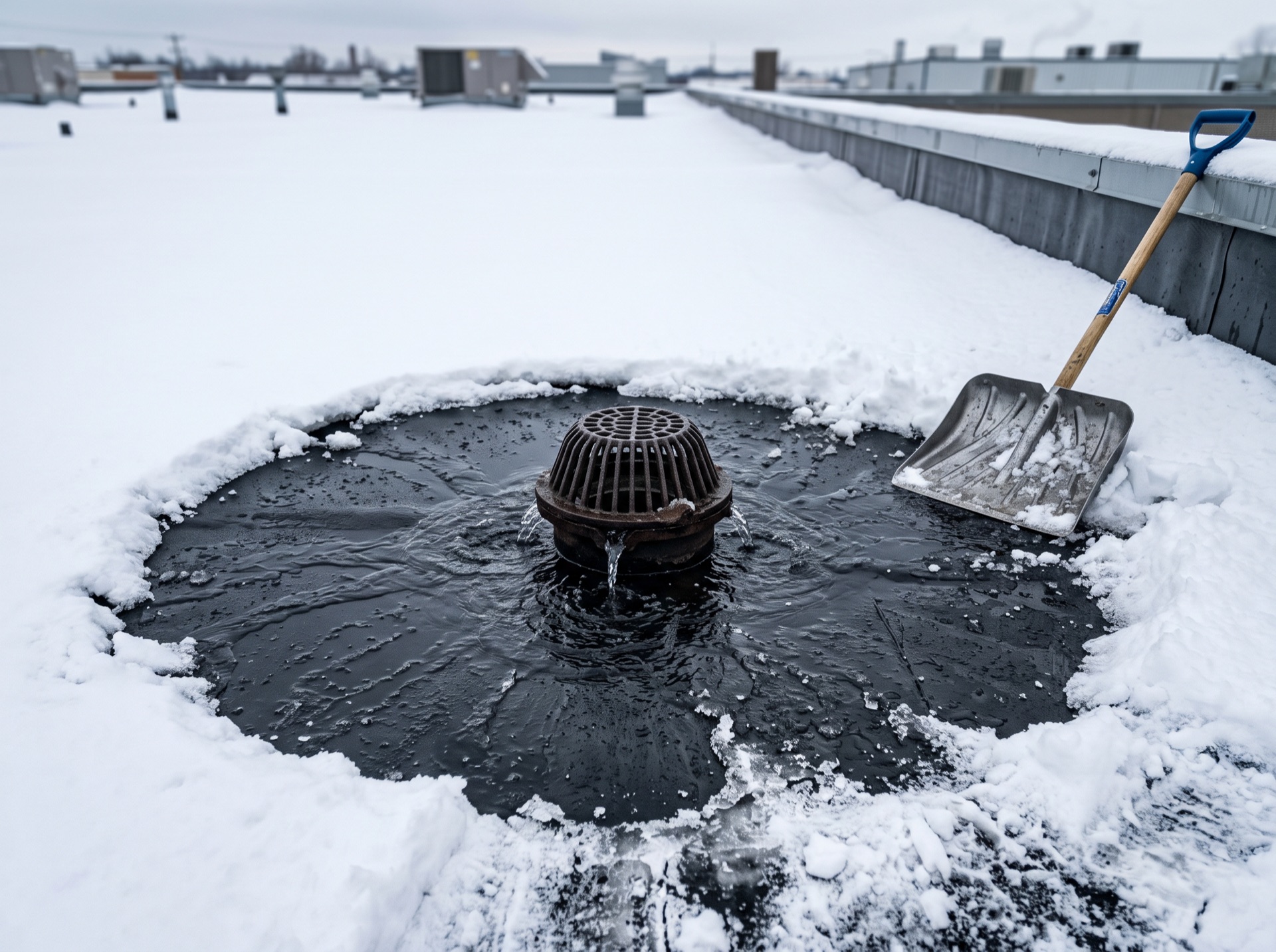
A residential gutter overflows when it blocks. An internal roof drain just stops, and the water stays on the deck at depth until it finds a seam, a flashing detail or a pitch pocket.
Crews open the drain throat and then confirm flow in the leader below before calling it clear. An open drain over a frozen leader is not an open drain, and on a Huntington building that distinction shows up as a tenant ceiling two floors down.
The pitched sections nobody plans for
Very few commercial buildings are flat all the way across. Entrance canopies, mansard faces, dormers over older frontages and the sloped transitions between roof levels all shed onto places where people walk.
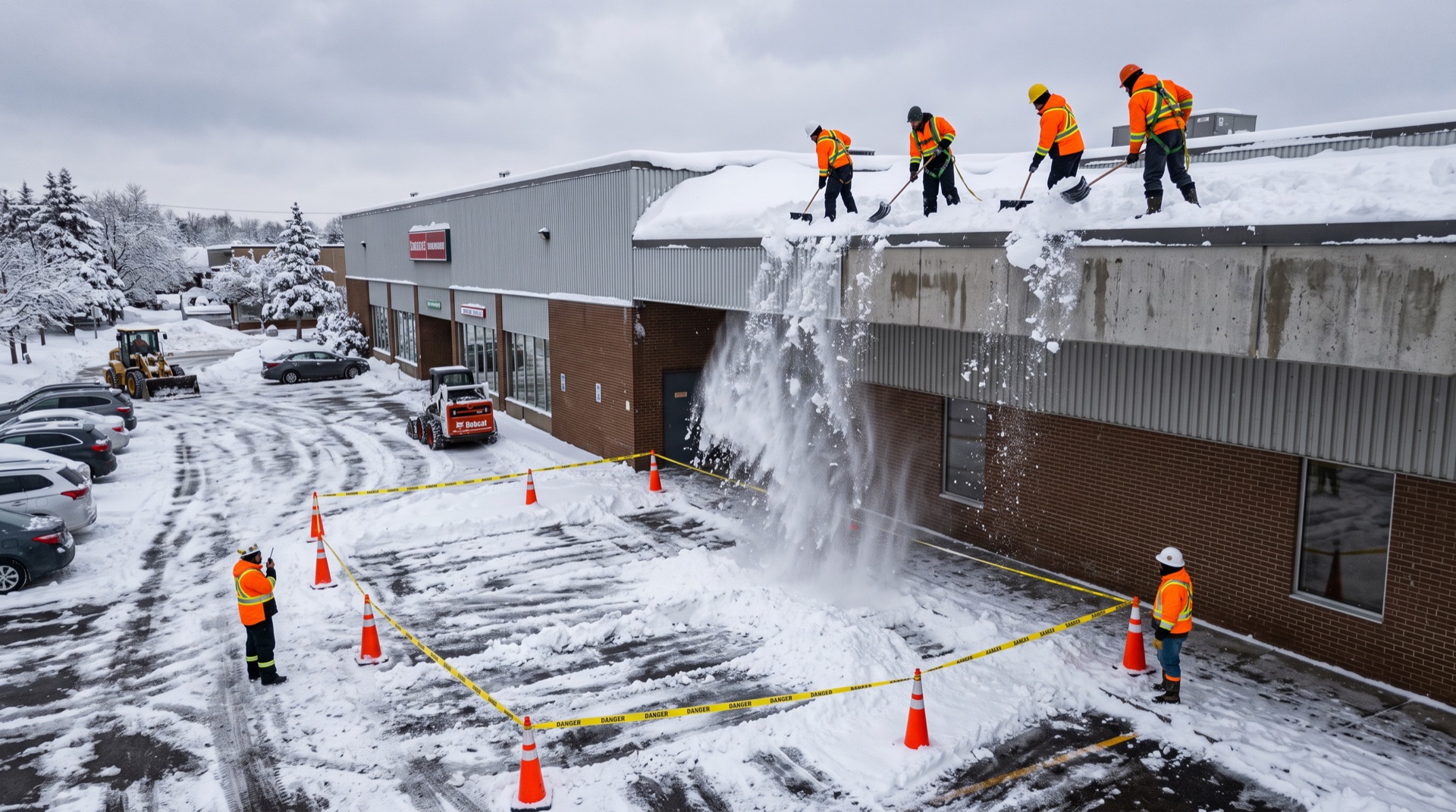
Those sections behave like a residential roof and get worked like one - steam at the eave, snow guards noted where they are missing, and the pavement below cordoned while material is coming down.
Overflow scuppers are the tell
Water running out of an overflow scupper in winter means the primary drains are not taking it. On a Huntington building that is a sign the roof is holding standing water somewhere above a frozen drain, and the load is being carried rather than shed.
Scuppers are checked first for exactly that reason, and a dry scupper above a wet roof is as informative as a running one.
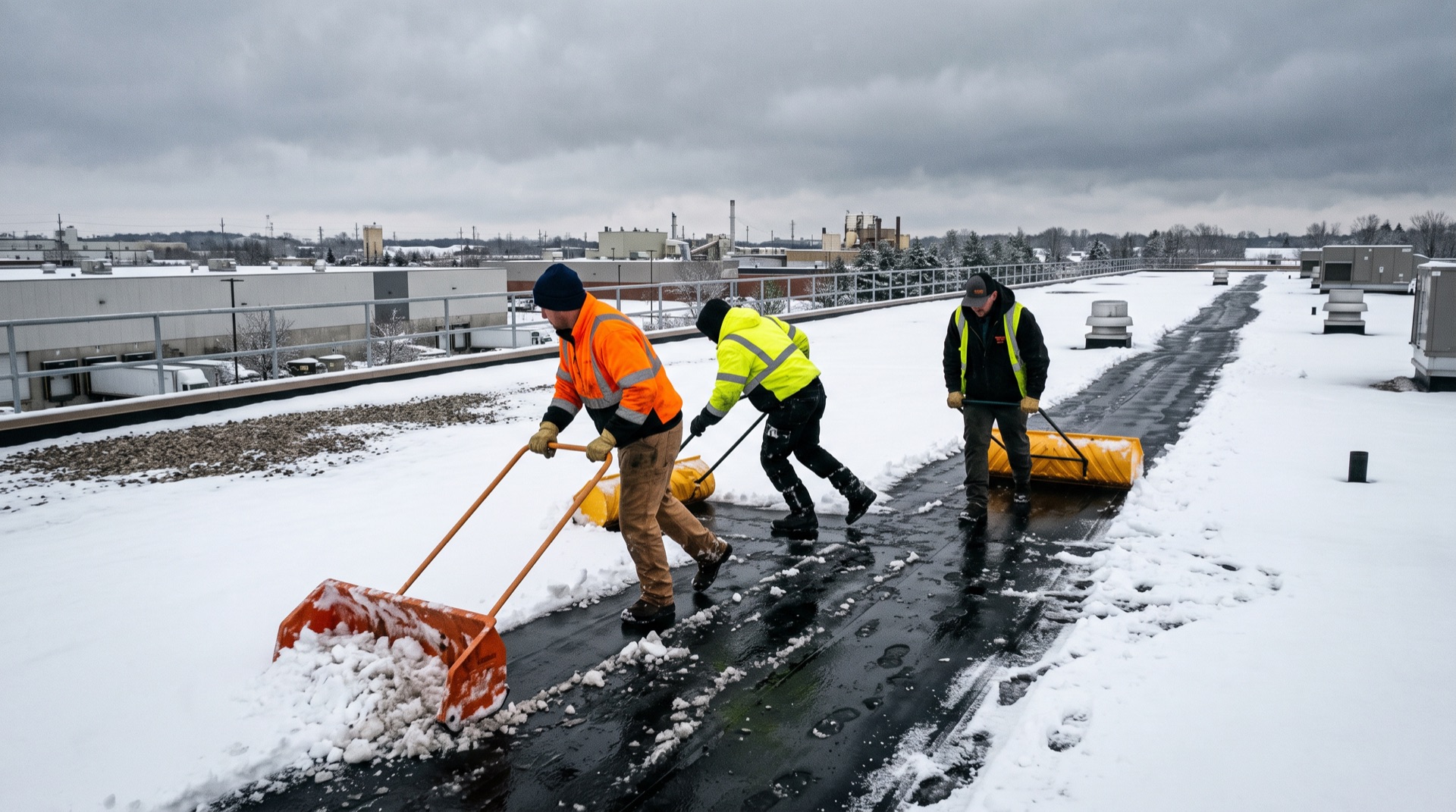
What you get in Huntington
- EPDM, TPO and mod-bitLow-pressure steam only, seams and flashing details avoided
- Flow confirmed belowAn open drain throat over a frozen leader is not an open drain
- Tenant-hours schedulingWork windows set around occupancy and access
| Dispatch window | Same day to 24 hours |
|---|---|
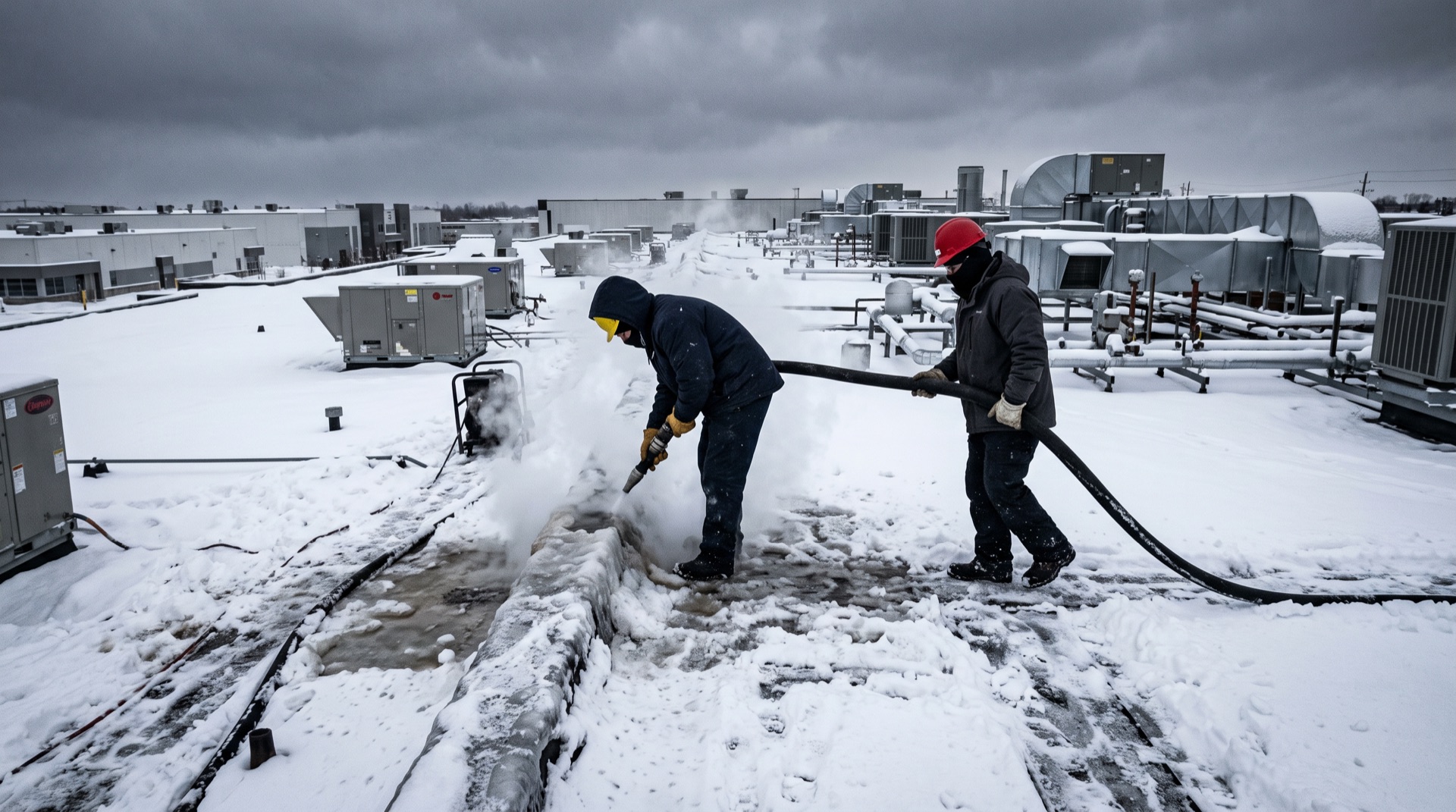
| Removal method | Low-pressure steam only. No chipping, salt or pressure washing. |
| Coverage area | Huntington and Cabell County |
| Pricing model | Billed by the crew hour, rate quoted before dispatch |
| Typical scope | Steam, 4-8 crew hours typical |
| Documentation | Dated before and after photos, written scope in Xactimate line items |
| Local ice-barrier practice | Eave membrane on new work, often absent |
Neighborhoods and Towns We Reach From Huntington
Crews working Huntington cover the adjoining communities on the same route — Lavalette, Shoals, Ceredo, Kenova and Barboursville — so a storm week usually means one truck handling several addresses in Cabell County rather than separate trips.
Nearest hub towns with their own commercial ice dams pages: Charleston, Parkersburg, Beckley, Lewisburg, Snowshoe, Clarksburg.
Huntington sits inside the regular West Virginia service area, so a crew is usually scheduled the same day or the following morning.
Most jobs do not stop at one service. Commercial Ice Dams in Huntington often runs alongside commercial roof snow removal in Huntington, and both get written into one scope rather than billed as separate visits.
Active leak right now? Our 24/7 Huntington steam ice dam removal crews are dispatched first during a freeze event. Call (888) 561-9664.