Most Killington homeowners find out about an ice dam from the inside — a damp patch on a bedroom ceiling, or water tracking down the inside of a window frame. As part of our complete Killington winter roof services, crews handle commercial ice dam removal across Rutland County.
Killington Ice Dams: What a Five-Month Snow Pack Does
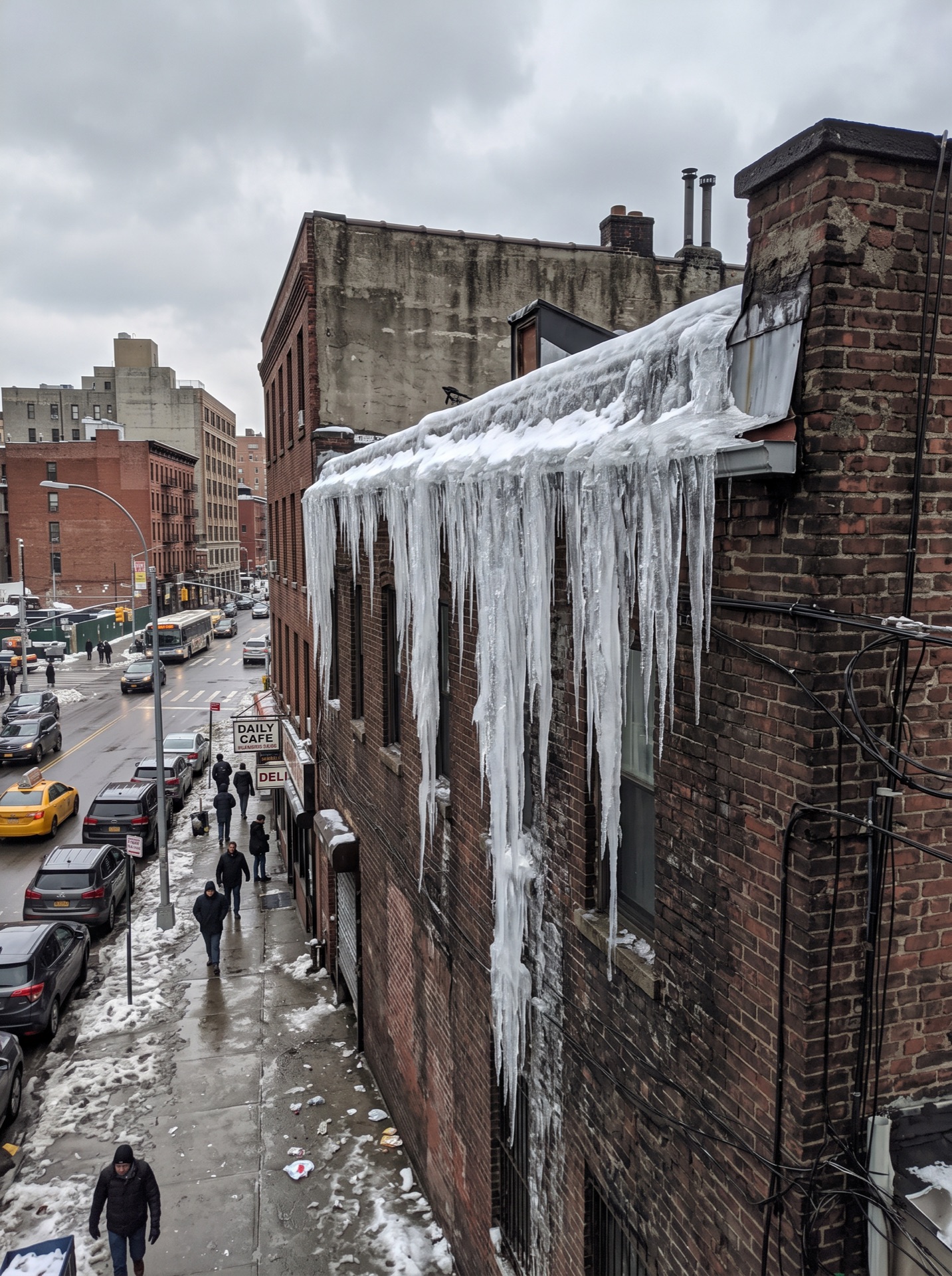
A roof in Rutland County spends most of the year's coldest months under continuous load. That is a different problem from a single heavy storm, and it produces a different kind of ice.

A long season is not a safer one. It means more freeze-thaw cycles, and each one adds a layer to the dam. By late winter the ice at a Rutland County eave can be a foot deep and locked to the shingle, with standing water sitting behind it.
Ice-barrier practice in Rutland County
In the colder Vermont jurisdictions the membrane requirement extends well up the roof plane rather than stopping at the first course, precisely because the ice here does not stay near the edge.
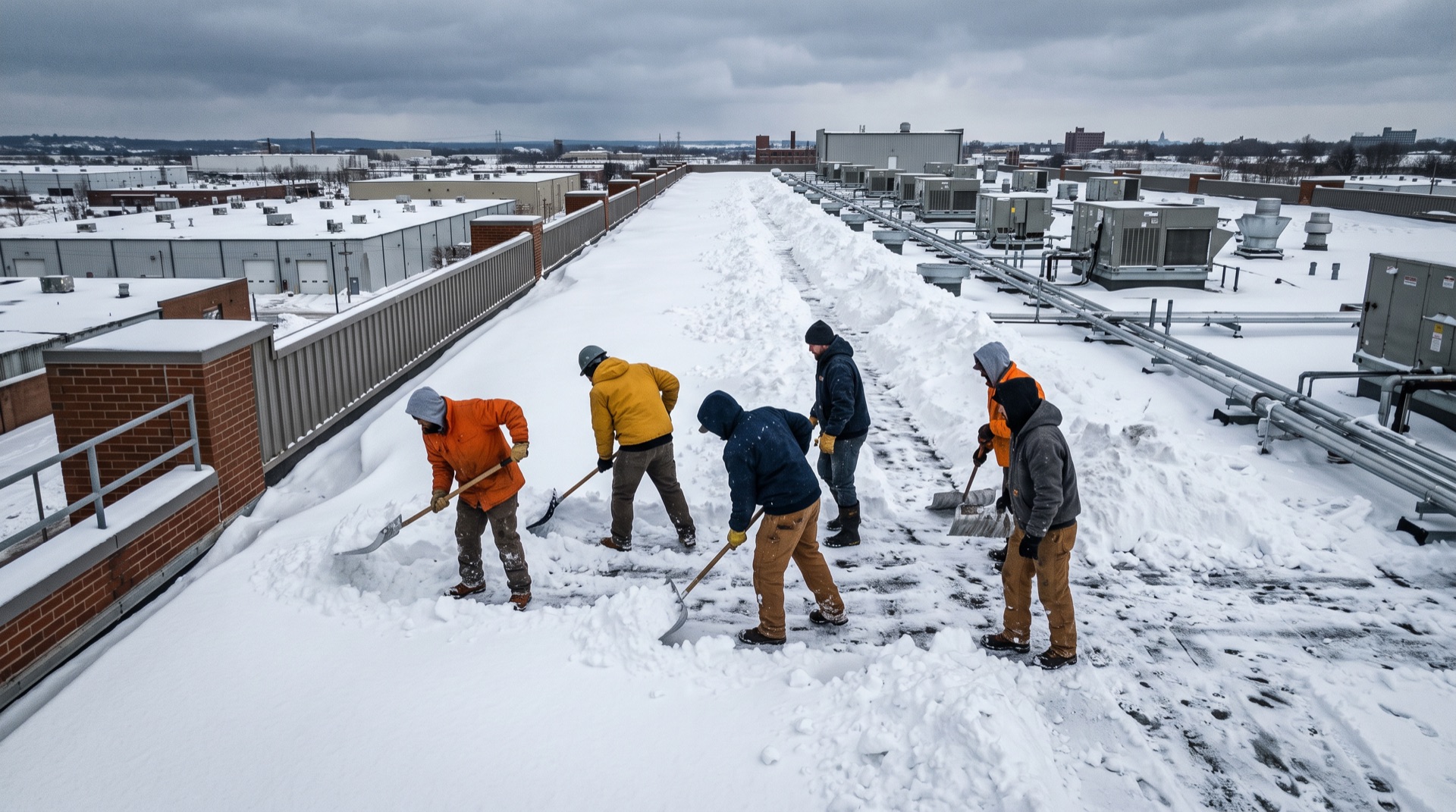
Commercial Ice Dam Removal in Killington: How The Work Runs
Internal drains fail differently from gutters
A residential gutter overflows when it blocks. An internal roof drain just stops, and the water stays on the deck at depth until it finds a seam, a flashing detail or a pitch pocket.
Crews open the drain throat and then confirm flow in the leader below before calling it clear. An open drain over a frozen leader is not an open drain, and on a Killington building that distinction shows up as a tenant ceiling two floors down.
Flat roofs fail differently
A pitched residential roof dams at the eave. A commercial deck dams at its drainage: frozen scuppers, iced-over internal drains, and ponding that refreezes into a sheet across the low spots. Water then sits on the membrane at depth, finds a seam or a flashing detail, and comes through into the tenant space below.
Parapet walls make it worse by holding the melt on the deck instead of letting it run off an edge. By the time it shows up as a ceiling tile stain in a Killington unit, there is usually standing water up there.
Insulation above the deck changes the melt pattern
A modern commercial assembly puts most of its insulation above the deck, so very little building heat reaches the membrane. That is good for energy and it means the snow that lands mostly stays - the roof does not self-clear the way an under-insulated one does.
Where dams do form on those roofs it is almost always at a thermal bridge: a parapet, a curb, a drain bowl or a line of fasteners. Those are the spots crews work first.
Scheduling around tenants
Noise, access, parking and the hours a Killington business can have equipment outside its door all shape when work happens. Some jobs run overnight for that reason.
Set the constraint on the call and the window gets planned around it rather than negotiated on the day.
Multiple buildings on one site
Campuses, retail strips and multi-building properties get walked together and prioritized by which deck is closest to trouble, rather than worked in the order the calls came in.
One scope, one invoice, one contact. It is a meaningfully different job from nine separate ones.
What you get in Killington
- Documentation for the boardCondition report and photo record with every invoice
- Plant worked aroundHVAC curbs, conduit, racking and railing avoided, not cleared over
- EPDM, TPO and mod-bitLow-pressure steam only, seams and flashing details avoided
| Removal method | Low-pressure steam only. No chipping, salt or pressure washing. |
|---|---|
| Typical scope | Steam, 6-14 crew hours typical |
| Primary climate stressor | Sustained sub-freezing, long season |
| Coverage area | Killington and Rutland County |
| Documentation | Dated before and after photos, written scope in Xactimate line items |
| Service | Commercial Ice Dam Removal in Killington, VT |
| Local ice-barrier practice | Eave membrane required on new work |
Killington Coverage and the Adjoining Communities
Crews working Killington cover the adjoining communities on the same route — Pittsfield, Gaysville, Bridgewater Corners, Chittenden and Stockbridge — so a storm week usually means one truck handling several addresses in Rutland County rather than separate trips.
Nearest hub towns with their own commercial ice dams pages: Rutland, Hartford, Middlebury, Manchester, Barre, Montpelier.
When a storm hits Rutland County, crews are dispatched by severity rather than by call order — water already inside the house goes first.
Most jobs do not stop at one service. Commercial Ice Dams in Killington often runs alongside commercial roof snow removal in Killington, and both get written into one scope rather than billed as separate visits.
Active leak right now? Our 24/7 Killington steam ice dam removal crews are dispatched first during a freeze event. Call (888) 561-9664.