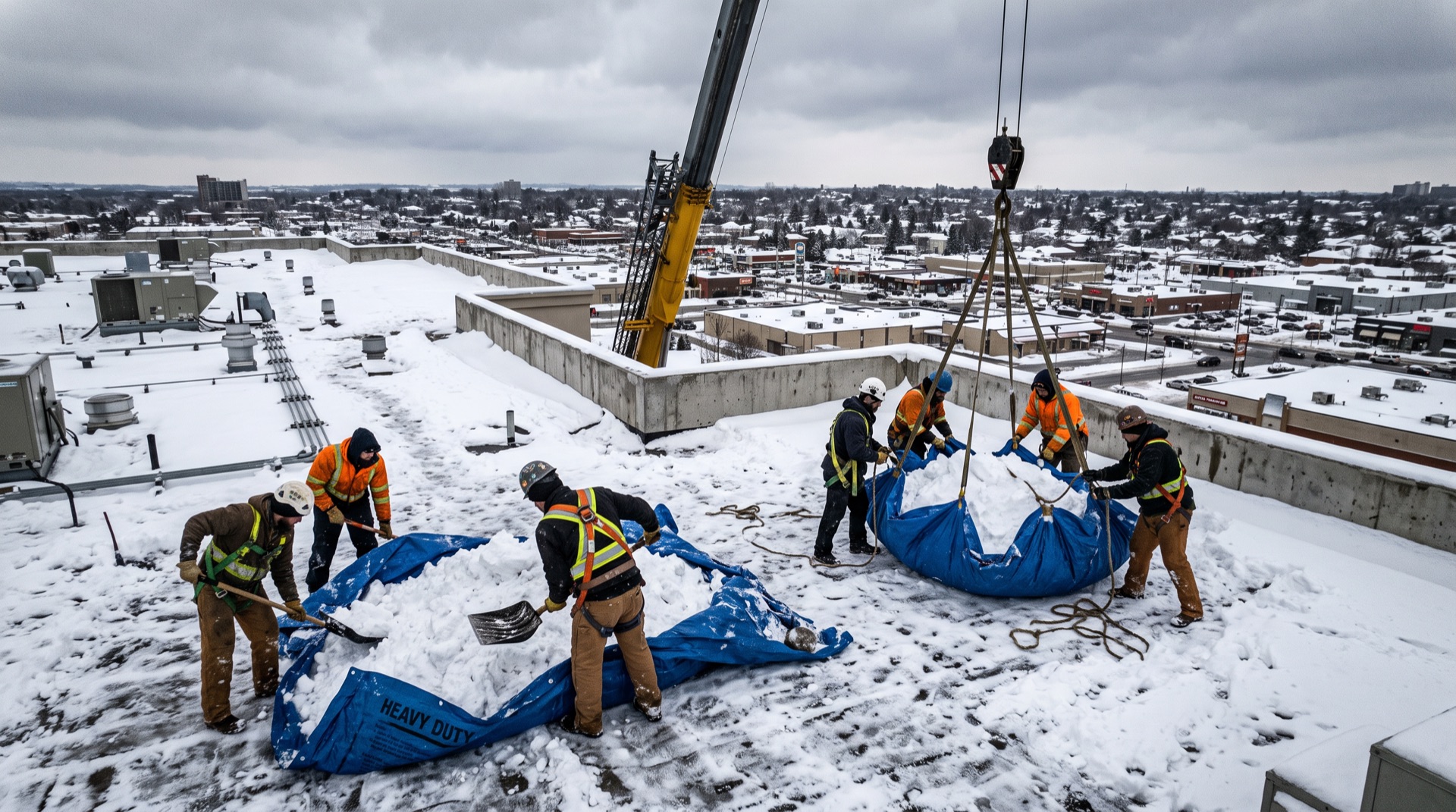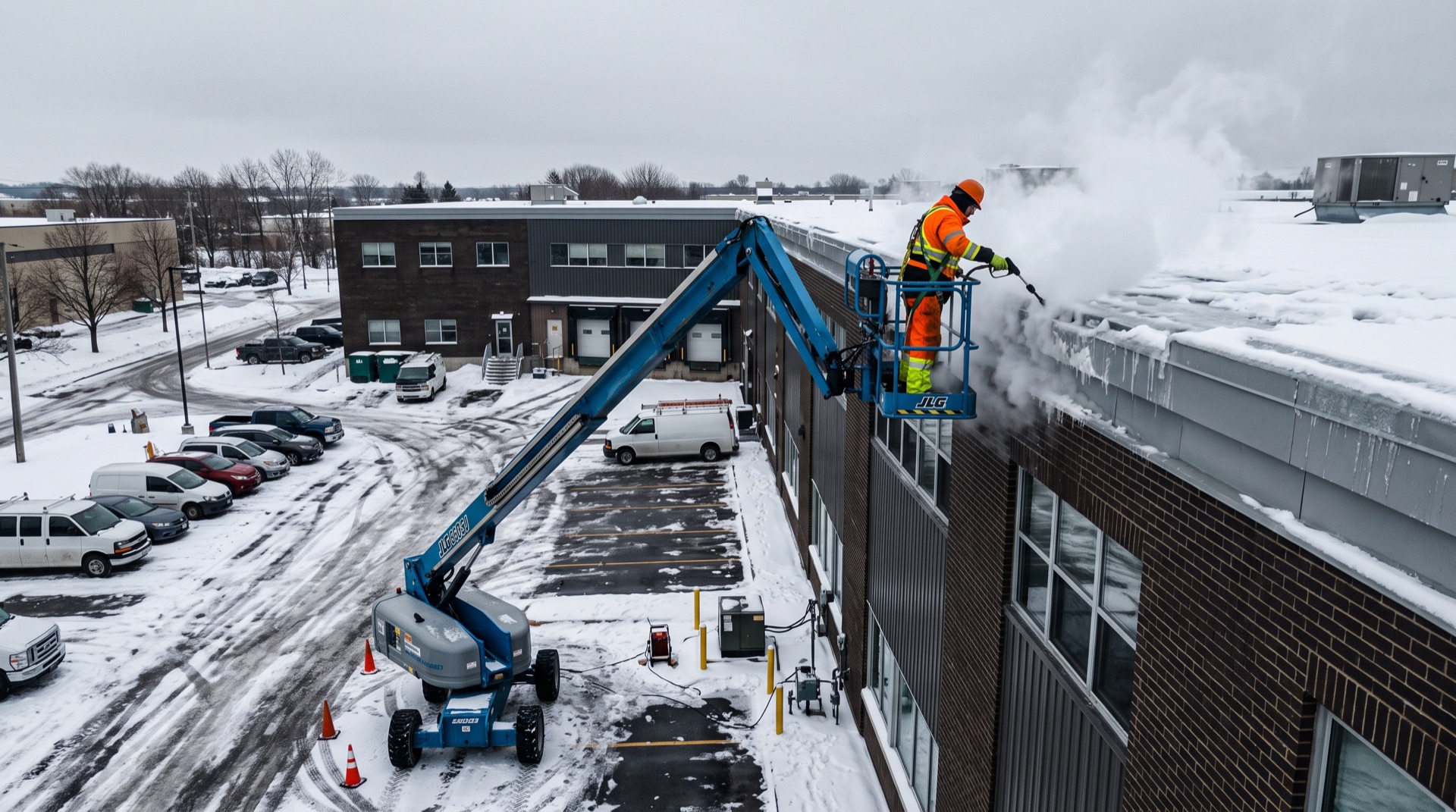
Ice dams are not a Reading problem so much as a Pennsylvania one, and they show up on the same handful of eaves and valleys year after year. As part of our complete Reading winter roof services, crews handle crane-assisted snow removal across Berks County.
Why Reading Roofs Dam Up: Nor'easter Load and the Maritime Swing
Berks County gets the worst combination for ice: snow with high water content, followed by temperatures that oscillate rather than settle. The pack does not stay frozen and it does not drain.

Retrofits often made it worse rather than better. Insulation laid on an attic floor without sealing the bypasses underneath it keeps the living space warm and sends the same warm air straight to the roof deck.
Ice-barrier practice in Berks County
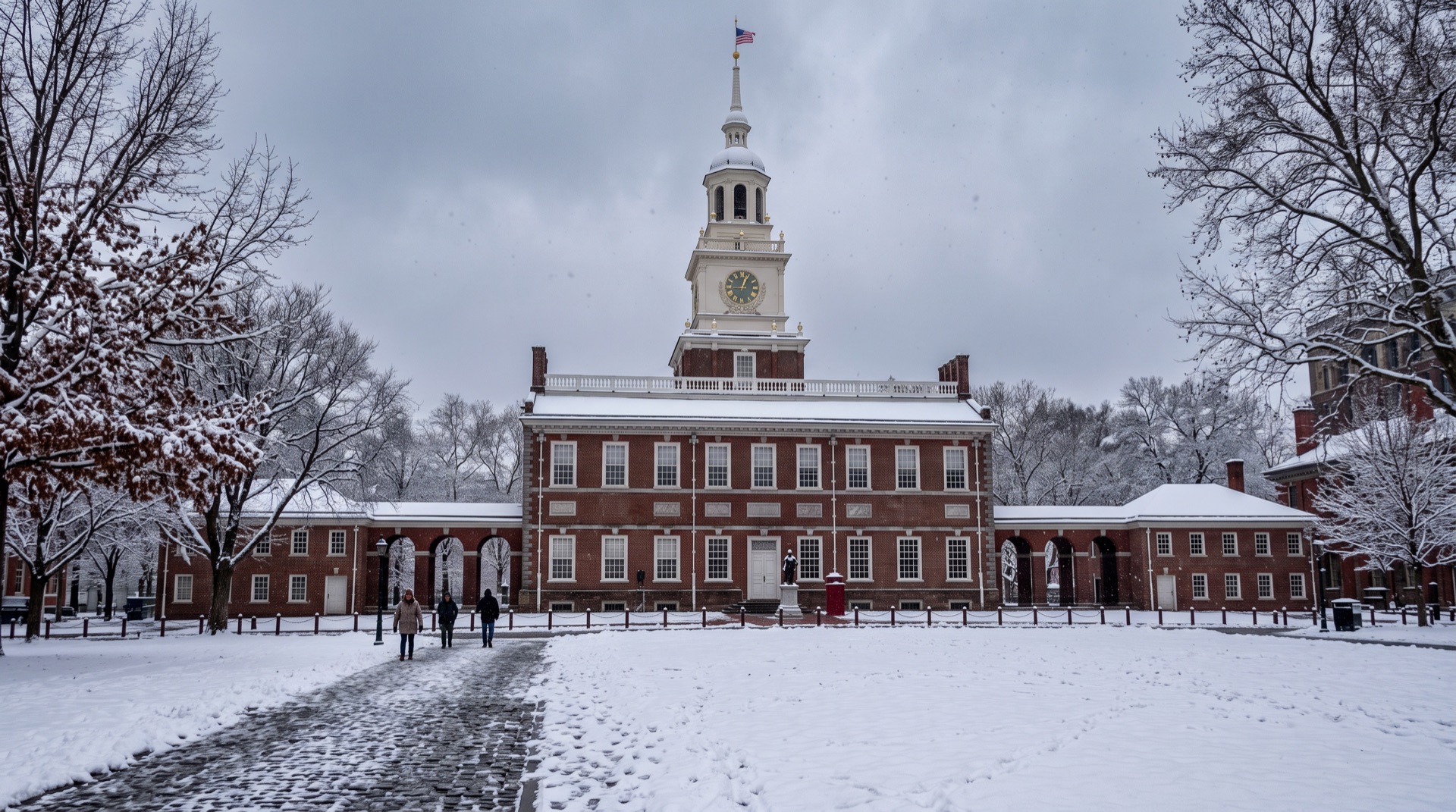
Most Berks County towns require self-adhering ice barrier at the eaves on a re-roof permit. In a historic district there may be additional review on materials, which is worth checking before work is scheduled.
Crane-Assisted Snow Removal in Reading: How The Work Runs
Outriggers on frozen and uneven ground
Frozen ground is not automatically good bearing. Frost heave, buried utilities, septic fields, soft fill under a lawn and anything that thaws mid-job all change what the pads are sitting on. Ceiling Sagging or Bulging After Snow.
Pads are sized for the load and placed deliberately. It is the least visible part of a pick in Reading and the part with the least margin for improvisation.
Wind limits and when a pick gets postponed
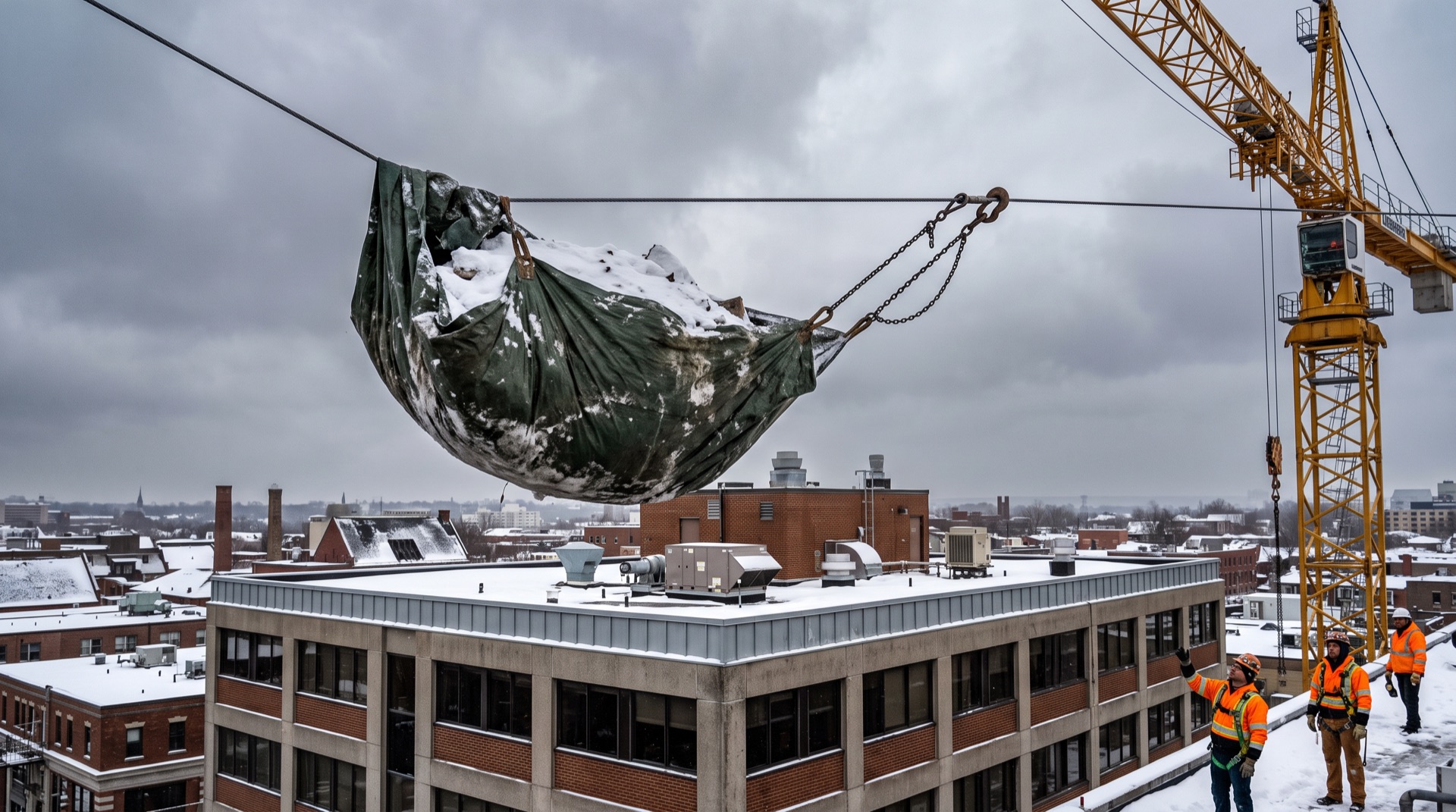
Every crane has a wind chart, and a tarp full of snow is about the worst possible load to put on a hook in a gust - large surface area, light enough to sail, heavy enough to hurt. The limit is lower than people expect and it is not negotiable.
A Reading pick that is cancelled for wind gets rescheduled rather than argued about. The alternative is a swinging load over an occupied building.
Planning the lift before anything moves
Site access, the swing radius, overhead lines, ground bearing for the outriggers and the ground drop zone all get walked first. On a site in Reading that walk often determines where the crane can physically sit, which determines everything else.
Permits get pulled where the municipality requires them for a street setup, and that lead time is built into the schedule rather than discovered on the day.
The arithmetic that justifies a crane
Snow weight is depth times density times area. Fresh powder is light; settled wet pack can be several times heavier for the same depth, and drifted pack heavier again.
Crews take depth and density readings at the drift points on a roof in Reading, work out the load, and compare it to the structure's design capacity. A crane gets mobilised when that number says hand clearing cannot win the race against the next storm.
Keeping people clear of the swing
A loaded tarp overhead is a serious exclusion zone. Pedestrian and vehicle routes get marshalled for the whole operation, and on an occupied building that means talking to whoever controls the doors before the first lift.
On a site in Reading with public frontage this is usually the part that needs the most coordination and the part that gets the least credit.
What you get in Reading
- Lift planned firstAccess, swing radius, overhead lines and drop zone walked before scheduling
- Load calculated firstDepth, density and area against design capacity before anything mobilises
- Marshalled exclusion zonePedestrian and vehicle control for the whole operation
| Typical scope | Steam, 4-10 crew hours typical |
|---|---|
| Local ice-barrier practice | Eave membrane standard on re-roofs |
| Coverage area | Reading and Berks County |
| Pricing model | Billed by the crew hour, rate quoted before dispatch |
| Primary climate stressor | Nor'easters, rapid thaw-freeze swing |
| Documentation | Dated before and after photos, written scope in Xactimate line items |
| Dispatch window | Same day to 24 hours |
Berks County Coverage From Reading
Crews working Reading cover the adjoining communities on the same route — Temple, Leesport, Mohnton, Blandon and Limekiln — so a storm week usually means one truck handling several addresses in Berks County rather than separate trips.
Nearest hub towns with their own crane snow removal pages: Pottstown, Lebanon, Lancaster, Allentown, West Chester, King of Prussia.
Reading sits inside the regular Pennsylvania service area, so a crew is usually scheduled the same day or the following morning.
Most jobs do not stop at one service. Crane Snow Removal in Reading often runs alongside commercial roof snow removal in Reading, and both get written into one scope rather than billed as separate visits.
Active leak right now? Our 24/7 Reading steam ice dam removal crews are dispatched first during a freeze event. Call (888) 561-9664.