Skip to content
Kansas City, MO
Deep Drifts & Big Roofs · Jackson County

Crane-Assisted Snow Removal in Kansas City, MO — Rapid Freeze‑Thaw Crews

Ice Dam Now handles crane-assisted snow removal for Kansas City, MO properties and the wider Jackson County. Removal is by low-pressure steam, never mechanical. Dispatch is same day where water is already inside, pricing is by the crew hour quoted before a crew leaves, and every job is photographed before and after for claim purposes. Crews are licensed, insured and harness-certified.

Weights documented — Depths, densities and loads recorded for the carrier
Outrigger pads — Bearing pads sized and placed for frozen and uneven ground
Marshalled exclusion zone — Pedestrian and vehicle control for the whole operation
Rip-stop tarp picks — Rated tarps and rigging, with lifts planned around the swing radius

Get Ice Dam Help Kansas City

A few quick questions, then pick a time. If water is coming in, call instead.

What is the zip code of the home?

Roof leaking right now? Call (888) 561-9664 — that is faster than any form.
Water coming through the ceiling?Every hour an ice dam sits there, more water gets under the shingles.Call (888) 561-9664
Same Day
For Water Already Inside
Steam
Safe On Every Covering
Jackson
County Coverage
Insured
Harness-Certified On Every Roof
Written
Scope Before Work Starts

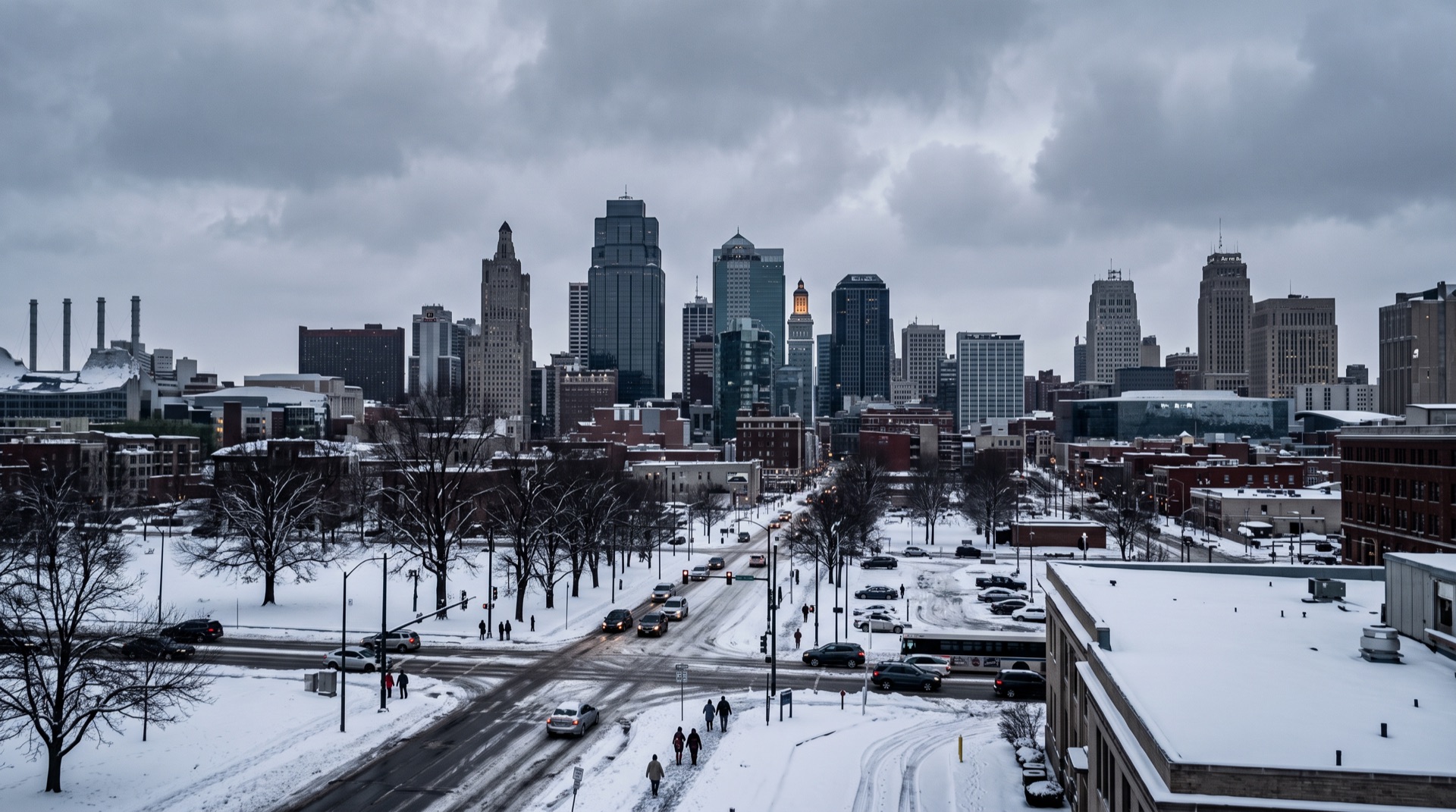
Winter in Kansas City does not need a record storm to put water inside a house. It needs a roof with snow on it, an attic leaking heat, and one cold night. As part of our complete Kansas City winter roof services, crews handle crane-assisted snow removal across Jackson County.

Why Kansas City Roofs Dam Up: Cycling, Not Snowfall Totals

Kansas City does not need a blizzard to get an ice dam. A few inches that melts by afternoon and refreezes overnight builds one just as effectively, and it does it over and over through the season.

Diagram showing how ice dams form on a roof from heat loss and snow melt
Heat escaping into the attic melts roof snow; the meltwater refreezes at the cold eave and the dam grows a layer every cycle.

Because the winters read as mild, the building stock is not built for ice. Attic insulation is thinner, eave details are less considered, and ice barrier is more often absent than present on a roof in Kansas City.

Ice-barrier practice in Jackson County

The residential code Missouri follows requires eave ice barrier on new work, and Jackson County enforces it. The variable on any given house is simply when it was last roofed.

Crane-Assisted Snow Removal in Kansas City: How The Work Runs

Planning the lift before anything moves

Site access, the swing radius, overhead lines, ground bearing for the outriggers and the ground drop zone all get walked first. On a site in Kansas City that walk often determines where the crane can physically sit, which determines everything else. Ceiling Sagging or Bulging After Snow.

Permits get pulled where the municipality requires them for a street setup, and that lead time is built into the schedule rather than discovered on the day.

Keeping people clear of the swing

A loaded tarp overhead is a serious exclusion zone. Pedestrian and vehicle routes get marshalled for the whole operation, and on an occupied building that means talking to whoever controls the doors before the first lift.

On a site in Kansas City with public frontage this is usually the part that needs the most coordination and the part that gets the least credit.

Outriggers on frozen and uneven ground

Frozen ground is not automatically good bearing. Frost heave, buried utilities, septic fields, soft fill under a lawn and anything that thaws mid-job all change what the pads are sitting on.

Pads are sized for the load and placed deliberately. It is the least visible part of a pick in Kansas City and the part with the least margin for improvisation.

What goes in the tarp and what does not

A pick lifts loose and broken snow. It does not lift a solid sheet of ice frozen to the membrane, and trying to make it do so is how a tarp takes the roof covering with it.

So the sequence is crews cutting and breaking the pack into liftable material, the crane moving it, and steam dealing with whatever is bonded to the surface. The crane is the transport, not the demolition.

Wind limits and when a pick gets postponed

Every crane has a wind chart, and a tarp full of snow is about the worst possible load to put on a hook in a gust - large surface area, light enough to sail, heavy enough to hurt. The limit is lower than people expect and it is not negotiable.

A Kansas City pick that is cancelled for wind gets rescheduled rather than argued about. The alternative is a swinging load over an occupied building.
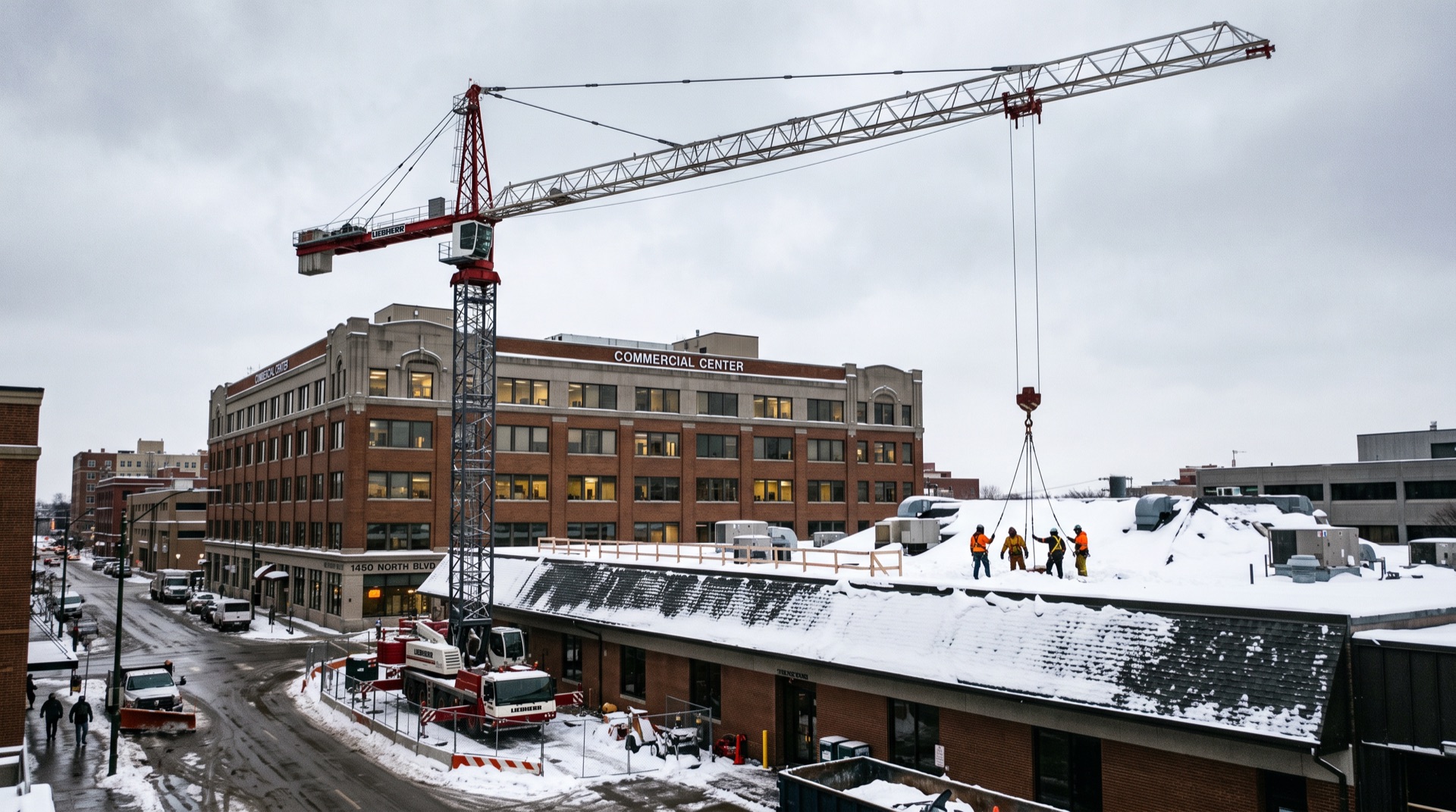
Liebherr tower crane boom extended over snow-covered building roof with workers below
Workers guide a Liebherr tower crane lifting operation on a snow-covered rooftop near the Commercial Center building.

What you get in Kansas City

  • Lift planned firstAccess, swing radius, overhead lines and drop zone walked before scheduling
  • Rip-stop tarp picksRated tarps and rigging, with lifts planned around the swing radius
  • Load calculated firstDepth, density and area against design capacity before anything mobilises
Crane-Assisted Snow Removal in Kansas City, MO — specification
Service specification for Kansas City, MO
ServiceCrane-Assisted Snow Removal in Kansas City, MO
Primary climate stressorRepeated thaw-freeze cycling
Coverage areaKansas City and Jackson County
Typical scopeSteam, 4-8 crew hours typical
Local ice-barrier practiceEave membrane on new work, often absent
Dispatch windowSame day to 24 hours
Pricing modelBilled by the crew hour, rate quoted before dispatch

Kansas City Coverage and the Adjoining Communities

Crews working Kansas City cover the adjoining communities on the same route — Riverside, Waldron and Liberty — so a storm week usually means one truck handling several addresses in Jackson County rather than separate trips.

Nearest hub towns with their own crane snow removal pages: Independence, Blue Springs, Lee's Summit, St. Joseph, Columbia, Jefferson City.

Kansas City sits inside the regular Missouri service area, so a crew is usually scheduled the same day or the following morning.

Most jobs do not stop at one service. Crane Snow Removal in Kansas City often runs alongside commercial roof snow removal in Kansas City, and both get written into one scope rather than billed as separate visits.

Active leak right now? Our 24/7 Kansas City steam ice dam removal crews are dispatched first during a freeze event. Call (888) 561-9664.
Conditions We Work In

Crane-Assisted Snow Removal In Practice

Conditions crews work in across Jackson County. Every job is photographed before and after.

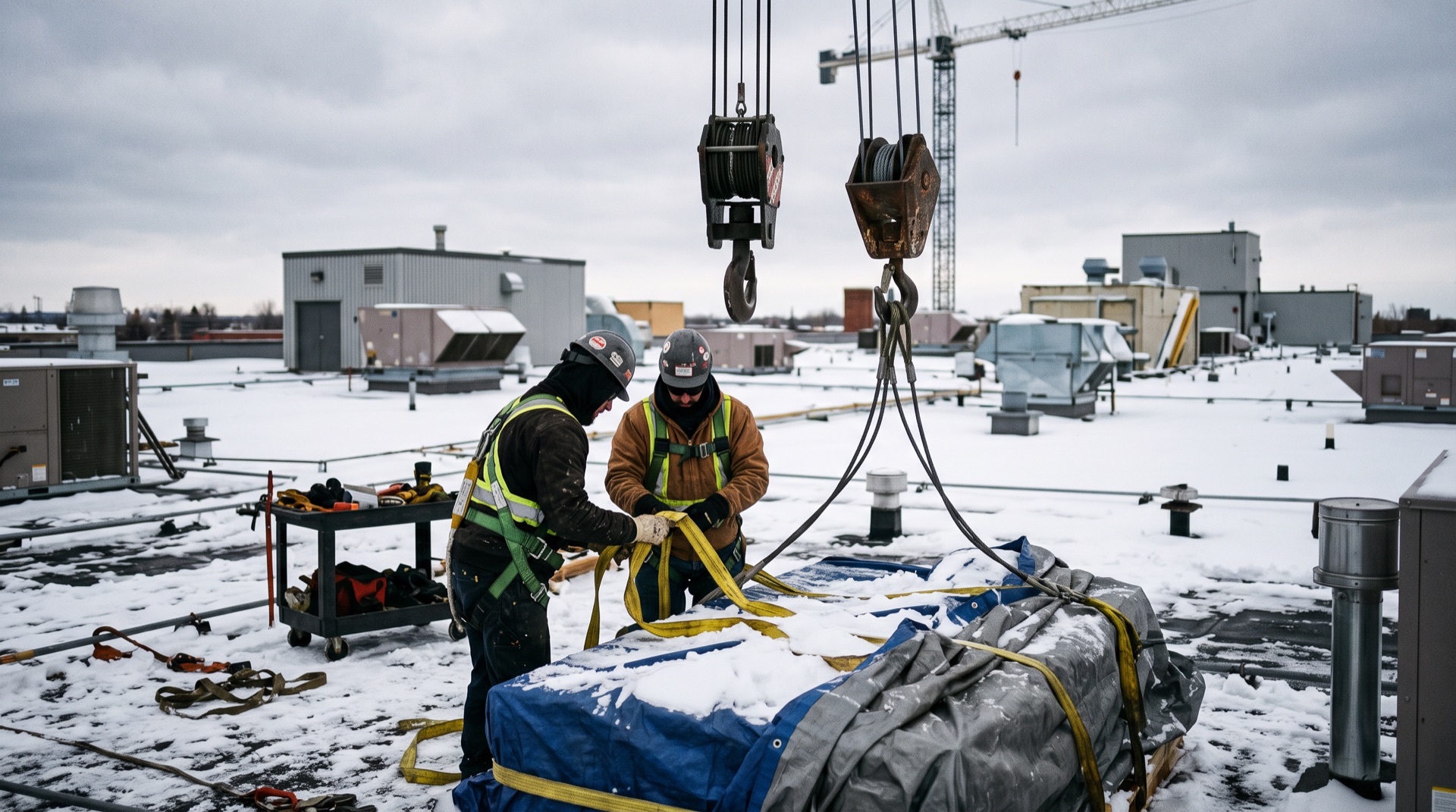
Two workers in hard hats rigging yellow lifting straps on snow-covered rooftop
Two workers secure yellow lifting straps around bundled equipment on a snow-covered commercial rooftop.
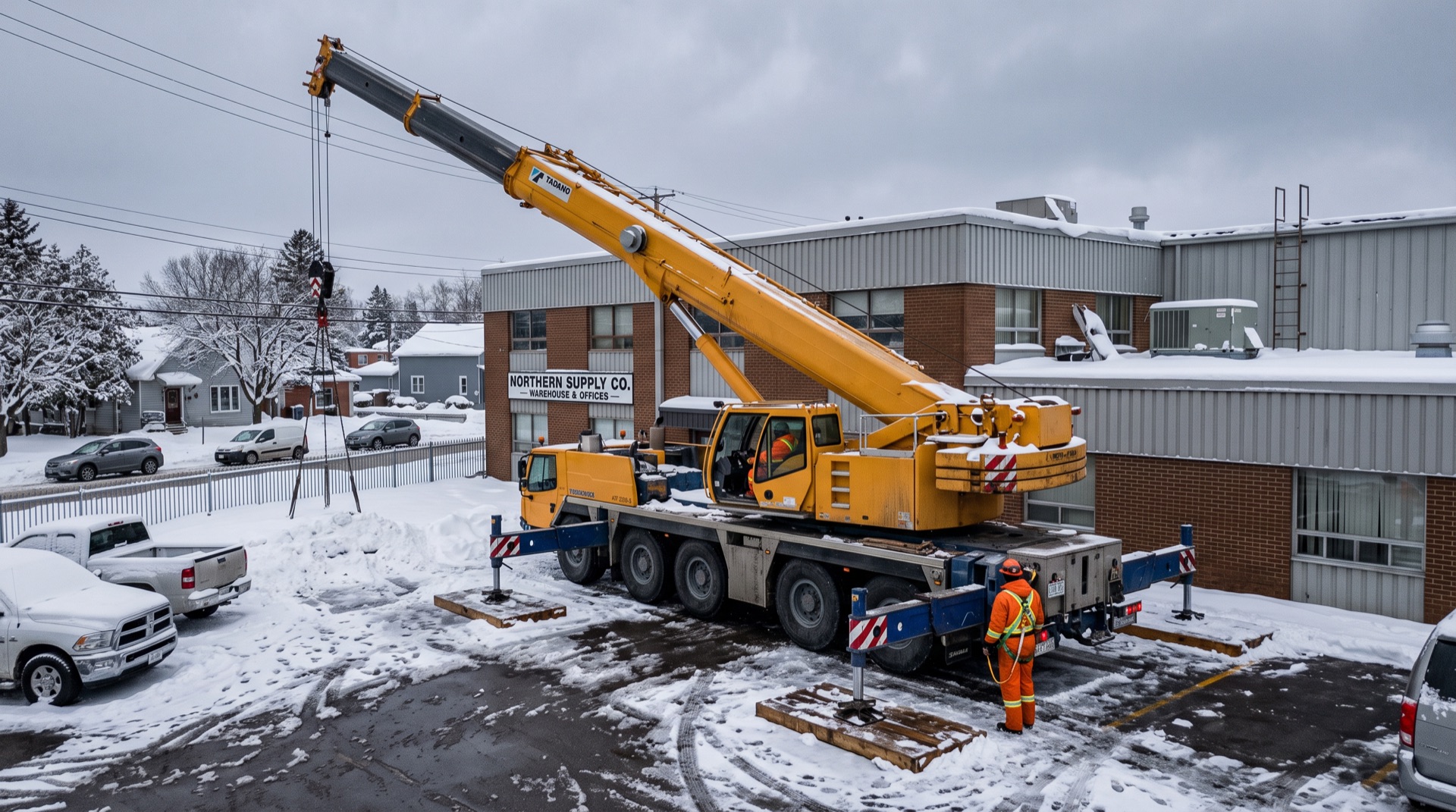
Yellow Tadano mobile crane set up at Northern Supply Co commercial building in winter
A Tadano mobile crane operates in a snowy parking lot outside the Northern Supply Co. warehouse and offices.
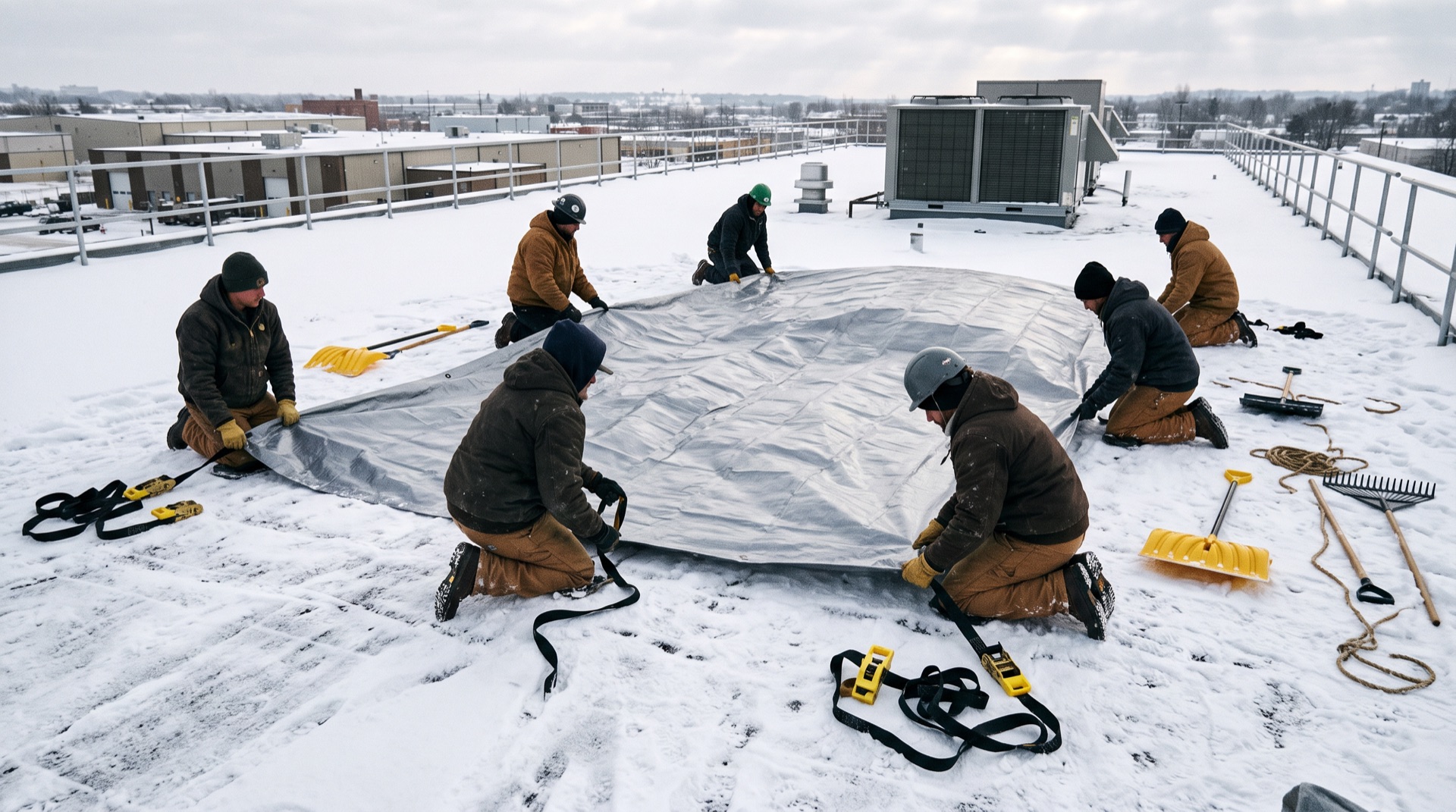
Six workers spreading a silver tarp across a snow-covered commercial rooftop
A six-person crew works together to secure a protective tarp over a snow-covered flat commercial roof.
FAQ

Kansas City and Jackson County FAQ

It is billed by the crew hour, and the rate plus a realistic time estimate are quoted on the phone before anyone is dispatched.

  • Scope drives the hours: length and thickness of the ice, roof pitch and height, and whether the gutters are frozen solid.
  • Access matters too — a three-story Kansas City roof takes longer to set up on than a ranch.
  • The invoice matches the quote. There are no surprise add-ons written on the tailgate.

Clear a path to the affected side, move vehicles off the driveway and unlock any side gate.

  • Put something under an active interior drip and move what you can out of the way.
  • Photograph the interior damage yourself as well - more evidence is never a problem.
  • Do not go on the roof or up a ladder. That is the part that sends people to hospital.

On a roof that is still leaking heat, it can — removal treats the symptom and the cause is in the attic.

  • Crews say so before leaving if the attic is obviously the problem.
  • A second visit in the same season at the same property is priced as the shorter job it usually is.
  • Air sealing, insulation and heat trace are what stop the cycle for good.

No, but there is a worse one: after the thaw, when the evidence has melted and the damage is all that is left.

  • Mid-storm calls are fine — crews work through freeze events.
  • An evening call for a leak that started that afternoon usually gets a next-morning slot.
  • Waiting for a weekend to pass is the most common and most expensive delay.

Same day or next morning for most Kansas City calls, with active interior leaks moved to the front of the schedule.

  • During a freeze event crews run from first light until dark across Jackson County.
  • The same route covers Riverside, Waldron, Liberty, so several addresses are usually handled in one run.
  • Call rather than using the form if water is coming in — the phone is always faster.

Enough to set outriggers fully, which is wider than the machine looks, plus clearance to the building and a unobstructed swing path. That is established on a site walk before anything is booked rather than discovered on the morning. Overhead power lines are frequently the deciding factor.

Less than people expect. The noise is a crane idling rather than impact work, and most of the activity is on the roof and in the drop zone. What does get restricted is the area under the swing path, which means some doors, parking and footpaths are out of use for the day and that gets planned with you in advance.

Nearby

Crane Snow Removal In Towns Around Kansas City

Same-Day Response

Get A Kansas City Crew Out

Nothing about an ice dam improves by waiting. It refreezes tonight, thicker, and the water behind it keeps looking for a way in.

✓ Licensed & insured✓ Low-pressure steam only✓ Rate quoted up front✓ Photos for your claim
Online Quote(888) 561-9664