Skip to content
Wyoming, MI
Deep Drifts & Big Roofs · Kent County

Crane-Assisted Snow Removal in Wyoming, MI — Lake‑Effect Storm Response

Ice Dam Now handles crane-assisted snow removal for Wyoming, MI properties and the wider Kent County. Removal is by low-pressure steam, never mechanical. Dispatch is same day where water is already inside, pricing is by the crew hour quoted before a crew leaves, and every job is photographed before and after for claim purposes. Crews are licensed, insured and harness-certified.

Permits handled — Pulled where the municipality requires them for a street setup
Marshalled exclusion zone — Pedestrian and vehicle control for the whole operation
Load calculated first — Depth, density and area against design capacity before anything mobilises
Weights documented — Depths, densities and loads recorded for the carrier

Get Ice Dam Help Wyoming

A few quick questions, then pick a time. If water is coming in, call instead.

What is the zip code of the home?

Roof leaking right now? Call (888) 561-9664 — that is faster than any form.
Water coming through the ceiling?Every hour an ice dam sits there, more water gets under the shingles.Call (888) 561-9664
24/7
Storm Season Dispatch
No Chipping
Steam Only
Kent
County Coverage
Crew Hour
Rate Quoted Up Front
Documented
Photos On Every Job

Ice dams are not a Wyoming problem so much as a Michigan one, and they show up on the same handful of eaves and valleys year after year. As part of our complete Wyoming winter roof services, crews handle crane-assisted snow removal across Kent County.

Snow Bands, Warm Attics and the Wyoming Eave

What makes Kent County roofs dam is not the seasonal total, it is how the snow arrives. Bands dump a heavy, saturated pack in hours, and that pack becomes a water reservoir sitting on a heated surface.

Diagram showing how ice dams form on roofs due to inadequate insulation and poor ventilation
Heat escaping into the attic melts roof snow; the meltwater refreezes at the cold eave and the dam grows a layer every cycle.

What turns that pack into a dam is the house underneath it. Warm air finds its way into the attic, the underside of the snow melts, and the water travels to an overhang that has no heated space below it. There it stops.

Ice-barrier practice in Kent County

Most Kent County building departments expect self-adhering ice barrier at the eaves on any re-roof permit. The houses that leak are generally the ones last roofed before that became routine.

Crane-Assisted Snow Removal in Wyoming: How The Work Runs

What it protects

Avoiding a structural failure is the obvious part. The less obvious part is that most carriers treat preventing an imminent collapse as loss mitigation, which is a very different conversation from a claim filed after the deck comes down. Weights, depths and dates are documented throughout for exactly that reason. Ceiling Sagging or Bulging After Snow.

What happens if the crane cannot get close enough

Overhead power, a narrow alley, soft ground that will not take outrigger loads, or a neighboring building in the swing path can all rule out a setup after a site visit.

That gets found on the walk rather than on the day. Where a crane genuinely will not work, the honest answer is a larger hand crew over more days with the cost difference laid out - not a pick that was never going to fit.

What goes in the tarp and what does not

A pick lifts loose and broken snow. It does not lift a solid sheet of ice frozen to the membrane, and trying to make it do so is how a tarp takes the roof covering with it.

So the sequence is crews cutting and breaking the pack into liftable material, the crane moving it, and steam dealing with whatever is bonded to the surface. The crane is the transport, not the demolition.

Outriggers on frozen and uneven ground

Frozen ground is not automatically good bearing. Frost heave, buried utilities, septic fields, soft fill under a lawn and anything that thaws mid-job all change what the pads are sitting on.

Pads are sized for the load and placed deliberately. It is the least visible part of a pick in Wyoming and the part with the least margin for improvisation.

Traffic control and the street closure conversation

A crane set up in a street needs the street. Depending on the municipality that means a permit, cones and flaggers, a parking suspension, or all of it, and the lead time is days rather than hours.

Those applications get made as part of the booking. Discovering on the morning of the lift that the road cannot legally be occupied is an expensive way to learn the local rules in Kent.
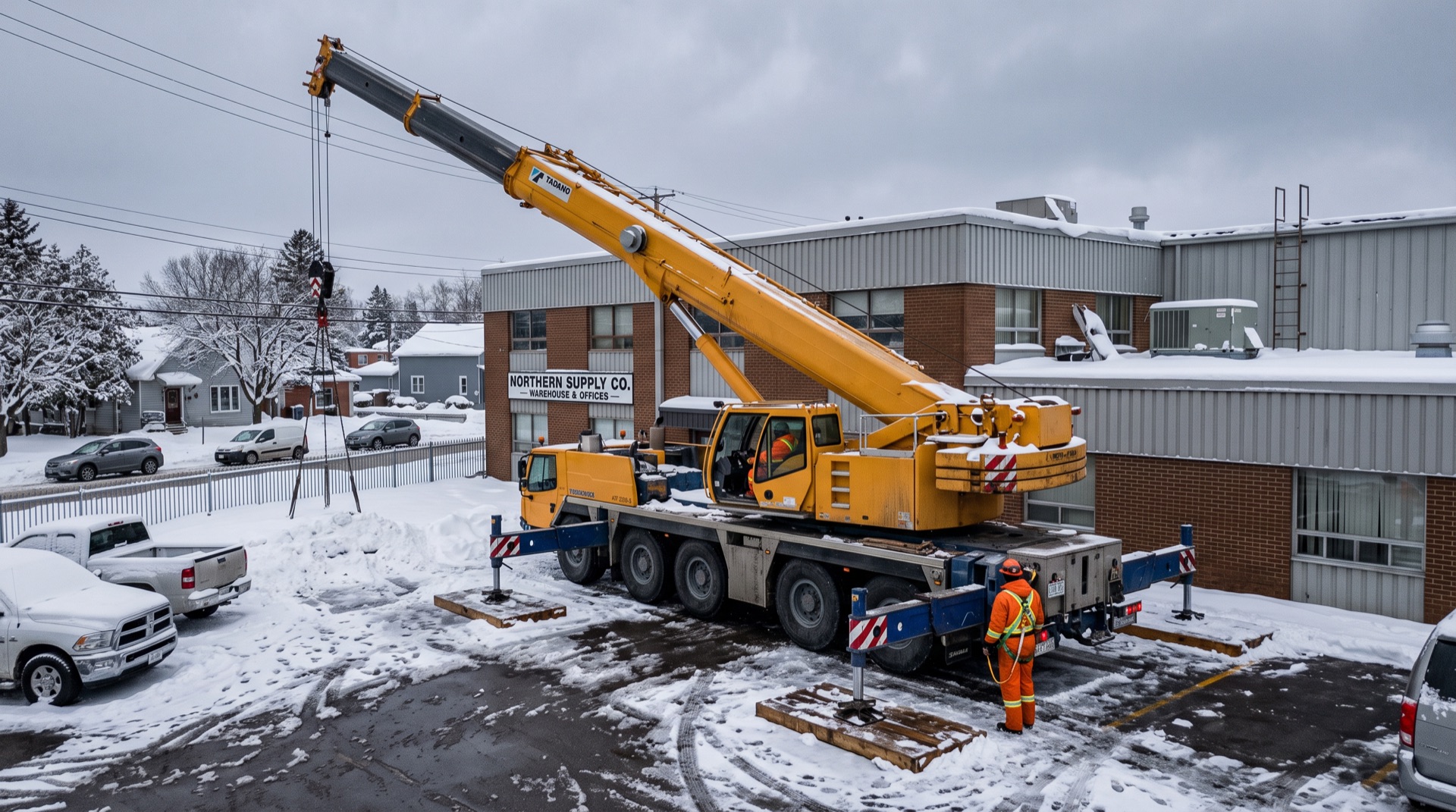
Yellow Tadano mobile crane set up at Northern Supply Co commercial building in winter
A Tadano mobile crane operates in a snowy parking lot outside the Northern Supply Co. warehouse and offices.

What you get in Wyoming

  • Lift planned firstAccess, swing radius, overhead lines and drop zone walked before scheduling
  • Weights documentedDepths, densities and loads recorded for the carrier
  • Marshalled exclusion zonePedestrian and vehicle control for the whole operation
Crane-Assisted Snow Removal in Wyoming, MI — specification
Service specification for Wyoming, MI
ServiceCrane-Assisted Snow Removal in Wyoming, MI
Pricing modelBilled by the crew hour, rate quoted before dispatch
Local ice-barrier practiceEave membrane expected on re-roofs
DocumentationDated before and after photos, written scope in Xactimate line items
Coverage areaWyoming and Kent County
Removal methodLow-pressure steam only. No chipping, salt or pressure washing.
Dispatch windowSame day to 24 hours

Wyoming Coverage and the Adjoining Communities

Crews working Wyoming cover the adjoining communities on the same route — Grandville, Jenison, Byron Center, Jamestown and Hudsonville — so a storm week usually means one truck handling several addresses in Kent County rather than separate trips.

Nearest hub towns with their own crane snow removal pages: Kentwood, Grand Rapids, Holland, Muskegon, Kalamazoo, Portage.

Crews cover Wyoming and the surrounding Kent County towns through the whole season, and during a freeze event they run from first light until dark.

Most jobs do not stop at one service. Crane Snow Removal in Wyoming often runs alongside commercial roof snow removal in Wyoming, and both get written into one scope rather than billed as separate visits.

Active leak right now? Our 24/7 Wyoming steam ice dam removal crews are dispatched first during a freeze event. Call (888) 561-9664.
Conditions We Work In

Crane-Assisted Snow Removal In Practice

Conditions crews work in across Kent County. Every job is photographed before and after.

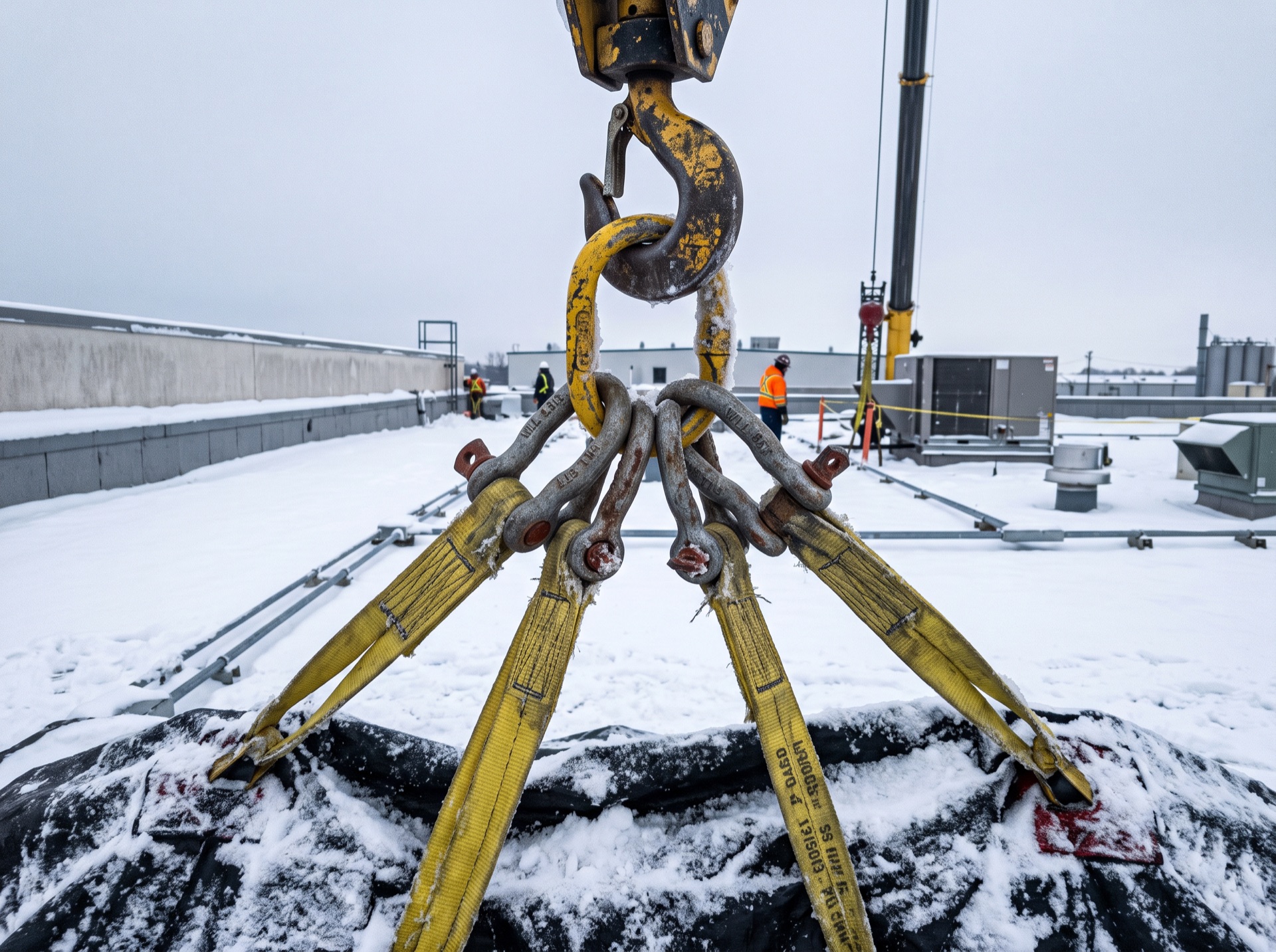
Crane hook with yellow lifting straps and shackles attached to snow-covered tarp on rooftop
Yellow lifting straps and heavy shackles connect a crane hook to a snow-covered tarp during a winter rooftop operation.
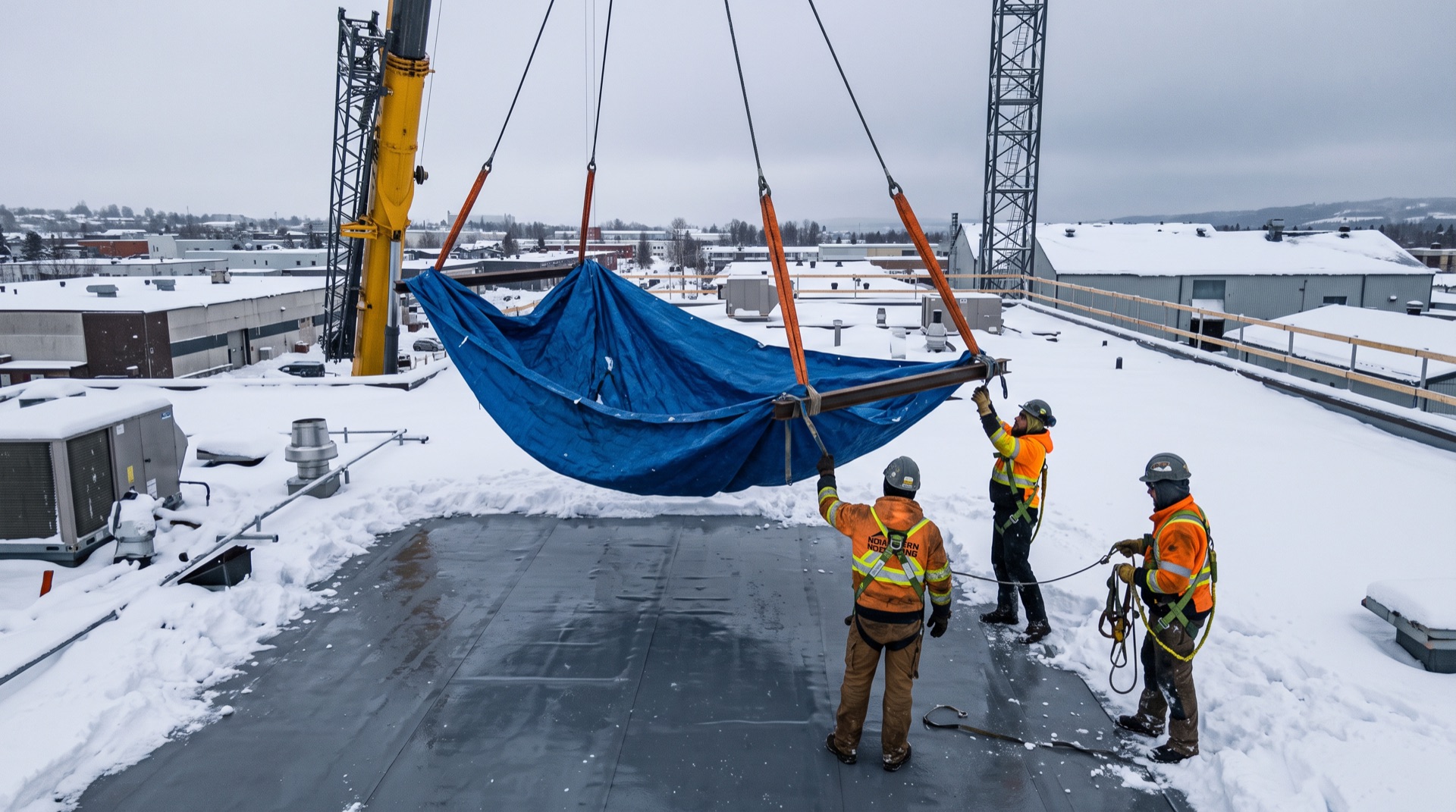
Three construction workers on snowy rooftop guiding empty blue tarp lowered by crane
Workers guide an empty blue tarp back onto the roof using a crane during winter roofing operations.
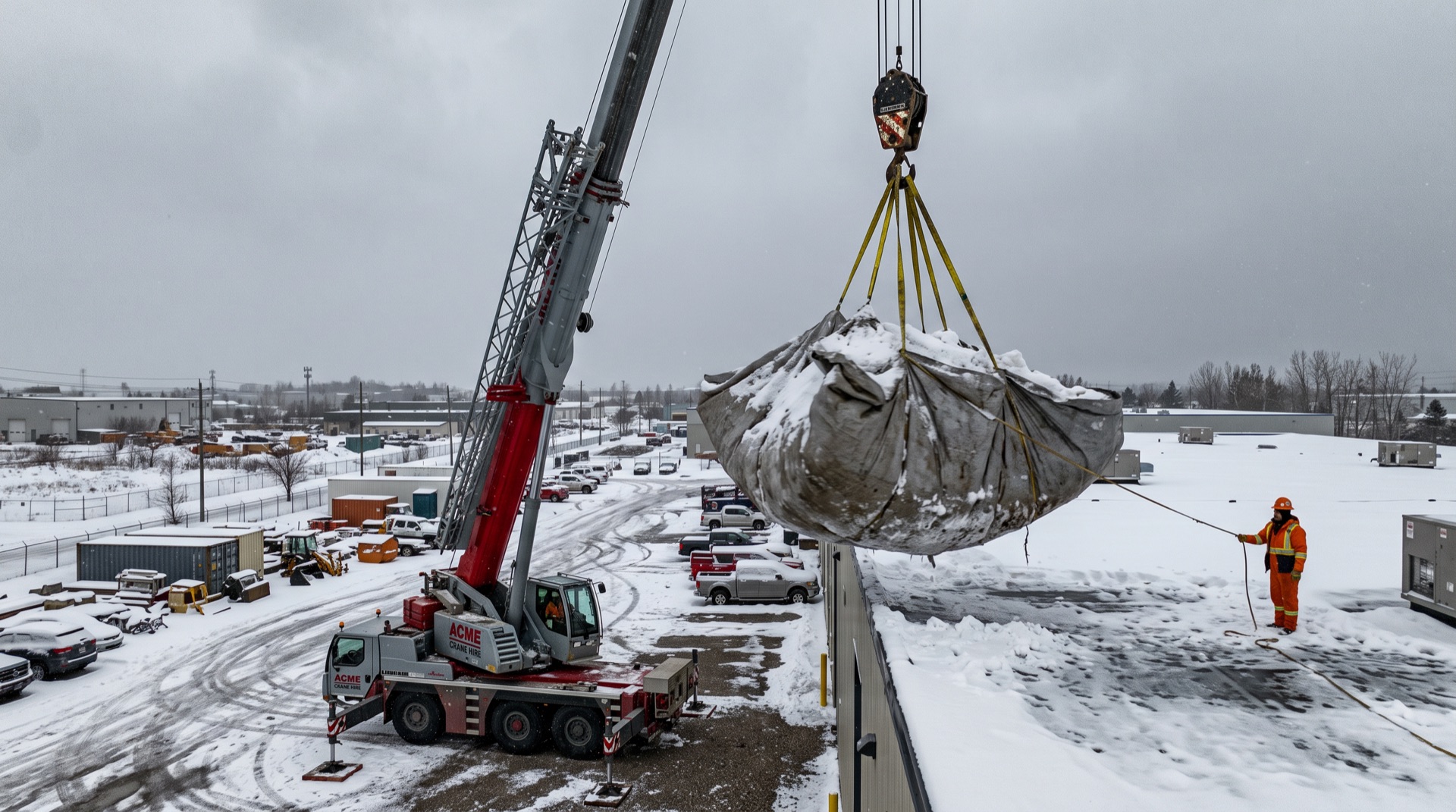
ACME crane lifting snow-covered tarp off commercial building roof in winter
An ACME mobile crane lifts a heavy snow-laden tarp from a commercial rooftop while a worker guides the load.
FAQ

Wyoming Questions We Actually Get Asked

It is billed by the crew hour, and the rate plus a realistic time estimate are quoted on the phone before anyone is dispatched.

  • Scope drives the hours: length and thickness of the ice, roof pitch and height, and whether the gutters are frozen solid.
  • Access matters too — a three-story Wyoming roof takes longer to set up on than a ranch.
  • The invoice matches the quote. There are no surprise add-ons written on the tailgate.

Yes. The dispatch area runs across Kent County, and several addresses in one area are usually handled in the same run.

  • Adjoining communities are on the same route rather than treated as a separate trip.
  • Rural addresses outside the normal radius get told the travel position on the call.
  • Capacity is moved into whichever part of Michigan the storm actually hits.

Because ice dams are made by heat loss, and two houses on the same street rarely leak heat the same way.

  • Attic air leaks around can lights, bath fans and the attic hatch are the usual source.
  • Crushed or missing soffit baffles stop the intake ventilation that would otherwise keep the deck cold.
  • An addition or dormer built over unheated space puts warm air right against a cold eave.
  • Local factor: lake-effect snow makes the difference show up faster here than it would further south.

On a roof that is still leaking heat, it can — removal treats the symptom and the cause is in the attic.

  • Crews say so before leaving if the attic is obviously the problem.
  • A second visit in the same season at the same property is priced as the shorter job it usually is.
  • Air sealing, insulation and heat trace are what stop the cycle for good.

More than it looks from the ground - a foot-deep dam across a thirty-foot eave is a few thousand pounds.

  • Depth is measured at the eave rather than estimated from the driveway.
  • The gutter trough underneath is usually frozen solid too and is part of the same mass.
  • That weight is one of the reasons chipping at it from a ladder goes badly.

Crews calculate the working load from snow depth, density and roof area and compare it against the structure's design capacity. If hand clearing cannot get the weight off faster than the next storm adds to it, or the roof is already deflecting, that is the threshold.

No. Tarps are laid on the snow, not the deck, and the load is lifted vertically clear rather than dragged. Nothing is skidded across the surface.

Nearby

Crane Snow Removal In Towns Around Wyoming

Same-Day Response

Get A Wyoming Crew Out

A dam left alone through February is not the same dam in March. It is bigger, and so is the repair behind it.

✓ Licensed & insured✓ Low-pressure steam only✓ Rate quoted up front✓ Photos for your claim
Online Quote(888) 561-9664