
Skip to content
Manhattan, KS
Stops The Next Dam · Riley County

Roof Snow Removal in Manhattan, KS — Thaw‑Cycle Storm Response

Roof Snow Removal in Manhattan, KS from Ice Dam Now: low-pressure steam only, across Riley County. No chipping, no salt, no pressure washing. Crews carry licensing, insurance and fall-protection certification, bill by the crew hour at a rate quoted on the phone, prioritize active interior leaks the same day, and document the work for insurance.

Paths cleared behind us — Driveways and walks are not left buried when the crew leaves
Standing schedules — Repeat properties can be cleared automatically after every storm
Drift points measured — Depth read where snow collects, not in the middle of the field
Eave-first clearing — The lower roof band where dams form gets cleared first, not last

Get Ice Dam Help Manhattan

A few quick questions, then pick a time. If water is coming in, call instead.

What is the zip code of the home?

Roof leaking right now? Call (888) 561-9664 — that is faster than any form.
Water coming through the ceiling?Every hour an ice dam sits there, more water gets under the shingles.Call (888) 561-9664
24/7
Dispatch All Winter
Steam
Only — No Pressure
Riley
County Coverage
Same Day
For Active Leaks
Insured
Licensed & Harness-Certified

Riley County sees the same pattern every winter: snow on the roof, warm air in the attic, and a line of ice building along the eave where the two meet. As part of our complete Manhattan winter roof services, crews handle roof snow removal across Riley County.

Manhattan Ice Dams: Why a Few Inches Is Enough

An ice dam needs meltwater and a cold eave, and Manhattan supplies both on an ordinary week. A thin cover that melts by lunchtime and sets again after dark is a perfectly good dam factory.

Diagram showing how ice dams form on a roof from heat loss and snow melt
Heat escaping into the attic melts roof snow; the meltwater refreezes at the cold eave and the dam grows a layer every cycle.

Because the winters read as mild, the building stock is not built for ice. Attic insulation is thinner, eave details are less considered, and ice barrier is more often absent than present on a roof in Manhattan.

Ice-barrier practice in Riley County

The residential code Kansas follows requires eave ice barrier on new work, and Riley County enforces it. The variable on any given house is simply when it was last roofed.

Roof Snow Removal in Manhattan: How The Work Runs

Clearing the eaves is what matters

The first three to six feet above the gutter line is where dams build, because that strip of roof sits past the heated part of the house. Taking the snow off that band removes the meltwater supply before the next thaw-freeze cycle can turn it into ice. Ceiling Sagging or Bulging After Snow.

Crews work from the ground with extended rakes wherever the pitch and height allow, and from the roof with harnesses and anchors when they do not. A cushion layer of snow is always left behind on the surface, because a rake run hard against bare shingle does its own damage.

Where the snow goes

Down is the easy part; where it lands matters. Crews work out the drop zones before starting so the pile does not end up on a deck, across a walkway, on top of shrubs, or against a basement window well.

Driveways and paths get cleared behind the work rather than left buried, which on a corner lot in Manhattan is often the difference between a tidy job and a complaint.

Clearing before the thaw rather than after

A warm spell is not relief. Meltwater from a deep pack has to go somewhere, and on a roof whose eaves and gutters are still frozen it goes under the shingles. The week a Manhattan forecast turns mild is the week the interior leak calls start.

Taking the snow off ahead of the thaw removes the water before it has a chance to find a way in, which is a far cheaper exercise than mitigating the ceiling it would otherwise come through.

How much of the roof actually needs clearing

Rarely all of it. The band that matters is the lower three to six feet above the gutter, because that is the strip sitting past the heated envelope where meltwater refreezes.

On a roof in Manhattan with no load concern, clearing that band and the valleys is usually the whole job. Scraping the full plane costs more, takes longer, and buys very little extra.

Skylights, vents and what gets flagged before clearing

Before a shovel moves, the crew walks the roof plan: skylights, solar panels, bath and ridge vents, satellite mounts, plumbing stacks and anything else that disappears under eighteen inches of snow. Each gets located and left proud of the surface.

On an older Manhattan roof the more useful part of that walk is often what it finds underneath - a lifted flashing or a soft spot in the deck that was there before the snow arrived and gets reported rather than covered back up.

Large piles of raked snow beside a gray clapboard house in winter
Heavy snow raked from the roof sits piled against the side of a gray house.

What you get in Manhattan

  • Eave-first clearingThe lower roof band where dams form gets cleared first, not last
  • Drift points measuredDepth read where snow collects, not in the middle of the field
  • Drop zones plannedSnow lands clear of decks, walkways, shrubs and window wells
Roof Snow Removal in Manhattan, KS — specification
Service specification for Manhattan, KS
Pricing modelBilled by the crew hour, rate quoted before dispatch
Dispatch windowSame day to 24 hours
Coverage areaManhattan and Riley County
Local ice-barrier practiceEave membrane on new work, often absent
ServiceRoof Snow Removal in Manhattan, KS
Primary climate stressorRepeated thaw-freeze cycling
DocumentationDated before and after photos, written scope in Xactimate line items

Neighborhoods and Towns We Reach From Manhattan

Crews working Manhattan cover the adjoining communities on the same route — Ogden, Saint George and Riley — so a storm week usually means one truck handling several addresses in Riley County rather than separate trips.

Nearest hub towns with their own roof snow removal pages: Topeka, Emporia, Salina, Lawrence, Leavenworth, Olathe.

During a cold snap Manhattan gets worked alongside the neighboring Riley County towns on the same route, with active interior leaks moved to the front of the list.

Most jobs do not stop at one service. Roof Snow Removal in Manhattan often runs alongside ice dam removal in Manhattan, and both get written into one scope rather than billed as separate visits.

Active leak right now? Our 24/7 Manhattan steam ice dam removal crews are dispatched first during a freeze event. Call (888) 561-9664.

Conditions We Work In

Roof Snow Removal In Practice

Conditions crews work in across Riley County. Every job is photographed before and after.

Worker in safety harness shoveling heavy snow off a residential roof
A roofing professional uses a safety harness and blue shovel to clear heavy snow accumulation from a residential roof.
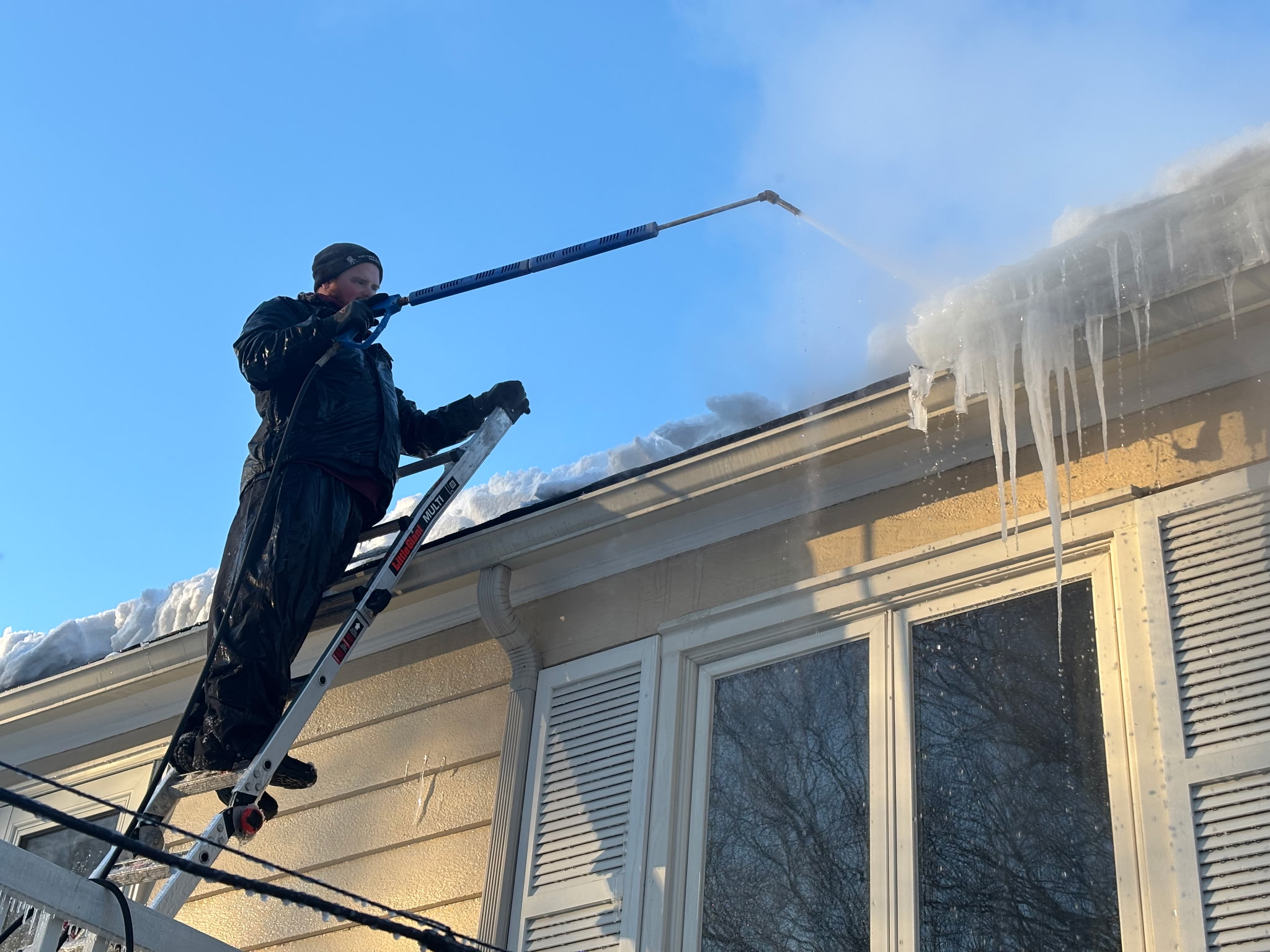
Worker on ladder using steam wand to remove ice dams and icicles from residential roof
A technician uses a high-pressure steam wand to melt ice dams and icicles from a home's roofline.
Large piles of raked snow beside a gray clapboard house in winter
Heavy snow raked from the roof sits piled against the side of a gray house.
FAQ

Local Questions About Manhattan Roofs

It is billed by the crew hour, and the rate plus a realistic time estimate are quoted on the phone before anyone is dispatched.

  • Scope drives the hours: length and thickness of the ice, roof pitch and height, and whether the gutters are frozen solid.
  • Access matters too — a three-story Manhattan roof takes longer to set up on than a ranch.
  • The invoice matches the quote. There are no surprise add-ons written on the tailgate.

On a roof that is still leaking heat, it can — removal treats the symptom and the cause is in the attic.

  • Crews say so before leaving if the attic is obviously the problem.
  • A second visit in the same season at the same property is priced as the shorter job it usually is.
  • Air sealing, insulation and heat trace are what stop the cycle for good.

Yes. The dispatch area runs across Riley County, and several addresses in one area are usually handled in the same run.

  • Adjoining communities are on the same route rather than treated as a separate trip.
  • Rural addresses outside the normal radius get told the travel position on the call.
  • Capacity is moved into whichever part of Kansas the storm actually hits.

Yes. Steam is safe on slate, cedar shake, tile and metal as well as asphalt, because it removes ice with heat rather than force.

  • Older Manhattan housing stock with original slate is exactly where chipping does the most damage.
  • Crews adjust the lance distance and dwell rather than the pressure.
  • Nothing mechanical touches the covering at any point.

Please do not. Salt corrodes flashing, fasteners, gutters and anything metal it drains across, and it damages whatever is planted below.

  • Calcium chloride is less aggressive than rock salt but still ends up in the soil at the drip line.
  • A puck melts a hole, not a drainage path, so the water simply refreezes a few inches further on.
  • Crews use heat and nothing else - no salt, no chemicals, nothing corrosive.

Often yes, because the danger is compounding rather than any single storm. A cleared roof meets the next storm from zero instead of adding it to a hardened base. The exception is the day before a heavy fall with no thaw behind it, in which case waiting a day is usually the better value and gets suggested.

Usually the lower three to six feet of every eave, plus valleys, and more than that where the load reading says so. Clearing the eaves is what prevents dams; clearing the whole roof is only necessary when the weight itself is the problem, and you will be told which situation you are in.

Nearby

Roof Snow Removal In Towns Around Manhattan

Same-Day Response

Get A Manhattan Crew Out

The cost of a steam visit does not change much from one week to the next. The cost of the water damage behind the dam does.

✓ Licensed & insured✓ Low-pressure steam only✓ Rate quoted up front✓ Photos for your claim
Online Quote(888) 561-9664