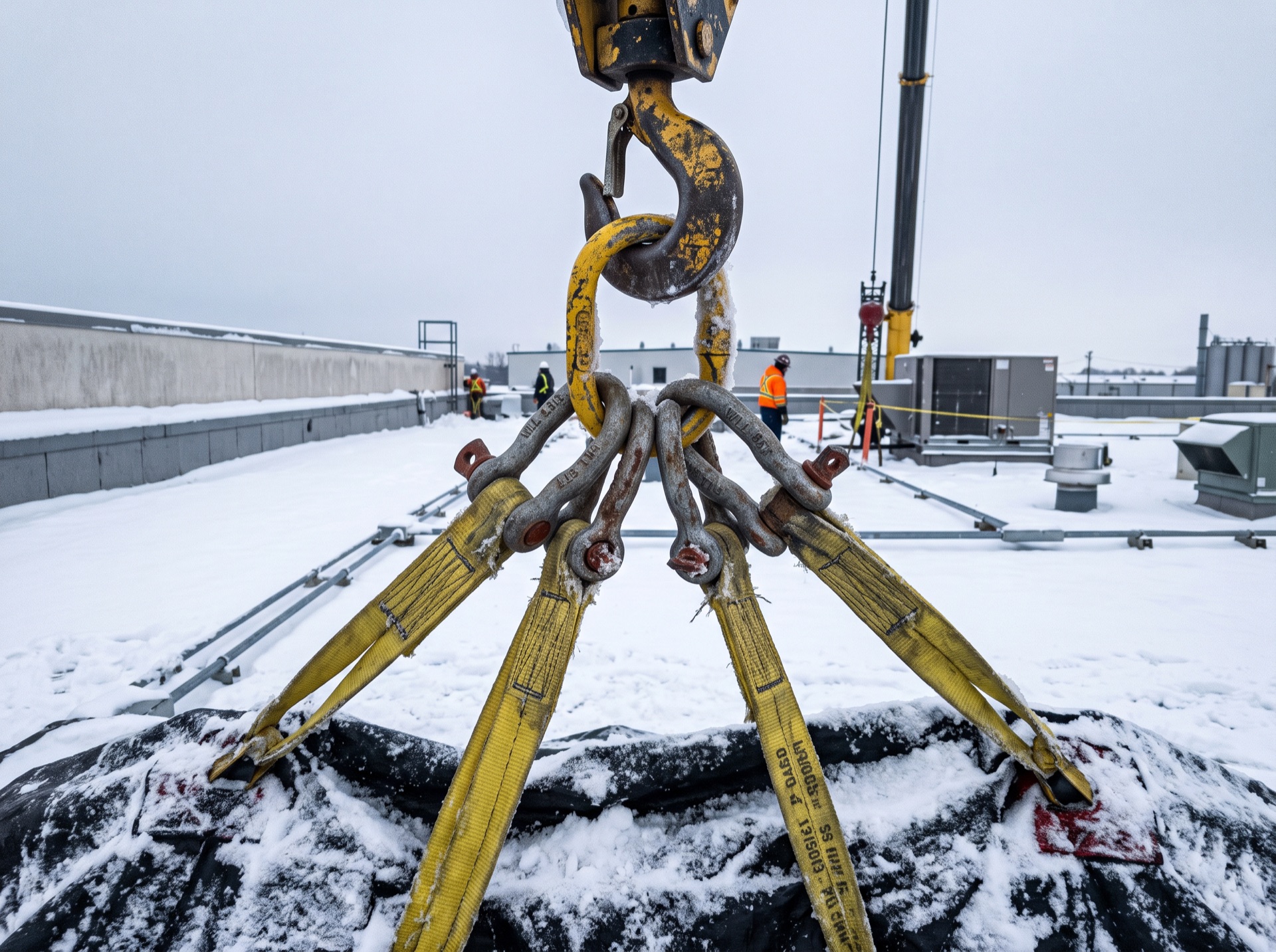
Ice dams are not an Anderson problem so much as an Indiana one, and they show up on the same handful of eaves and valleys year after year. As part of our complete Anderson winter roof services, crews handle crane-assisted snow removal across Madison County.
The Anderson Problem Is the Thermometer, Not the Snowfall
The snow totals here are unremarkable, which is exactly why Anderson roofs get caught out. An ice dam needs meltwater and a cold eave, not a record storm.

The building stock has no margin for it. Because the winters here read as mild, attics tend to be under-insulated, eave details are less considered, and ice barrier is as often absent as present on a roof in Anderson.
Ice-barrier practice in Madison County
The residential code Indiana follows calls for eave ice barrier on new work. Enforcement in Madison County is real but recent, so the age of the roof is what decides whether it is there.
Crane-Assisted Snow Removal in Anderson: How The Work Runs
What happens if the crane cannot get close enough
Overhead power, a narrow alley, soft ground that will not take outrigger loads, or a neighboring building in the swing path can all rule out a setup after a site visit. Ceiling Sagging or Bulging After Snow.
That gets found on the walk rather than on the day. Where a crane genuinely will not work, the honest answer is a larger hand crew over more days with the cost difference laid out - not a pick that was never going to fit.
Wind limits and when a pick gets postponed
Every crane has a wind chart, and a tarp full of snow is about the worst possible load to put on a hook in a gust - large surface area, light enough to sail, heavy enough to hurt. The limit is lower than people expect and it is not negotiable.
A Anderson pick that is cancelled for wind gets rescheduled rather than argued about. The alternative is a swinging load over an occupied building.
When a crane is the right call
Multi-story homes and estates where the upper roof cannot be safely reached. Large commercial and industrial decks where the sheer tonnage makes hand clearing a multi-day job. Any roof where deflection is already visible and the load has to come off today rather than over a week.
The decision is made on numbers, not instinct. Depth, density and area give a working load figure, and that figure against the roof's design capacity is what determines whether a crane gets mobilised to a property in Anderson.
How a pick actually works
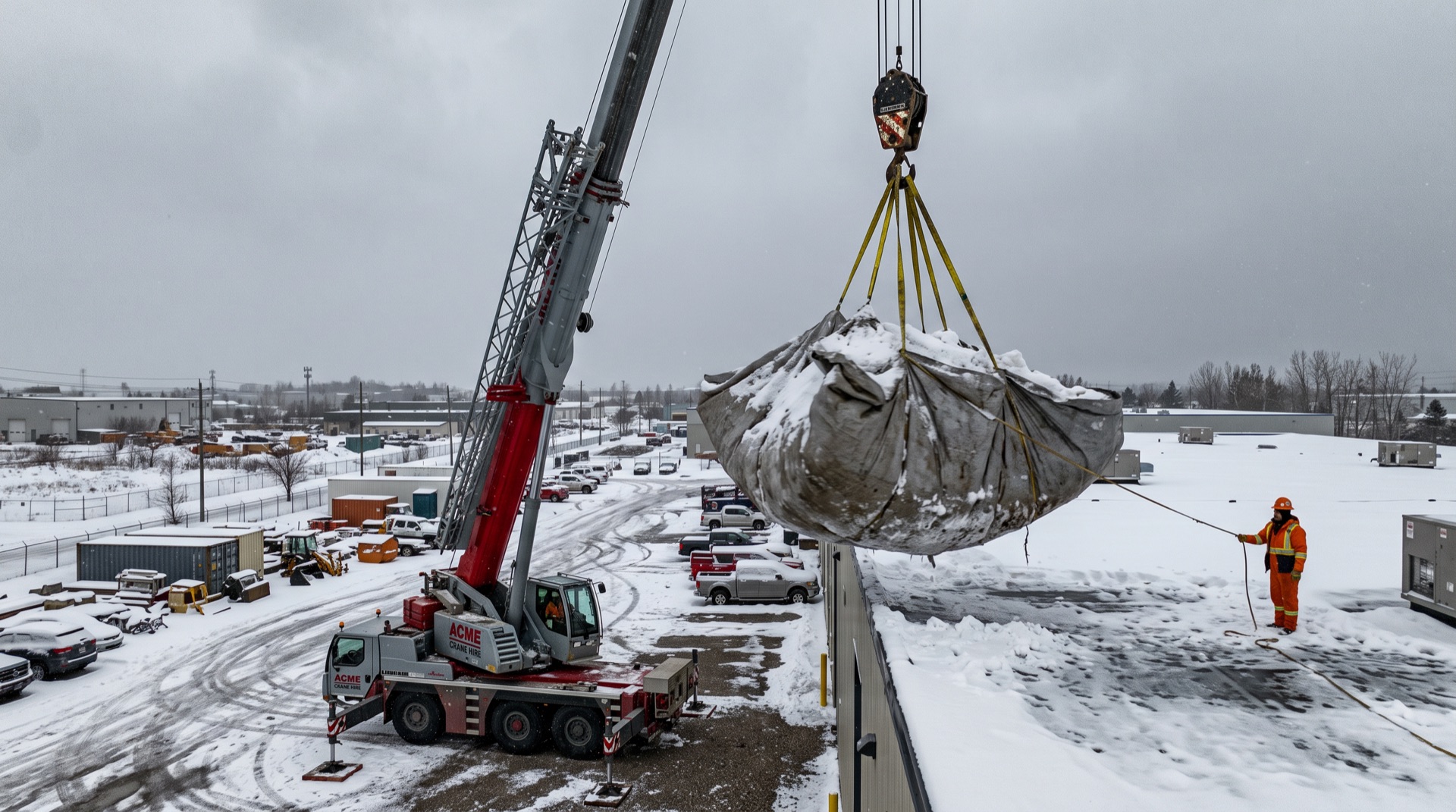
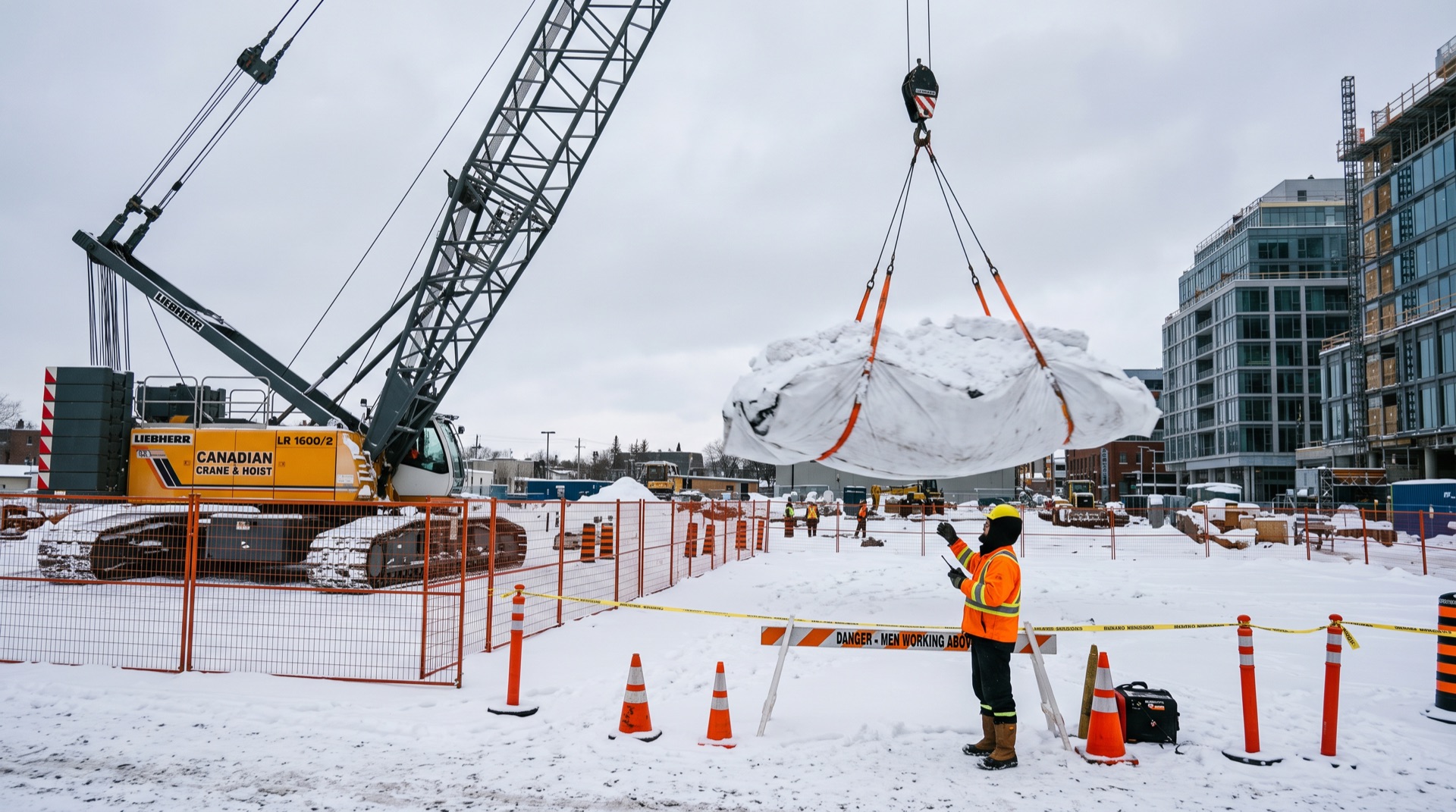
Rip-stop tarps are laid out and anchored on the deck, crews load them, and the boom lifts each loaded tarp clear and sets it down in a designated drop zone on the ground. Outrigger pads are placed on frozen ground rated for the load, and a pedestrian exclusion zone is set and marshalled for the whole operation.
It is a planned lift, not an improvisation. Site access, swing radius, overhead lines, drop zone and ground bearing all get walked before the first tarp goes down.
Traffic control and the street closure conversation
A crane set up in a street needs the street. Depending on the municipality that means a permit, cones and flaggers, a parking suspension, or all of it, and the lead time is days rather than hours.
Those applications get made as part of the booking. Discovering on the morning of the lift that the road cannot legally be occupied is an expensive way to learn the local rules in Madison.
What you get in Anderson
- Load calculated firstDepth, density and area against design capacity before anything mobilises
- Weights documentedDepths, densities and loads recorded for the carrier
- Permits handledPulled where the municipality requires them for a street setup
| Primary climate stressor | Repeated thaw-freeze cycling |
|---|---|
| Typical scope | Steam, 4-8 crew hours typical |
| Coverage area | Anderson and Madison County |
| Local ice-barrier practice | Eave membrane on new work, often absent |
| Removal method | Low-pressure steam only. No chipping, salt or pressure washing. |
| Pricing model | Billed by the crew hour, rate quoted before dispatch |
| Documentation | Dated before and after photos, written scope in Xactimate line items |
Madison County Coverage From Anderson
Crews working Anderson cover the adjoining communities on the same route — Lapel, Frankton, Ingalls, Markleville and Pendleton — so a storm week usually means one truck handling several addresses in Madison County rather than separate trips.
Nearest hub towns with their own crane snow removal pages: Noblesville, Fishers, Muncie, Westfield, Carmel, Lawrence.
Crews cover Anderson and the surrounding Madison County towns through the whole season, and during a freeze event they run from first light until dark.
Most jobs do not stop at one service. Crane Snow Removal in Anderson often runs alongside commercial roof snow removal in Anderson, and both get written into one scope rather than billed as separate visits.
Active leak right now? Our 24/7 Anderson steam ice dam removal crews are dispatched first during a freeze event. Call (888) 561-9664.