



The Cook County Trap: Modest Snow, Constant Cycling
Three inches of snow and a week of days above freezing and nights below it will build ice on a Cook County eave just as reliably as a foot of snow further north.

And the cycling is relentless rather than dramatic. Fifteen or twenty crossings of freezing in a season each add a layer, and the houses with the thinnest attic insulation in Cook County all find out in the same week.
Ice-barrier practice in Cook County
The residential code Illinois follows requires eave ice barrier on new work, and Cook County enforces it. The variable on any given house is simply when it was last roofed.
How We Work an Orland Park Ice Dam
The first pass is assessment: eaves, valleys, gutter line and any interior staining, all photographed with timestamps. You see what the crew sees, and the rate and likely hours are agreed before work begins.
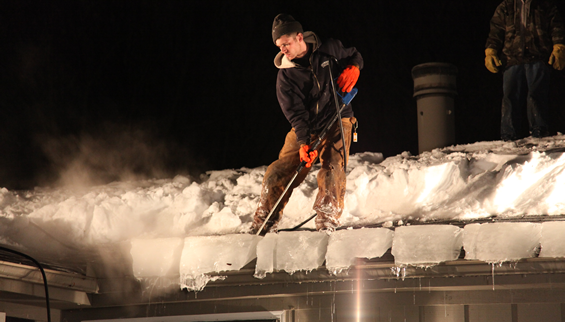
Steam then takes the dam off in sections, prioritizing wherever water is actively backing up behind it. The gutter trough and downspout are cleared through to daylight on the same visit, because a clear eave over a frozen gutter is a temporary fix.
How long a removal actually takes
A single-story eave with a thin dam and clear gutters is often an hour or two. A two-story Orland Park house with ice standing a foot deep across the front, frozen downspouts and a valley packed solid is most of a day for a two-man crew. The honest answer on the phone is a range and the reason for it, not a number designed to win the booking.
The estimate is revised out loud if the roof turns out worse than it looked from the ground, before the extra hours are worked rather than after they appear on the invoice.
Why the gutter has to be cleared in the same visit
A dam sitting above a gutter packed solid with ice is only half the problem. Clear the eave and leave the trough frozen, and the next day's meltwater has nowhere to run — it backs up onto the roof and the dam rebuilds from the bottom.
Crews steam the trough and the downspout through to daylight on the same visit. It adds time, which is why the hour estimate given on the phone accounts for it, and it is the difference between a fix and a repeat visit in Orland Park the following week.
Why a drainage channel is not removal
Cutting a few channels through a dam so water can get past is quick and it is sometimes sold as ice dam removal. It drains the roof for as long as the channels stay open, which in an Orland Park cold snap can be a single night before they close again.
Removing the dam means taking the ice off down to the shingle along the whole affected run, so the eave can drain the way it was built to. It takes longer and it is the only version that holds.
| Typical scope | Steam, 4-8 crew hours typical |
|---|---|
| Dispatch window | Same day to 24 hours |
| Service | Ice dam removal in Orland Park, IL |
| Local ice-barrier practice | Eave membrane on new work, often absent |
| Coverage area | Orland Park and Cook County |
| Pricing model | Billed by the crew hour, rate quoted before dispatch |
| Documentation | Dated before and after photos, written scope in Xactimate line items |
Cook County Coverage From Orland Park
Crews working Orland Park cover the adjoining communities on the same route — Palos Park, Palos Heights, Oak Forest, Homer Glen and Worth — so a storm week usually means one truck handling several addresses in Cook County rather than separate trips.
Nearest hub towns with their own crew pages: Tinley Park, Oak Lawn, Hanover Park, Romeoville, Bolingbrook, Joliet.
During a cold snap Orland Park gets worked alongside the neighboring Cook County towns on the same route, with active interior leaks moved to the front of the list.
Water through a ceiling in Orland Park is a same-day call, not a next-week one. (888) 561-9664 goes straight to dispatch.