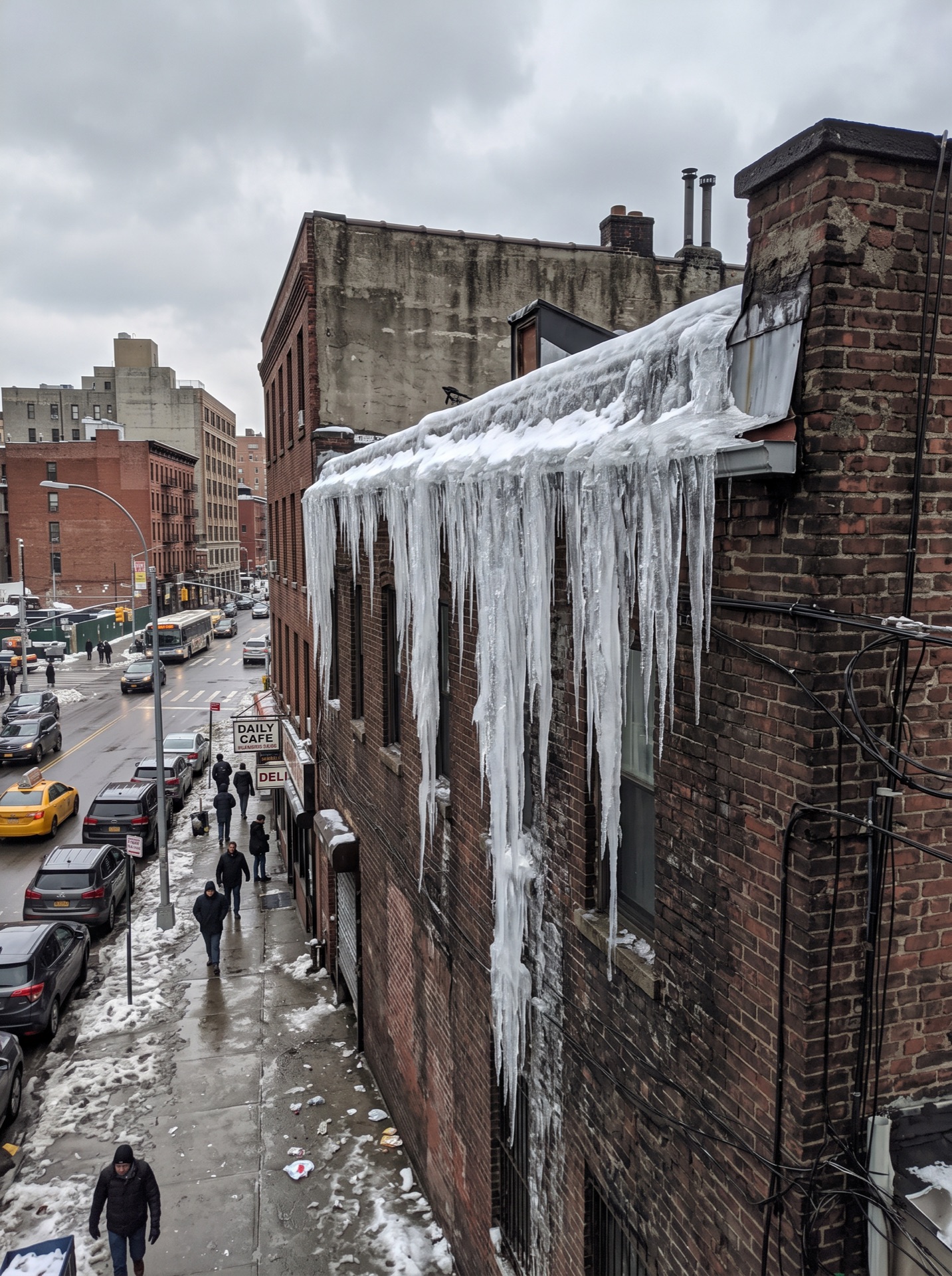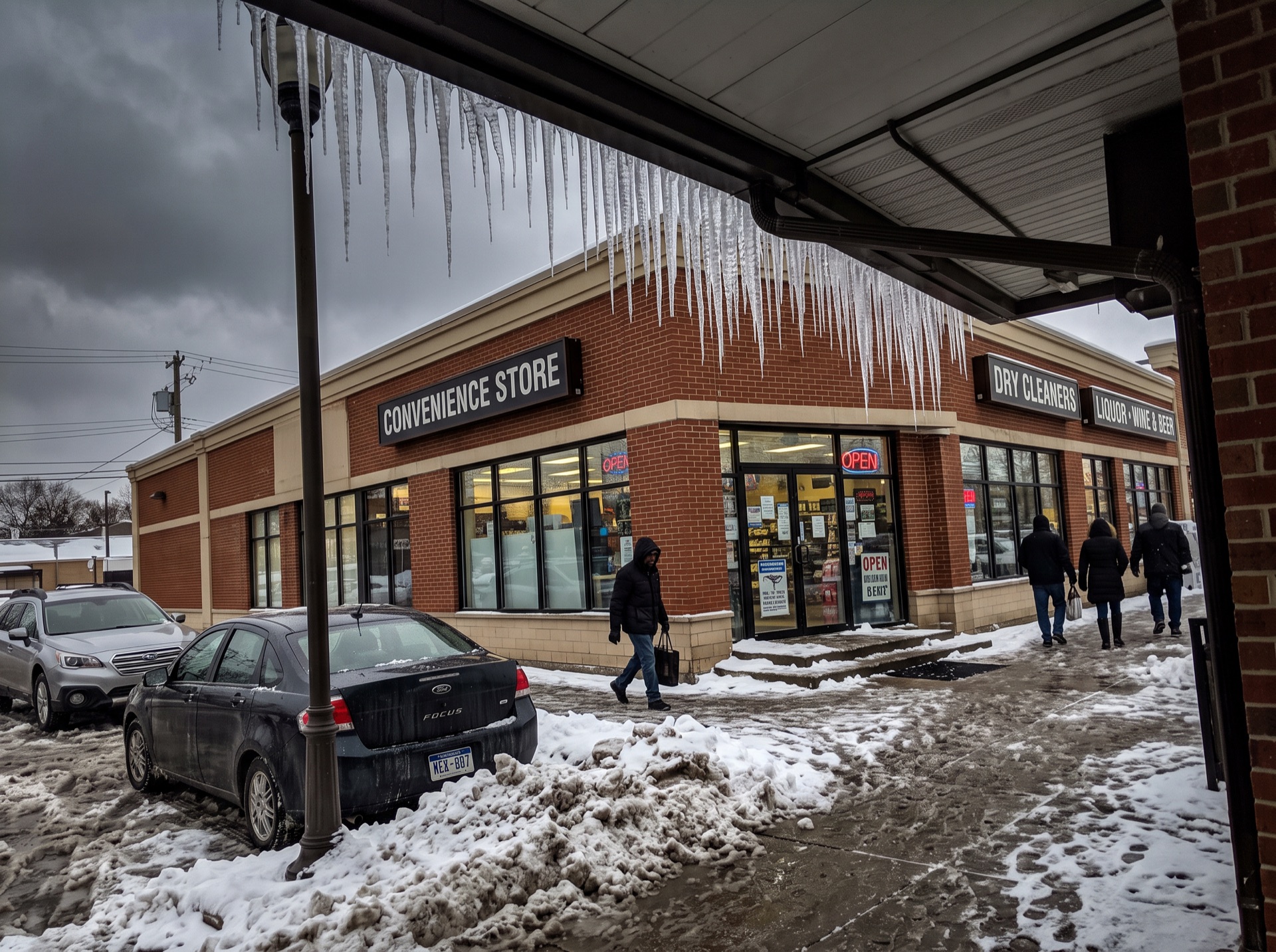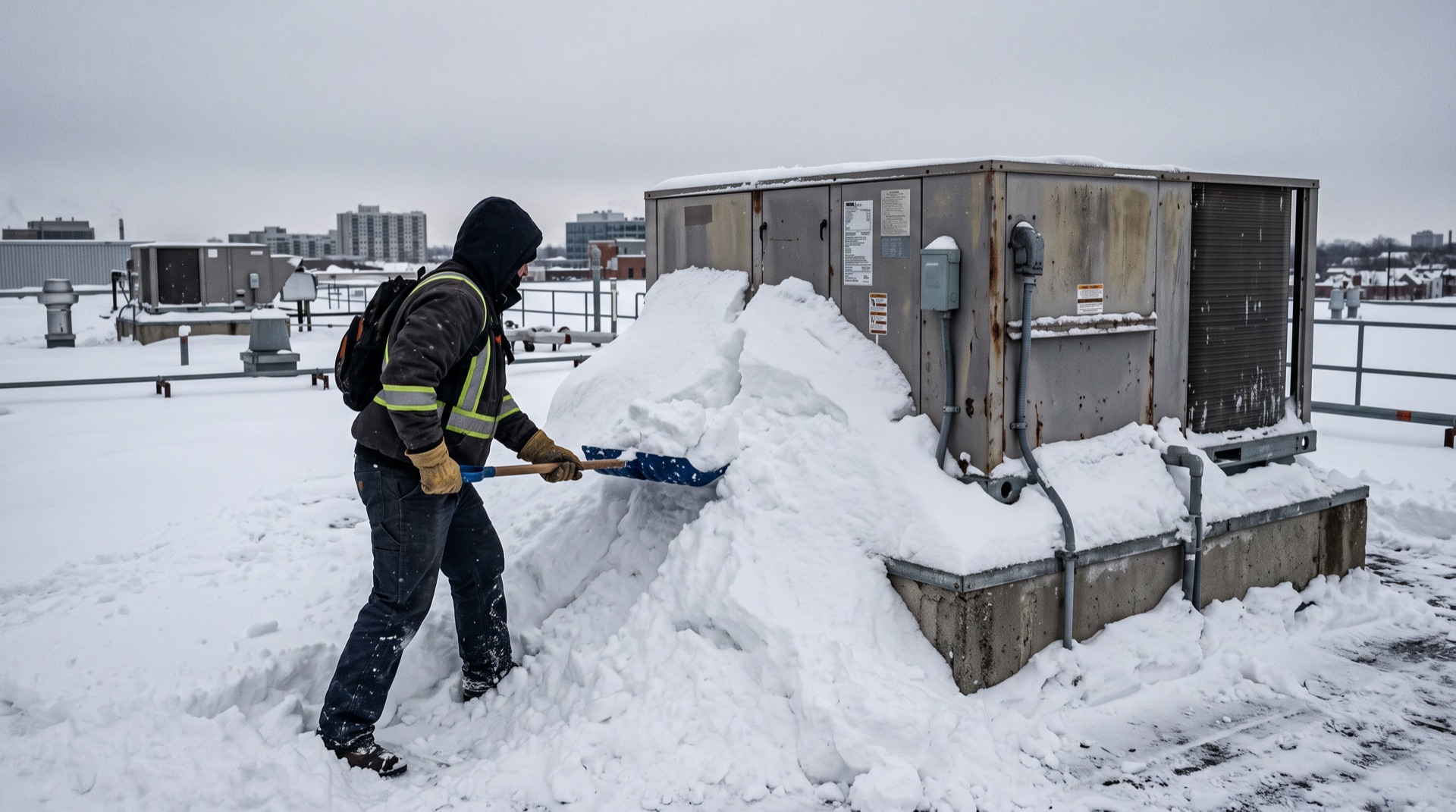
Most Bristol homeowners find out about an ice dam from the inside — a damp patch on a bedroom ceiling, or water tracking down the inside of a window frame. As part of our complete Bristol winter roof services, crews handle commercial roof snow removal across Hartford County.
Why Bristol Roofs Dam Up: Nor'easter Load and the Maritime Swing
Coastal storms deliver the heaviest snow by weight. A single nor'easter can put a wet, dense pack on a roof in Bristol in one night, and the maritime air that follows rarely stays on one side of freezing for long.

Then there is the architecture. Bristol has a great deal of older housing with shallow eave returns, knee-wall attics and rooms built out over porches, all of which put heated air against cold deck with very little between.
Ice-barrier practice in Hartford County
Coastal Connecticut jurisdictions generally require the membrane to extend past the interior wall line. On a house in Bristol with a deep overhang that is further up the roof than a single course.
Commercial Roof Snow Removal in Bristol: How The Work Runs
Storm routes and standing contracts
Properties on a standing contract get a scheduled clear after each qualifying snowfall, with a single point of contact and a condition report per visit. For a portfolio, that means the clearing order is decided in advance by risk rather than by whoever calls first during the storm. Ceiling Sagging or Bulging After Snow.
Reduction, not bare deck
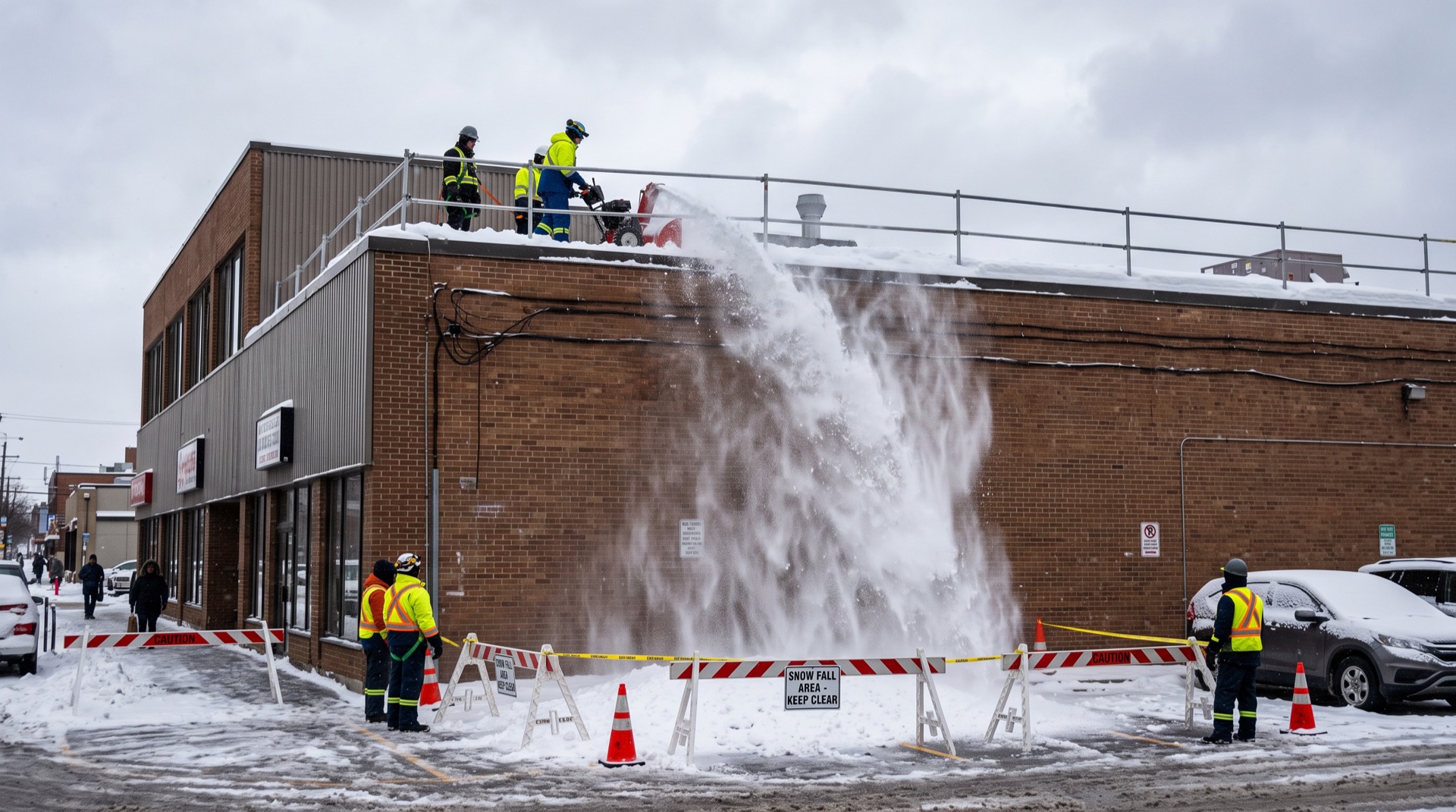
The goal is to bring the load under threshold safely, not to scrape a roof in Bristol clean. Clearing is balanced across the deck so load is not shifted onto one bay, drains and scuppers are opened so melt has an exit, and a cushion layer always stays on the membrane.
Where the figures call for it, crews bring in crane-assisted picks instead of adding bodies to a roof that is already carrying too much.
Reading the design load off the drawings
Where structural drawings exist they state the design ground snow load and the roof's own capacity, and that number turns the whole question from opinion into arithmetic. Measured depth and density against design capacity gives a percentage rather than an argument.
Where the drawings have been lost - common on older Bristol stock - the conservative assumption is the code minimum of the era the building went up, which is usually well below what a modern roof would be built to.
Fall protection on a deck with no anchors
Most commercial roofs have no permanent anchor points and a parapet too low to count as a guard. Working near an unprotected edge legally requires a system, and improvising one is where people get hurt.
Crews bring mobile anchors, warning lines and whatever the layout actually needs. Where the roof cannot be worked safely at all, that gets reported to the Bristol property manager as a finding, because it will be just as true during the next storm.
Why large decks carry the most risk
A long-span steel or open-web joist roof has the least margin exactly where the drift is deepest — mid-span. Snow does not settle evenly either: it piles against parapets, behind rooftop units, in the lee of higher adjoining roofs, and in valleys between bays. The average depth across the roof is not the number that matters.
Crews survey depth and density at the drift points rather than the middle of the field, and calculate the working load from that against the structure's design capacity.
What you get in Bristol
- Overflows opened firstDrains and scuppers cleared before the load comes off
- Mid-span measuredDepth read over the longest unsupported span, not the average
- One invoice per siteMulti-building properties scoped and billed together
| Pricing model | Billed by the crew hour, rate quoted before dispatch |
|---|---|
| Dispatch window | Same day to 24 hours |
| Removal method | Low-pressure steam only. No chipping, salt or pressure washing. |
| Local ice-barrier practice | Eave membrane standard on re-roofs |
| Documentation | Dated before and after photos, written scope in Xactimate line items |
| Primary climate stressor | Nor'easters, rapid thaw-freeze swing |
| Coverage area | Bristol and Hartford County |
Hartford County Coverage From Bristol
Crews working Bristol cover the adjoining communities on the same route — Pequabuck, Plainville, Terryville, Unionville and Burlington — so a storm week usually means one truck handling several addresses in Hartford County rather than separate trips.
Nearest hub towns with their own commercial snow pages: Southington, New Britain, Farmington, Newington, West Hartford, Waterbury.
During a cold snap Bristol gets worked alongside the neighboring Hartford County towns on the same route, with active interior leaks moved to the front of the list.
Most jobs do not stop at one service. Commercial Snow in Bristol often runs alongside crane-assisted snow removal in Bristol, and both get written into one scope rather than billed as separate visits.
Active leak right now? Our 24/7 Bristol steam ice dam removal crews are dispatched first during a freeze event. Call (888) 561-9664.