

Skip to content
Cincinnati, OH
Deep Drifts & Big Roofs · Hamilton County

Crane-Assisted Snow Removal in Cincinnati, OH — Freeze‑Thaw Response

Ice Dam Now provides crane-assisted snow removal in Cincinnati, OH and the surrounding Hamilton County, using low-pressure steam only — never chipping, salt or pressure washing. Crews are licensed, insured and harness-certified, dispatch same day for active interior leaks, and bill by the crew hour at a rate quoted before dispatch. Dated photo documentation is supplied for insurance claims.

Load calculated first — Depth, density and area against design capacity before anything mobilises
Rip-stop tarp picks — Rated tarps and rigging, with lifts planned around the swing radius
Lift planned first — Access, swing radius, overhead lines and drop zone walked before scheduling
Outrigger pads — Bearing pads sized and placed for frozen and uneven ground

Get Ice Dam Help Cincinnati

A few quick questions, then pick a time. If water is coming in, call instead.

What is the zip code of the home?

Roof leaking right now? Call (888) 561-9664 — that is faster than any form.
Water coming through the ceiling?Every hour an ice dam sits there, more water gets under the shingles.Call (888) 561-9664
24/7
Dispatch All Winter
Steam
Only — No Pressure
Hamilton
County Coverage
Same Day
For Active Leaks
Insured
Licensed & Harness-Certified

Most Cincinnati homeowners find out about an ice dam from the inside — a damp patch on a bedroom ceiling, or water tracking down the inside of a window frame. As part of our complete Cincinnati winter roof services, crews handle crane-assisted snow removal across Hamilton County.

Cincinnati Ice Dams: Why a Few Inches Is Enough

The snow totals here are unremarkable, which is exactly why Cincinnati roofs get caught out. An ice dam needs meltwater and a cold eave, not a record storm.

Diagram showing how ice dams form on a roof from heat loss and snow melt
Heat escaping into the attic melts roof snow; the meltwater refreezes at the cold eave and the dam grows a layer every cycle.

That is the part homeowners miss. Total snowfall here is modest compared with the northern belt, so roofs in Hamilton County are often built and insulated as though ice is not a concern. Then a cycling week in January finds every weak eave at once.

Ice-barrier practice in Hamilton County

Because ice is not the first thing a homeowner in Cincinnati thinks about, the membrane is the detail most often value-engineered out of a re-roof. It is worth asking for by name on any quote.

Crane-Assisted Snow Removal in Cincinnati: How The Work Runs

How a pick actually works

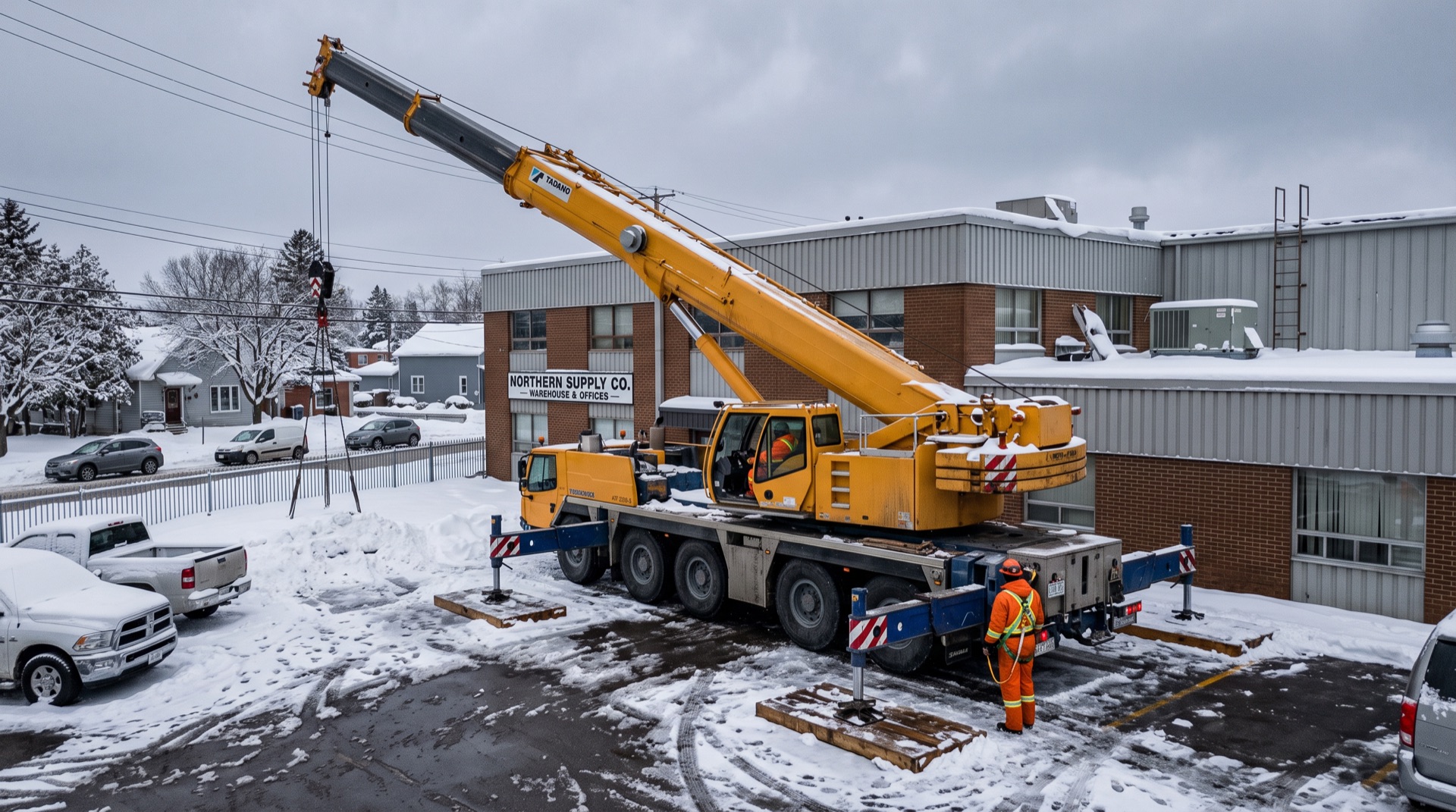
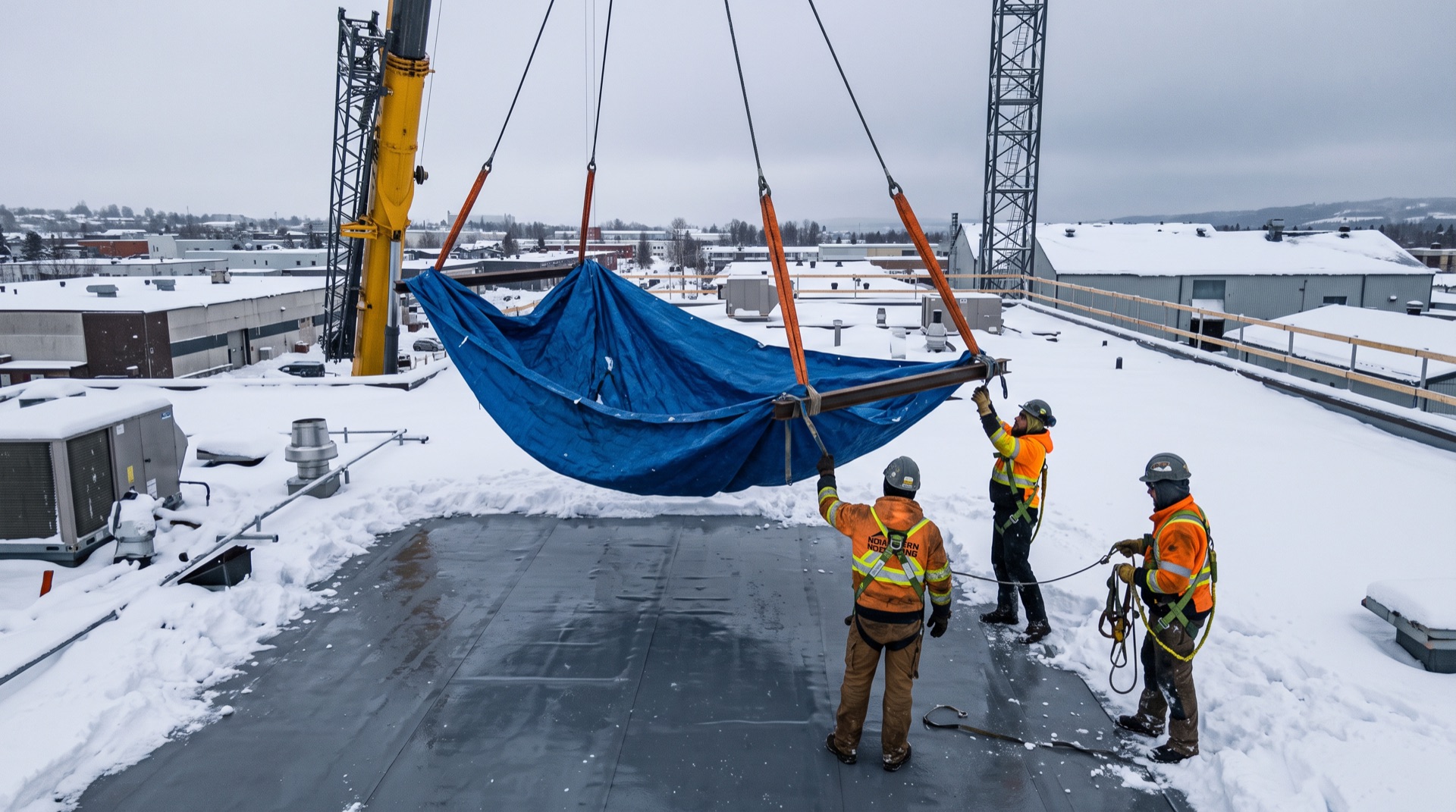
Rip-stop tarps are laid out and anchored on the deck, crews load them, and the boom lifts each loaded tarp clear and sets it down in a designated drop zone on the ground. Outrigger pads are placed on frozen ground rated for the load, and a pedestrian exclusion zone is set and marshalled for the whole operation. Ceiling Sagging or Bulging After Snow.

It is a planned lift, not an improvisation. Site access, swing radius, overhead lines, drop zone and ground bearing all get walked before the first tarp goes down.

What goes in the tarp and what does not

A pick lifts loose and broken snow. It does not lift a solid sheet of ice frozen to the membrane, and trying to make it do so is how a tarp takes the roof covering with it.

So the sequence is crews cutting and breaking the pack into liftable material, the crane moving it, and steam dealing with whatever is bonded to the surface. The crane is the transport, not the demolition.

Documenting the load for the carrier

Depths, densities, calculated loads and dated photographs are recorded through the operation. Most carriers treat preventing an imminent structural failure as loss mitigation, which is a very different claim from one filed after a deck comes down.

That record is what supports it, and it only exists if somebody took the readings at the time.

Reach, radius and why the chart decides

Capacity falls away sharply with radius. A machine that lifts comfortably at thirty feet may be well short of the same load at eighty, which is why the far corner of a large deck sometimes needs a bigger crane rather than a longer day.

The chart is run before the quote, so the number given is for a machine that can actually reach the whole roof in Cincinnati rather than most of it.

The arithmetic that justifies a crane

Snow weight is depth times density times area. Fresh powder is light; settled wet pack can be several times heavier for the same depth, and drifted pack heavier again.

Crews take depth and density readings at the drift points on a roof in Cincinnati, work out the load, and compare it to the structure's design capacity. A crane gets mobilised when that number says hand clearing cannot win the race against the next storm.
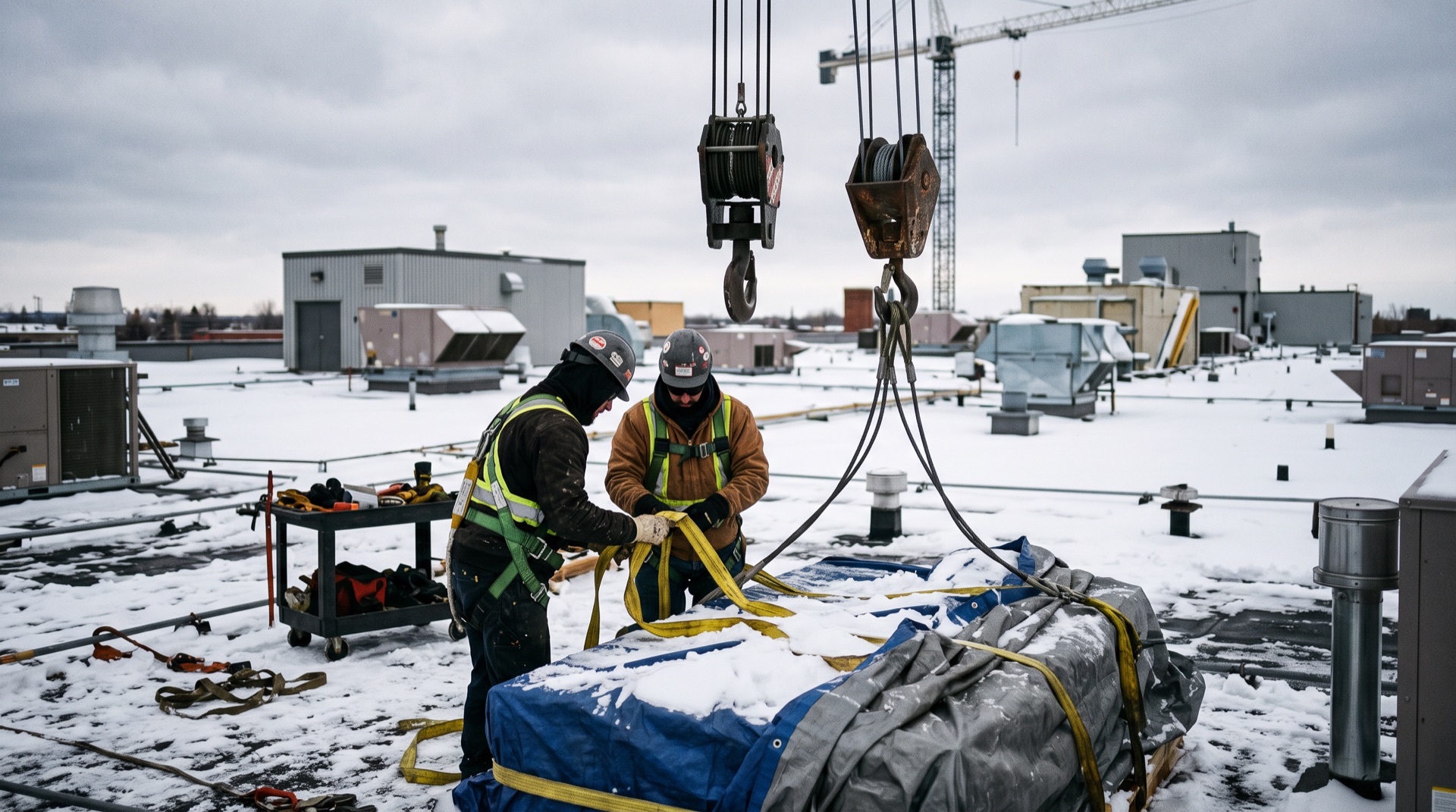
Two workers in hard hats rigging yellow lifting straps on snow-covered rooftop
Two workers secure yellow lifting straps around bundled equipment on a snow-covered commercial rooftop.

What you get in Cincinnati

  • Lift planned firstAccess, swing radius, overhead lines and drop zone walked before scheduling
  • Marshalled exclusion zonePedestrian and vehicle control for the whole operation
  • Rip-stop tarp picksRated tarps and rigging, with lifts planned around the swing radius
Crane-Assisted Snow Removal in Cincinnati, OH — specification
Service specification for Cincinnati, OH
Primary climate stressorRepeated thaw-freeze cycling
DocumentationDated before and after photos, written scope in Xactimate line items
Coverage areaCincinnati and Hamilton County
Local ice-barrier practiceEave membrane on new work, often absent
Pricing modelBilled by the crew hour, rate quoted before dispatch
ServiceCrane-Assisted Snow Removal in Cincinnati, OH
Typical scopeSteam, 4-8 crew hours typical

Where We Dispatch Around Cincinnati

Crews working Cincinnati cover the adjoining communities on the same route — Mount Saint Joseph, Addyston, North Bend, Miamitown and Cleves — so a storm week usually means one truck handling several addresses in Hamilton County rather than separate trips.

Nearest hub towns with their own crane snow removal pages: Fairfield, Mason, Hamilton, Middletown, Centerville, Kettering.

When a storm hits Hamilton County, crews are dispatched by severity rather than by call order — water already inside the house goes first.

Most jobs do not stop at one service. Crane Snow Removal in Cincinnati often runs alongside commercial roof snow removal in Cincinnati, and both get written into one scope rather than billed as separate visits.

Active leak right now? Our 24/7 Cincinnati steam ice dam removal crews are dispatched first during a freeze event. Call (888) 561-9664.
Conditions We Work In

Crane-Assisted Snow Removal In Practice

Conditions crews work in across Hamilton County. Every job is photographed before and after.

Yellow Tadano mobile crane set up at Northern Supply Co commercial building in winter
A Tadano mobile crane operates in a snowy parking lot outside the Northern Supply Co. warehouse and offices.
Two workers in hard hats rigging yellow lifting straps on snow-covered rooftop
Two workers secure yellow lifting straps around bundled equipment on a snow-covered commercial rooftop.
Three construction workers on snowy rooftop guiding empty blue tarp lowered by crane
Workers guide an empty blue tarp back onto the roof using a crane during winter roofing operations.
FAQ

What Cincinnati Homeowners Ask First

It is billed by the crew hour, and the rate plus a realistic time estimate are quoted on the phone before anyone is dispatched.

  • Scope drives the hours: length and thickness of the ice, roof pitch and height, and whether the gutters are frozen solid.
  • Access matters too — a three-story Cincinnati roof takes longer to set up on than a ranch.
  • The invoice matches the quote. There are no surprise add-ons written on the tailgate.

Material coming off a roof has to land somewhere, so drop zones are chosen before anything starts.

  • Shrubs, condensers, railings and low porch roofs get identified and worked around.
  • Walkways and the driveway are cleared again before the crew leaves.
  • On a tight Cincinnati lot material sometimes has to be carried out, which is said in the quote.

More than it looks from the ground - a foot-deep dam across a thirty-foot eave is a few thousand pounds.

  • Depth is measured at the eave rather than estimated from the driveway.
  • The gutter trough underneath is usually frozen solid too and is part of the same mass.
  • That weight is one of the reasons chipping at it from a ladder goes badly.

Before the thaw rather than after it. The leak happens when the ice has water behind it, which is a day or two after the snow stops.

  • Calling during the storm is fine and often gets an earlier slot.
  • The expensive version is waiting until water appears on a ceiling.
  • Crews run across Hamilton County from first light through a freeze event.

Yes. The dispatch area runs across Hamilton County, and several addresses in one area are usually handled in the same run.

  • Adjoining communities are on the same route rather than treated as a separate trip.
  • Rural addresses outside the normal radius get told the travel position on the call.
  • Capacity is moved into whichever part of Ohio the storm actually hits.

No. Tarps are laid on the snow, not the deck, and the load is lifted vertically clear rather than dragged. Nothing is skidded across the surface.

Crews calculate the working load from snow depth, density and roof area and compare it against the structure's design capacity. If hand clearing cannot get the weight off faster than the next storm adds to it, or the roof is already deflecting, that is the threshold.

Nearby

Crane Snow Removal In Towns Around Cincinnati

Same-Day Response

Get A Cincinnati Crew Out

Waiting for a thaw is a strategy, but it is an expensive one — the melt has to go somewhere, and it goes into the insulation first.

✓ Licensed & insured✓ Low-pressure steam only✓ Rate quoted up front✓ Photos for your claim
Online Quote(888) 561-9664