Skip to content
Westland, MI
Deep Drifts & Big Roofs · Wayne County

Crane-Assisted Snow Removal in Westland, MI — Thaw‑Cycle Storm Response

Ice Dam Now handles crane-assisted snow removal for Westland, MI properties and the wider Wayne County. Removal is by low-pressure steam, never mechanical. Dispatch is same day where water is already inside, pricing is by the crew hour quoted before a crew leaves, and every job is photographed before and after for claim purposes. Crews are licensed, insured and harness-certified.

Permits handled — Pulled where the municipality requires them for a street setup
Weights documented — Depths, densities and loads recorded for the carrier
Lift planned first — Access, swing radius, overhead lines and drop zone walked before scheduling
Load calculated first — Depth, density and area against design capacity before anything mobilises

Get Ice Dam Help Westland

A few quick questions, then pick a time. If water is coming in, call instead.

What is the zip code of the home?

Roof leaking right now? Call (888) 561-9664 — that is faster than any form.
Water coming through the ceiling?Every hour an ice dam sits there, more water gets under the shingles.Call (888) 561-9664
Same Day
For Water Already Inside
Steam
Safe On Every Covering
Wayne
County Coverage
Insured
Harness-Certified On Every Roof
Written
Scope Before Work Starts

Homeowners across Wayne County call about icicles. Icicles are cosmetic. The dam behind them, holding back standing water, is not. As part of our complete Westland winter roof services, crews handle crane-assisted snow removal across Wayne County.

Small Snow, Repeated Cycles: Westland Ice Dams

The snow totals here are unremarkable, which is exactly why Westland roofs get caught out. An ice dam needs meltwater and a cold eave, not a record storm.

Diagram showing how ice dams form on roofs due to inadequate insulation and poor ventilation
Heat escaping into the attic melts roof snow; the meltwater refreezes at the cold eave and the dam grows a layer every cycle.

The expectation is the problem. Nobody in Westland re-roofs with ice dams in mind, so when a cycling stretch arrives the houses with the least margin all leak in the same week.

Ice-barrier practice in Wayne County

The residential code Michigan follows calls for eave ice barrier on new work. Enforcement in Wayne County is real but recent, so the age of the roof is what decides whether it is there.

Crane-Assisted Snow Removal in Westland: How The Work Runs

Outriggers on frozen and uneven ground

Frozen ground is not automatically good bearing. Frost heave, buried utilities, septic fields, soft fill under a lawn and anything that thaws mid-job all change what the pads are sitting on. Ceiling Sagging or Bulging After Snow.

Pads are sized for the load and placed deliberately. It is the least visible part of a pick in Westland and the part with the least margin for improvisation.

When a crane is the right call

Multi-story homes and estates where the upper roof cannot be safely reached. Large commercial and industrial decks where the sheer tonnage makes hand clearing a multi-day job. Any roof where deflection is already visible and the load has to come off today rather than over a week.

The decision is made on numbers, not instinct. Depth, density and area give a working load figure, and that figure against the roof's design capacity is what determines whether a crane gets mobilised to a property in Westland.

How a pick actually works

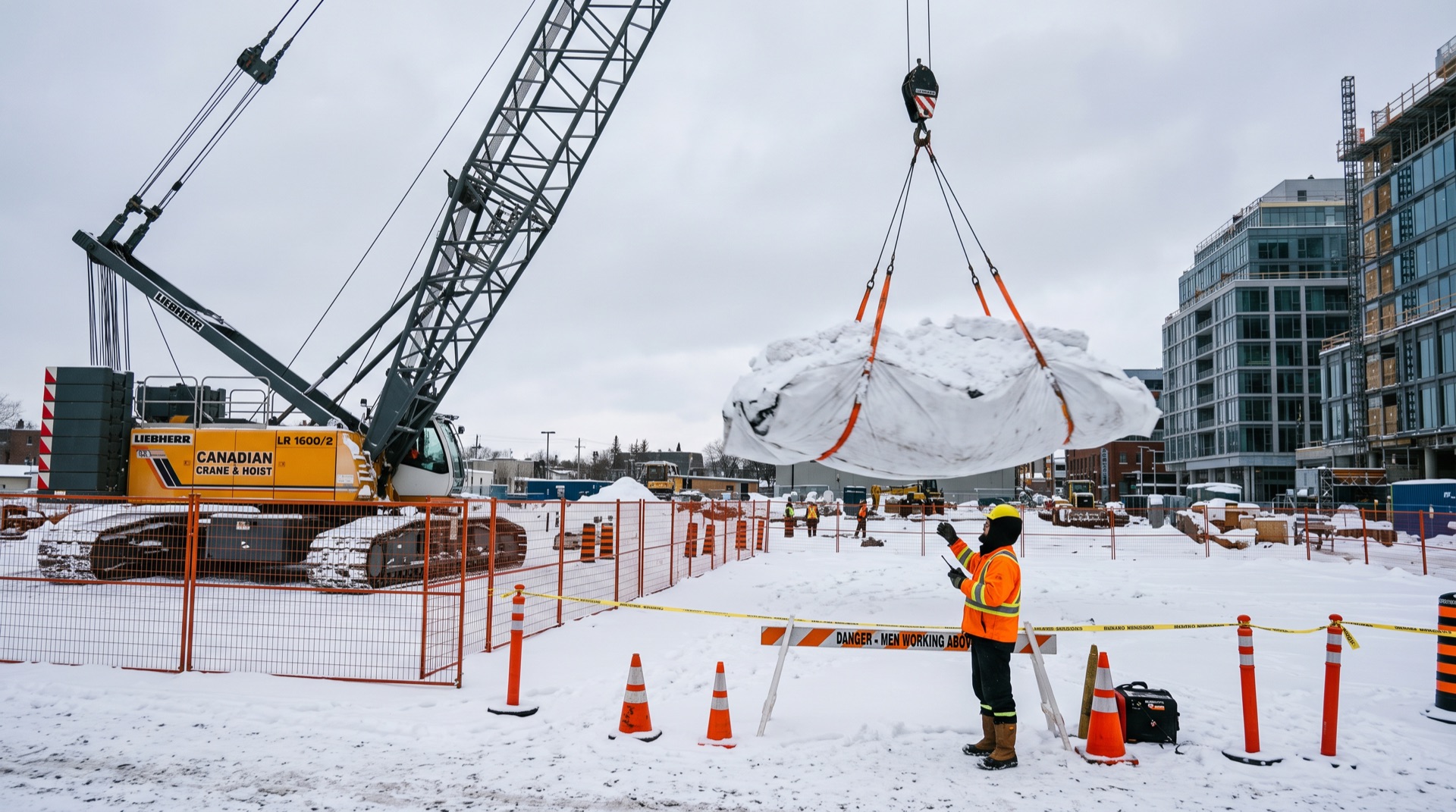
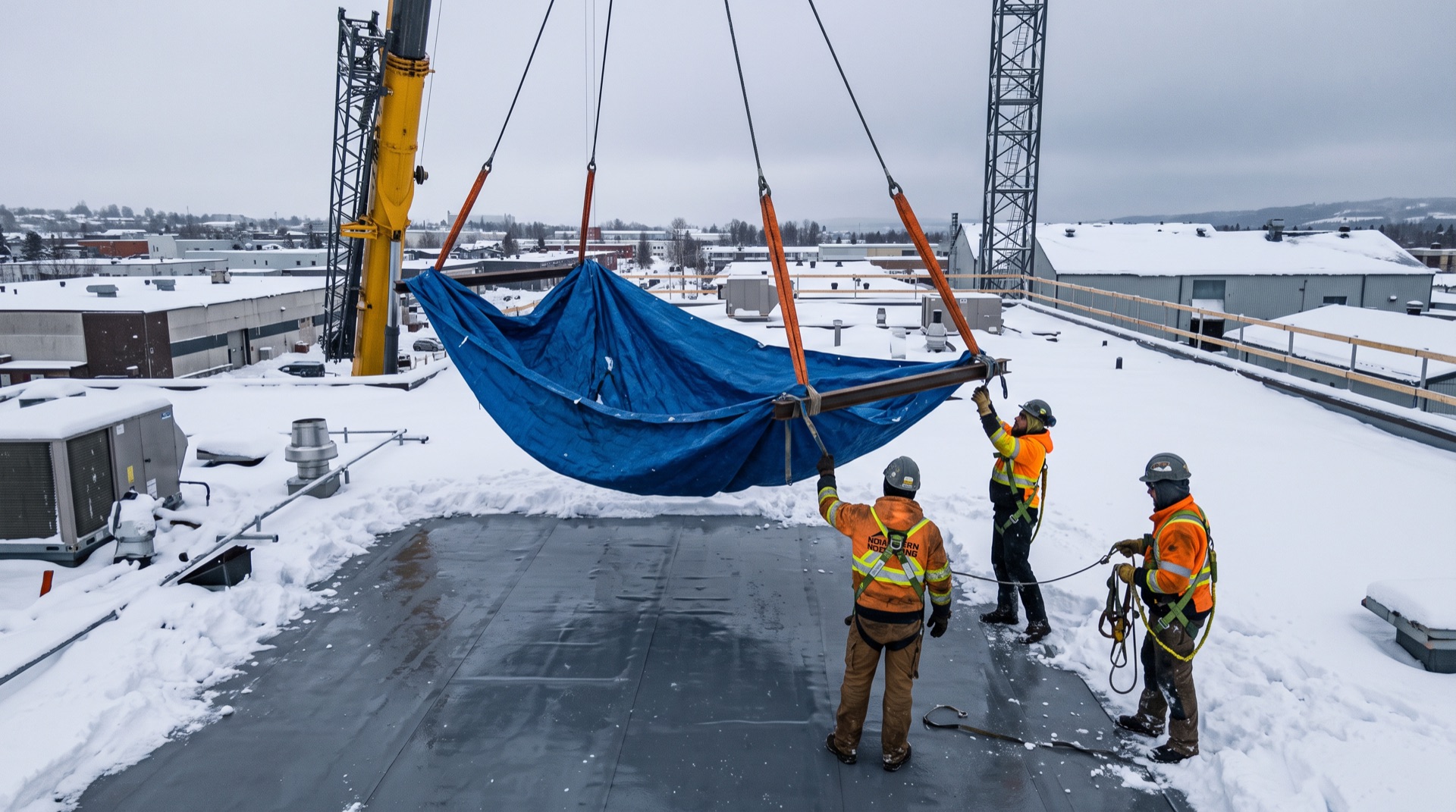
Rip-stop tarps are laid out and anchored on the deck, crews load them, and the boom lifts each loaded tarp clear and sets it down in a designated drop zone on the ground. Outrigger pads are placed on frozen ground rated for the load, and a pedestrian exclusion zone is set and marshalled for the whole operation.

It is a planned lift, not an improvisation. Site access, swing radius, overhead lines, drop zone and ground bearing all get walked before the first tarp goes down.

Planning the lift before anything moves

Site access, the swing radius, overhead lines, ground bearing for the outriggers and the ground drop zone all get walked first. On a site in Westland that walk often determines where the crane can physically sit, which determines everything else.

Permits get pulled where the municipality requires them for a street setup, and that lead time is built into the schedule rather than discovered on the day.

Documenting the load for the carrier

Depths, densities, calculated loads and dated photographs are recorded through the operation. Most carriers treat preventing an imminent structural failure as loss mitigation, which is a very different claim from one filed after a deck comes down.

That record is what supports it, and it only exists if somebody took the readings at the time.
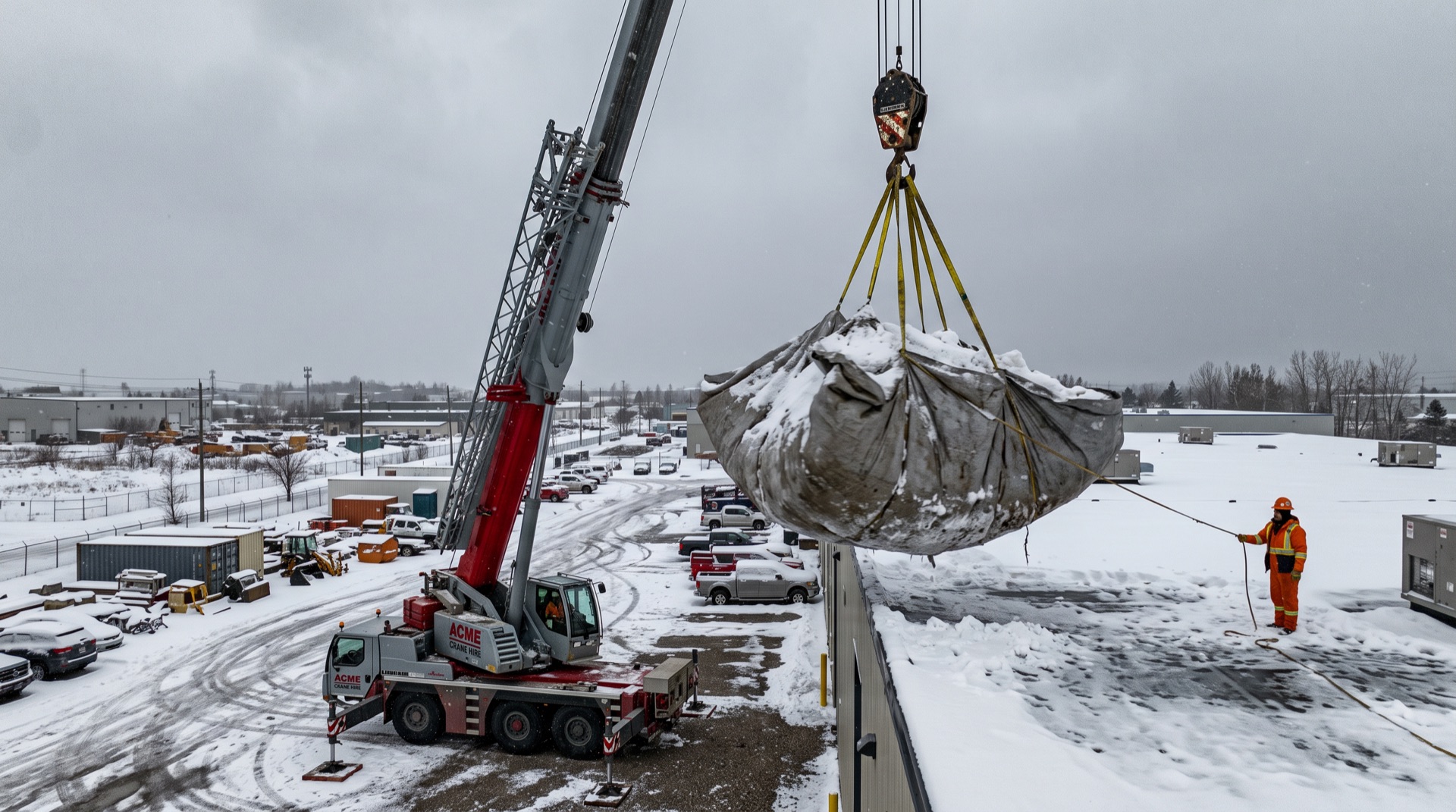
ACME crane lifting snow-covered tarp off commercial building roof in winter
An ACME mobile crane lifts a heavy snow-laden tarp from a commercial rooftop while a worker guides the load.

What you get in Westland

  • Rip-stop tarp picksRated tarps and rigging, with lifts planned around the swing radius
  • Outrigger padsBearing pads sized and placed for frozen and uneven ground
  • Marshalled exclusion zonePedestrian and vehicle control for the whole operation
Crane-Assisted Snow Removal in Westland, MI — specification
Service specification for Westland, MI
Coverage areaWestland and Wayne County
Pricing modelBilled by the crew hour, rate quoted before dispatch
DocumentationDated before and after photos, written scope in Xactimate line items
Primary climate stressorRepeated thaw-freeze cycling
Typical scopeSteam, 4-8 crew hours typical
Local ice-barrier practiceEave membrane on new work, often absent
ServiceCrane-Assisted Snow Removal in Westland, MI

Westland Coverage and the Adjoining Communities

Crews working Westland cover the adjoining communities on the same route — Garden City, Wayne, Inkster, Canton and Redford — so a storm week usually means one truck handling several addresses in Wayne County rather than separate trips.

Nearest hub towns with their own crane snow removal pages: Livonia, Dearborn Heights, Taylor, Southfield, Dearborn, Lincoln Park.

Coverage runs across Westland and the nearby towns all winter, and capacity is surged into whichever Michigan market the storm actually hits.

Most jobs do not stop at one service. Crane Snow Removal in Westland often runs alongside commercial roof snow removal in Westland, and both get written into one scope rather than billed as separate visits.

Active leak right now? Our 24/7 Westland steam ice dam removal crews are dispatched first during a freeze event. Call (888) 561-9664.
Conditions We Work In

Crane-Assisted Snow Removal In Practice

Conditions crews work in across Wayne County. Every job is photographed before and after.

Three construction workers on snowy rooftop guiding empty blue tarp lowered by crane
Workers guide an empty blue tarp back onto the roof using a crane during winter roofing operations.
Crane hook with yellow lifting straps and shackles attached to snow-covered tarp on rooftop
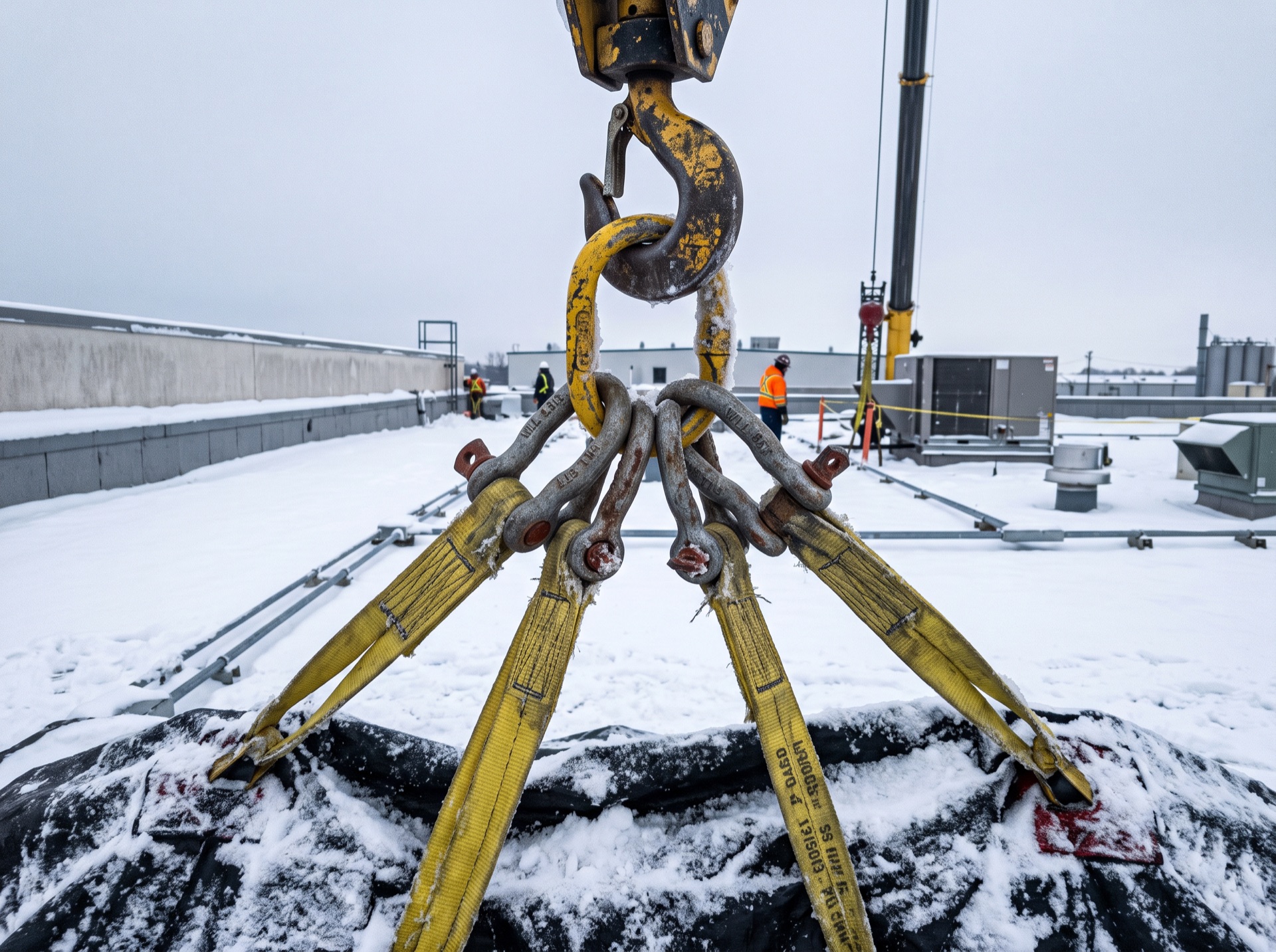
Yellow lifting straps and heavy shackles connect a crane hook to a snow-covered tarp during a winter rooftop operation.
Construction worker guides snow-covered tarp lifted by Liebherr crawler crane at winter job site
A signal worker directs a Liebherr LR 1600/2 crane hoisting a heavy snow-laden tarp at an urban construction site.
FAQ

Westland Questions We Actually Get Asked

It is billed by the crew hour, and the rate plus a realistic time estimate are quoted on the phone before anyone is dispatched.

  • Scope drives the hours: length and thickness of the ice, roof pitch and height, and whether the gutters are frozen solid.
  • Access matters too — a three-story Westland roof takes longer to set up on than a ranch.
  • The invoice matches the quote. There are no surprise add-ons written on the tailgate.

On a roof that is still leaking heat, it can — removal treats the symptom and the cause is in the attic.

  • Crews say so before leaving if the attic is obviously the problem.
  • A second visit in the same season at the same property is priced as the shorter job it usually is.
  • Air sealing, insulation and heat trace are what stop the cycle for good.

Only where there is interior damage to document or dry. Pure exterior removal happens entirely from outside.

  • If water has come in, seeing it is what makes the claim documentation worth anything.
  • Attic access helps identify the heat source but is not required for removal.
  • Nobody needs to be home for exterior-only work, provided access and payment are arranged.

Because ice dams are made by heat loss, and two houses on the same street rarely leak heat the same way.

  • Attic air leaks around can lights, bath fans and the attic hatch are the usual source.
  • Crushed or missing soffit baffles stop the intake ventilation that would otherwise keep the deck cold.
  • An addition or dormer built over unheated space puts warm air right against a cold eave.
  • Local factor: repeated thaw-freeze cycling makes the difference show up faster here than it would further south.

The crew hours on site, the equipment and the photo documentation - with the rate and an estimate given on the phone beforehand.

  • Travel to a Westland address inside the normal service area is not an added line.
  • If the roof turns out worse than described, you are told before the extra hours are worked.
  • The invoice matches what was quoted. Nothing gets added on the tailgate.

Crews calculate the working load from snow depth, density and roof area and compare it against the structure's design capacity. If hand clearing cannot get the weight off faster than the next storm adds to it, or the roof is already deflecting, that is the threshold.

Cold is not the problem; wind is. Every machine has a wind chart and a tarp of snow is a large, light load that is dangerous in gusts. A pick gets postponed for wind rather than pushed through, and rescheduling is built into how these jobs are booked.

Nearby

Crane Snow Removal In Towns Around Westland

Same-Day Response

Get A Westland Crew Out

Waiting for a thaw is a strategy, but it is an expensive one — the melt has to go somewhere, and it goes into the insulation first.

✓ Licensed & insured✓ Low-pressure steam only✓ Rate quoted up front✓ Photos for your claim
Online Quote(888) 561-9664