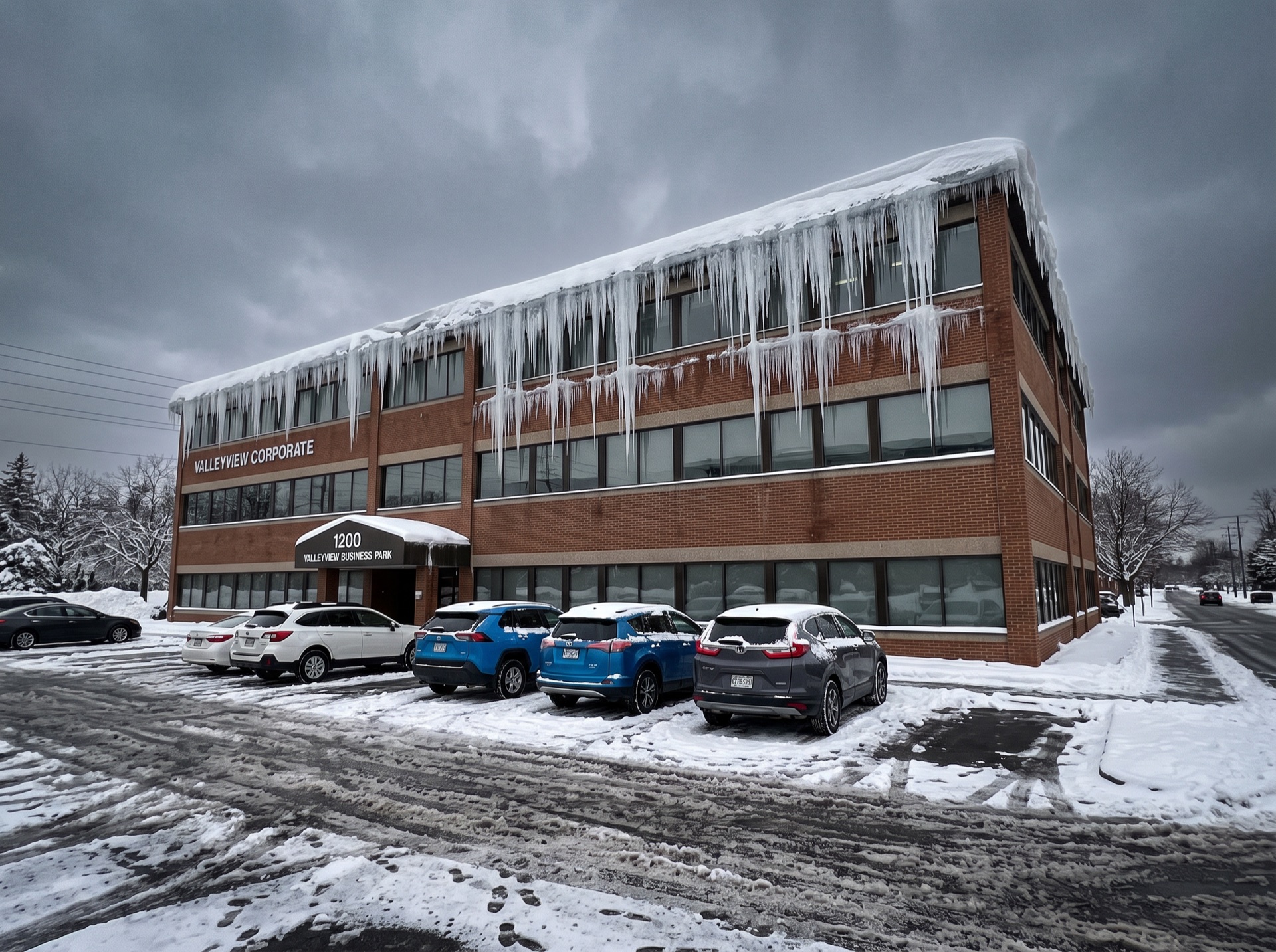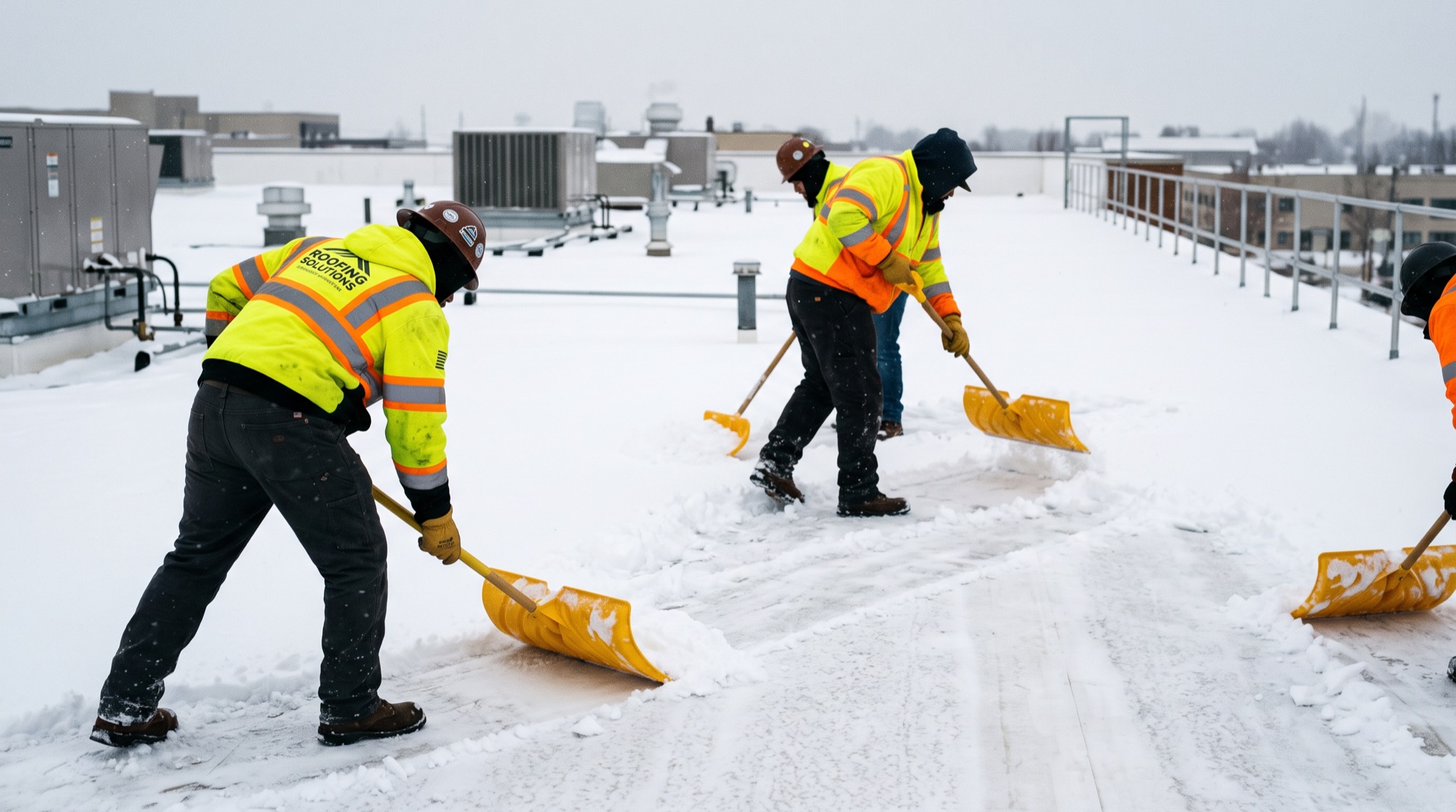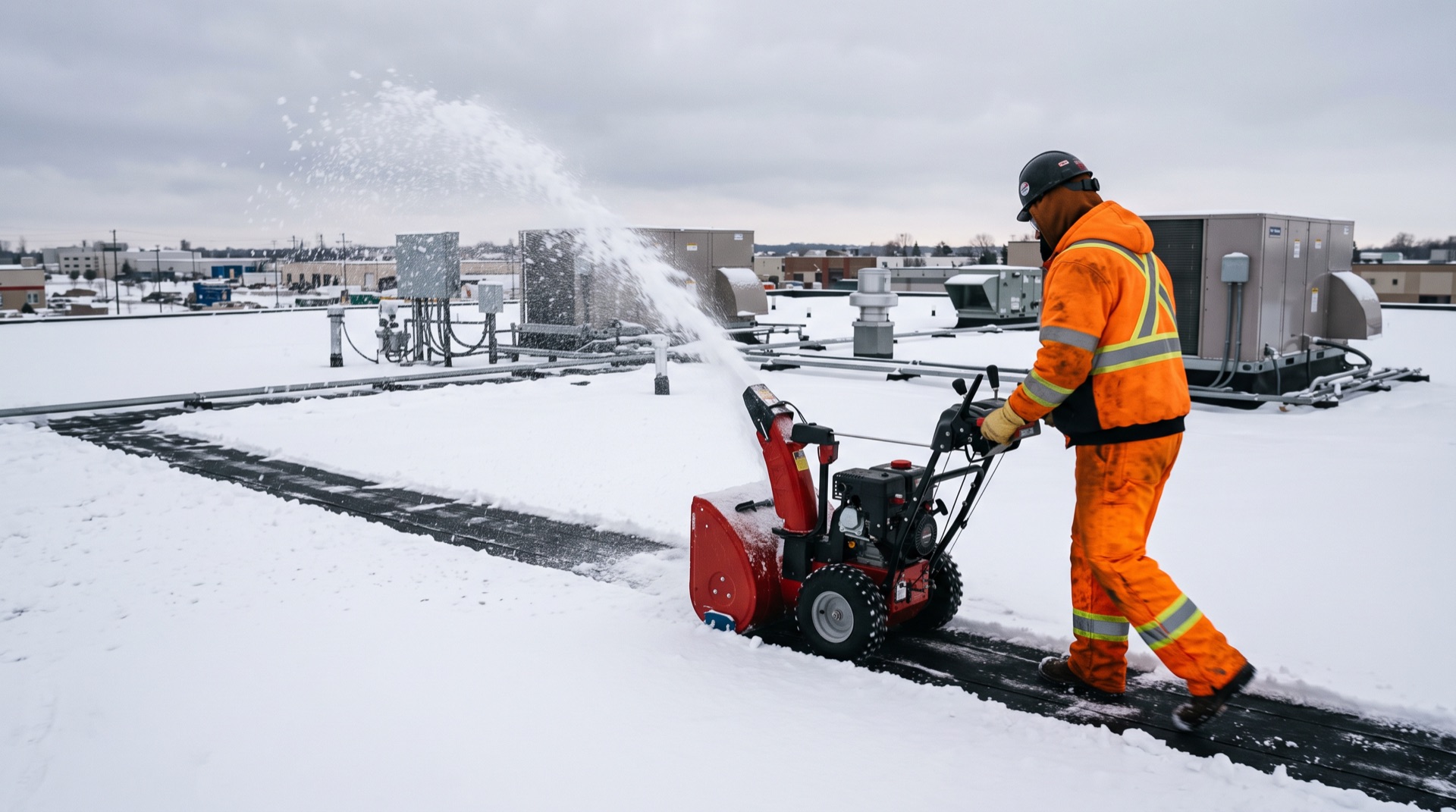
Every Escanaba winter produces the same two calls: the ones who see the ice early, and the ones who see the ceiling stain first. As part of our complete Escanaba winter roof services, crews handle commercial ice dam removal across Delta County.
The Delta County Pattern: Heavy Bands, Fast Thaws
Roofs in Escanaba are loaded unevenly and quickly. A band sets up, dumps for six hours and moves, and the roof is carrying a dense wet pack it did not have at breakfast. Nothing about that snow wants to slide off.

The damage comes on the thaw. Warm air leaking into the attic melts the underside of that pack, the meltwater runs to an eave that is still well below freezing, and it sets. Repeat that four or five times in a January and the ridge of ice at the gutter line stops being cosmetic.
Ice-barrier practice in Delta County
What matters on an Escanaba roof is not whether ice barrier exists but how far up it runs. Water backed up behind a foot of ice travels much further than the first course, and a membrane that stops short is a membrane that stops working.
Commercial Ice Dam Removal in Escanaba: How The Work Runs
Flat roofs fail differently
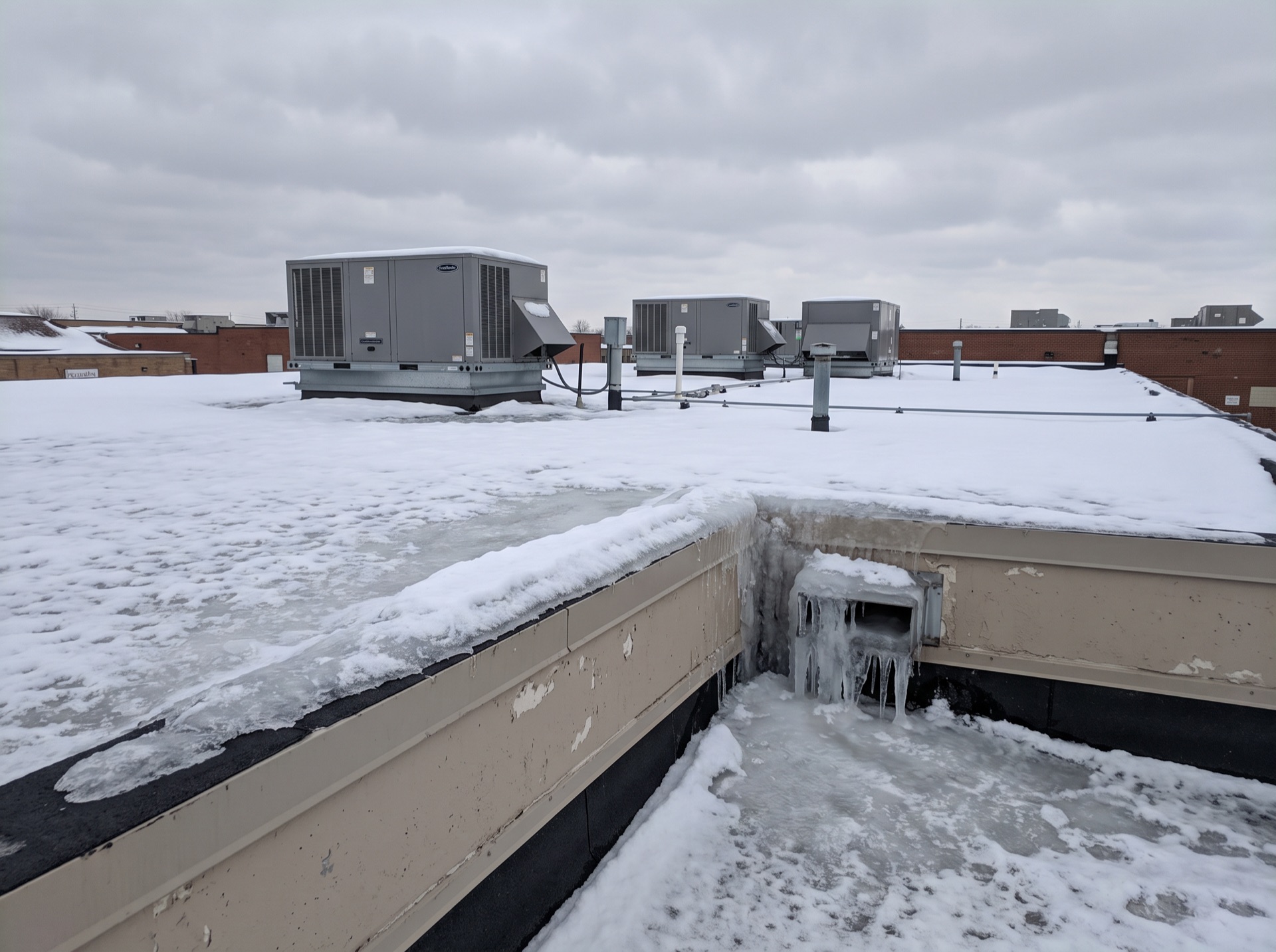
A pitched residential roof dams at the eave. A commercial deck dams at its drainage: frozen scuppers, iced-over internal drains, and ponding that refreezes into a sheet across the low spots. Water then sits on the membrane at depth, finds a seam or a flashing detail, and comes through into the tenant space below.
Parapet walls make it worse by holding the melt on the deck instead of letting it run off an edge. By the time it shows up as a ceiling tile stain in an Escanaba unit, there is usually standing water up there.
Scheduling around tenants
Noise, access, parking and the hours an Escanaba business can have equipment outside its door all shape when work happens. Some jobs run overnight for that reason.
Set the constraint on the call and the window gets planned around it rather than negotiated on the day.
Insulation above the deck changes the melt pattern
A modern commercial assembly puts most of its insulation above the deck, so very little building heat reaches the membrane. That is good for energy and it means the snow that lands mostly stays - the roof does not self-clear the way an under-insulated one does.
Where dams do form on those roofs it is almost always at a thermal bridge: a parapet, a curb, a drain bowl or a line of fasteners. Those are the spots crews work first.
What the board or the owner gets
A condition report with dated photographs, what was found, what was done and what is still a risk — in a form that can go to a board, an owner or a carrier without being rewritten.
For a managed Escanaba property that document is usually the reason the spend gets approved without a second conversation.
Working around rooftop plant
HVAC curbs, exhaust fans, conduit, gas lines, solar racking and railing are all obstacles and all drift traps. The snow behind a large unit is usually the deepest on the roof and the ice under it the thickest.
Crews work around and under them rather than over, and anything running stays running.
What you get in Escanaba
- Plant worked aroundHVAC curbs, conduit, racking and railing avoided, not cleared over
- EPDM, TPO and mod-bitLow-pressure steam only, seams and flashing details avoided
- Documentation for the boardCondition report and photo record with every invoice
| Pricing model | Billed by the crew hour, rate quoted before dispatch |
|---|---|
| Primary climate stressor | Lake-effect bands, wet heavy pack |
| Documentation | Dated before and after photos, written scope in Xactimate line items |
| Dispatch window | Same day to 24 hours |
| Typical scope | Steam, 6-12 crew hours typical |
| Coverage area | Escanaba and Delta County |
| Local ice-barrier practice | Eave membrane expected on re-roofs |
Delta County Coverage From Escanaba
Crews working Escanaba cover the adjoining communities on the same route — Wells, Gladstone, Bark River, Cornell and Harris — so a storm week usually means one truck handling several addresses in Delta County rather than separate trips.
Nearest hub towns with their own commercial ice dams pages: Marquette, Traverse City, Petoskey, Sault Ste. Marie, Muskegon, Alpena.
Scheduling for Escanaba tightens up during a freeze event, which is exactly when the phone beats the form. Water coming in means a call, not an email.
Most jobs do not stop at one service. Commercial Ice Dams in Escanaba often runs alongside commercial roof snow removal in Escanaba, and both get written into one scope rather than billed as separate visits.
Active leak right now? Our 24/7 Escanaba steam ice dam removal crews are dispatched first during a freeze event. Call (888) 561-9664.