Skip to content
Orono, ME
Structural Snow Load · Penobscot County

Commercial Roof Snow Removal in Orono, ME — Full‑Season Storm Response

Commercial Roof Snow Removal in Orono, ME from Ice Dam Now: low-pressure steam only, across Penobscot County. No chipping, no salt, no pressure washing. Crews carry licensing, insurance and fall-protection certification, bill by the crew hour at a rate quoted on the phone, prioritize active interior leaks the same day, and document the work for insurance.

Mid-span measured — Depth read over the longest unsupported span, not the average
Drains kept open — Scuppers and internal drains cleared so meltwater has an exit
Drift-point survey — Depth and density measured where it collects, not where it is convenient
Overflows opened first — Drains and scuppers cleared before the load comes off

Get Ice Dam Help Orono

A few quick questions, then pick a time. If water is coming in, call instead.

What is the zip code of the home?

Roof leaking right now? Call (888) 561-9664 — that is faster than any form.
Water coming through the ceiling?Every hour an ice dam sits there, more water gets under the shingles.Call (888) 561-9664
24/7
Storm Season Dispatch
No Chipping
Steam Only
Penobscot
County Coverage
Crew Hour
Rate Quoted Up Front
Documented
Photos On Every Job

Winter in Orono does not need a record storm to put water inside a house. It needs a roof with snow on it, an attic leaking heat, and one cold night. As part of our complete Orono winter roof services, crews handle commercial roof snow removal across Penobscot County.

Orono Ice Dams and the Winter That Does Not Break

Snow that falls on a roof in Orono in December tends to stay there. A pack that never fully clears is a pack that keeps feeding meltwater to the same eave for months on end.

Diagram showing how ice dams form on a roof from heat loss and snow melt
Heat escaping into the attic melts roof snow; the meltwater refreezes at the cold eave and the dam grows a layer every cycle.

A long season is not a safer one. It means more freeze-thaw cycles, and each one adds a layer to the dam. By late winter the ice at a Penobscot County eave can be a foot deep and locked to the shingle, with standing water sitting behind it.

Ice-barrier practice in Penobscot County

Maine code has required ice-barrier underlayment at the eaves for years on new work, but plenty of housing stock predates it. On an older Orono roof the only thing between backed-up water and the deck is the shingle course itself.

Commercial Roof Snow Removal in Orono: How The Work Runs

What the documentation covers

Depth and density readings, calculated load, dated photographs and a written condition report per visit. Ceiling Sagging or Bulging After Snow.

Preventing an imminent failure is treated as loss mitigation by most carriers, and that record is what supports the position if it is ever tested.

Ponding after the clear

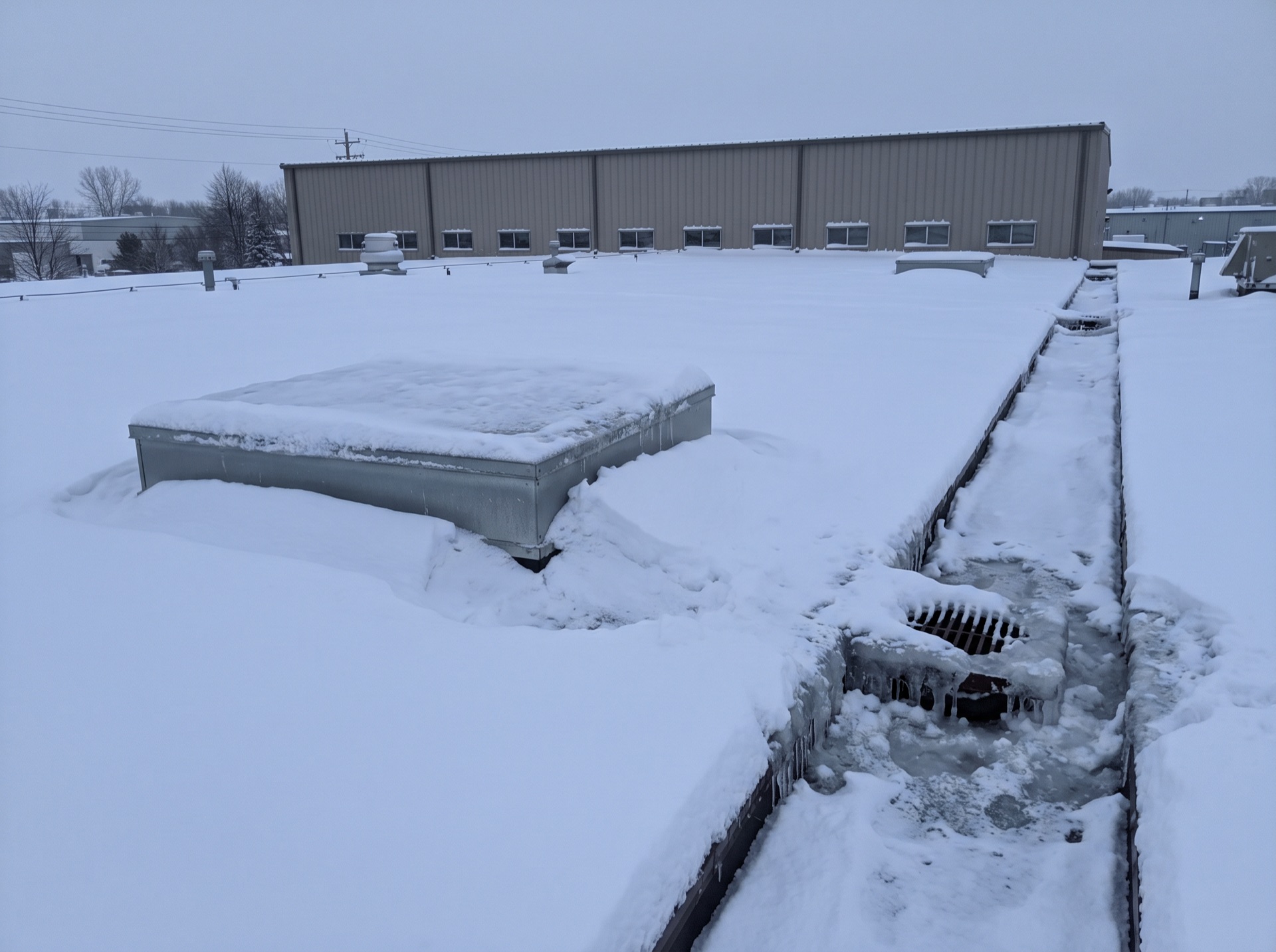
Taking the snow off a flat roof with frozen drains leaves meltwater with nowhere to go, and water that ponds and refreezes puts load back on a deck that was just relieved.

So drains and overflows are opened as part of the clear rather than afterwards, and the roof is left draining. A clear that stops at the snow is half a job.

Reading the design load off the drawings

Where structural drawings exist they state the design ground snow load and the roof's own capacity, and that number turns the whole question from opinion into arithmetic. Measured depth and density against design capacity gives a percentage rather than an argument.

Where the drawings have been lost - common on older Orono stock - the conservative assumption is the code minimum of the era the building went up, which is usually well below what a modern roof would be built to.

Unbalanced loading is the real hazard

Snow does not settle evenly on a large deck. It piles against parapets, behind rooftop units, in the lee of a higher adjoining roof and in the valleys between bays.

Clearing has to be balanced for the same reason. Taking it all off one bay and none off the next shifts the load rather than removing it.

Reduction to a threshold, not a bare deck

The goal is bringing the load under the structure's capacity safely, with a cushion layer left on the membrane throughout.

Scraping a commercial Orono roof to bare membrane costs more, takes longer and risks the roof covering for no structural benefit.
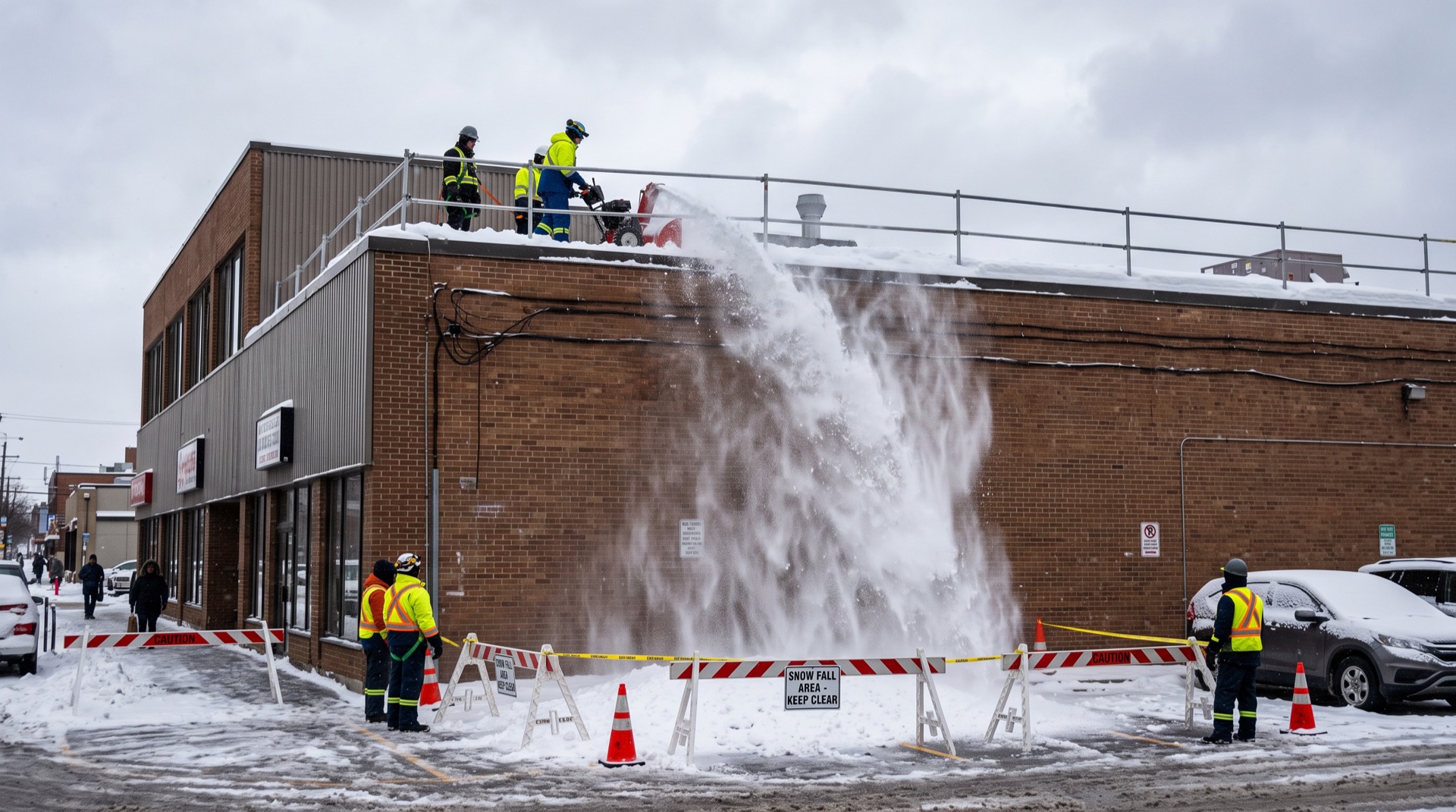
Workers use snow blower on commercial rooftop discharging snow over parapet wall onto blocked sidewalk
A rooftop crew uses a snow blower to clear a commercial building roof, discharging snow to the cordoned-off street below.

What you get in Orono

  • Drains kept openScuppers and internal drains cleared so meltwater has an exit
  • Mid-span measuredDepth read over the longest unsupported span, not the average
  • Portfolio routesStanding storm schedules with per-visit condition reports
Commercial Roof Snow Removal in Orono, ME — specification
Service specification for Orono, ME
DocumentationDated before and after photos, written scope in Xactimate line items
ServiceCommercial Roof Snow Removal in Orono, ME
Primary climate stressorSustained sub-freezing, long season
Typical scopeSteam, 6-14 crew hours typical
Coverage areaOrono and Penobscot County
Removal methodLow-pressure steam only. No chipping, salt or pressure washing.
Dispatch windowSame day to 24 hours

Where We Dispatch Around Orono

Crews working Orono cover the adjoining communities on the same route — Stillwater, Bradley, Old Town, Milford and Eddington — so a storm week usually means one truck handling several addresses in Penobscot County rather than separate trips.

Nearest hub towns with their own commercial snow pages: Bangor, Ellsworth, Bar Harbor, Camden, Waterville, Augusta.

Coverage runs across Orono and the nearby towns all winter, and capacity is surged into whichever Maine market the storm actually hits.

Most jobs do not stop at one service. Commercial Snow in Orono often runs alongside crane-assisted snow removal in Orono, and both get written into one scope rather than billed as separate visits.

Active leak right now? Our 24/7 Orono steam ice dam removal crews are dispatched first during a freeze event. Call (888) 561-9664.
Conditions We Work In

Commercial Roof Snow Removal In Practice

Conditions crews work in across Penobscot County. Every job is photographed before and after.

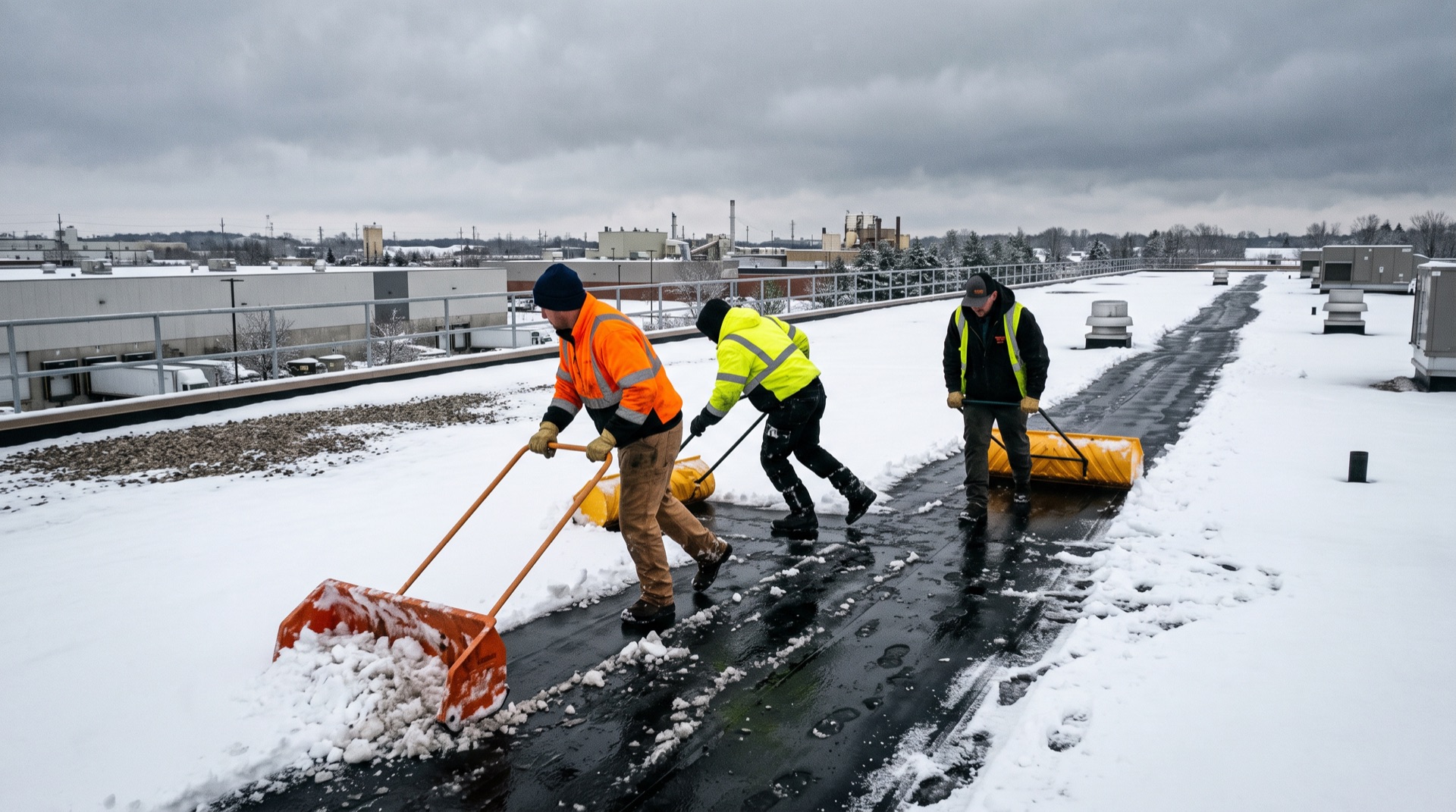
Three workers in high-visibility vests pushing snow off a flat warehouse roof
A three-person crew uses push plows to clear heavy snow from a large commercial flat roof.
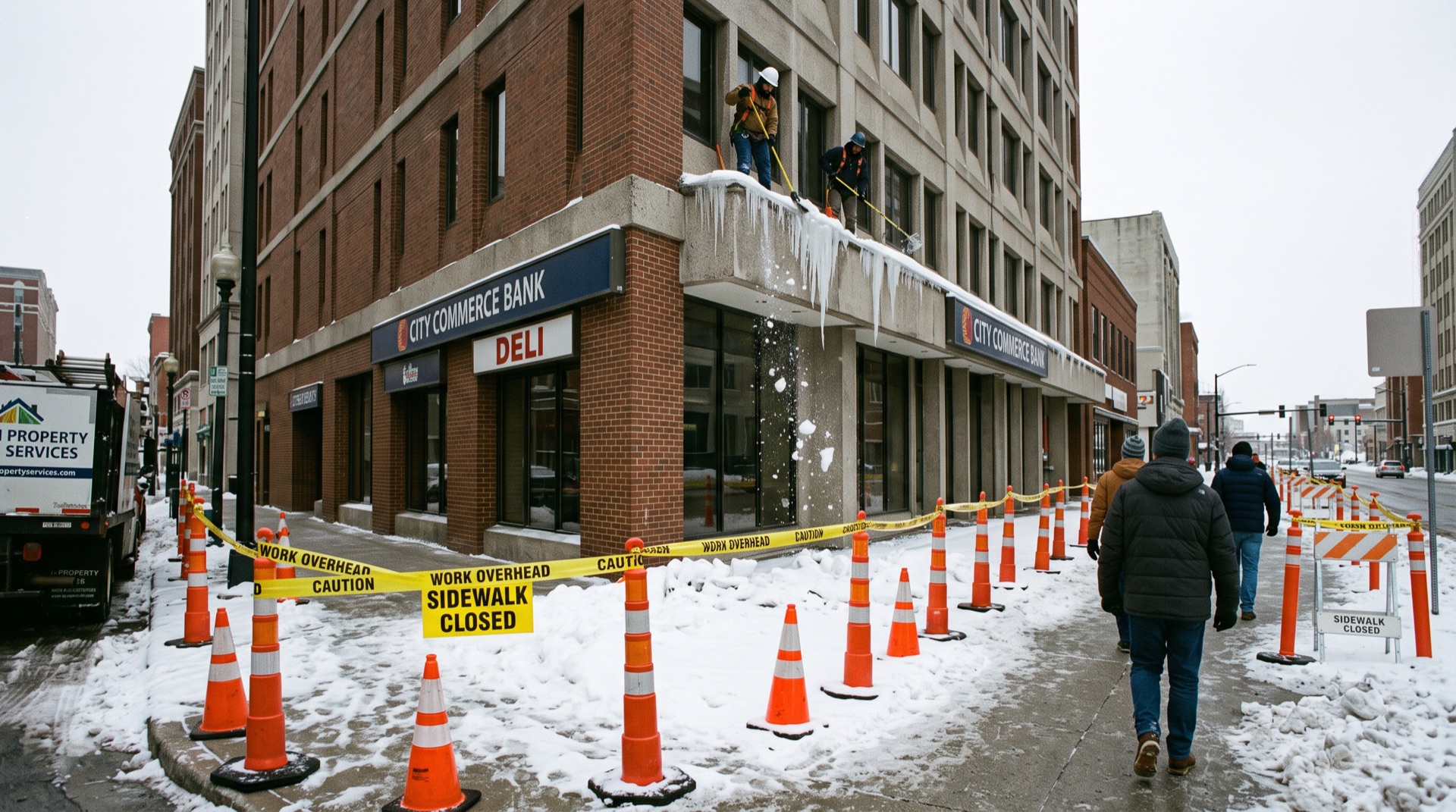
Workers removing snow and ice from building ledge above closed sidewalk with orange cones
Workers clear dangerous ice and snow from a City Commerce Bank building ledge while caution tape and cones protect pedestrians below.
Heavy snow load on flat commercial warehouse roof with frozen drain and icicles
A flat commercial warehouse roof bears heavy snow accumulation with a completely frozen interior drain.
FAQ

Orono and Penobscot County FAQ

It is billed by the crew hour, and the rate plus a realistic time estimate are quoted on the phone before anyone is dispatched.

  • Scope drives the hours: length and thickness of the ice, roof pitch and height, and whether the gutters are frozen solid.
  • Access matters too — a three-story Orono roof takes longer to set up on than a ranch.
  • The invoice matches the quote. There are no surprise add-ons written on the tailgate.

Tell the crew. Chipping marks change what the roof needs and they matter for the claim.

  • Cracked shingles and punctures get photographed and reported rather than steamed over.
  • Damage caused by removal attempts is treated differently by carriers than storm damage.
  • It is extremely common and nobody is going to lecture you about it.

Please do not. Salt corrodes flashing, fasteners, gutters and anything metal it drains across, and it damages whatever is planted below.

  • Calcium chloride is less aggressive than rock salt but still ends up in the soil at the drip line.
  • A puck melts a hole, not a drainage path, so the water simply refreezes a few inches further on.
  • Crews use heat and nothing else - no salt, no chemicals, nothing corrosive.

Usually. The equipment needs a water supply and a place to park within hose reach, which is normally achievable even on a tight lot.

  • Hose runs of a few hundred feet are routine.
  • Street parking in a Penobscot County residential area is generally workable.
  • Tell dispatch about access on the call so the right setup arrives.

Because ice dams are made by heat loss, and two houses on the same street rarely leak heat the same way.

  • Attic air leaks around can lights, bath fans and the attic hatch are the usual source.
  • Crushed or missing soffit baffles stop the intake ventilation that would otherwise keep the deck cold.
  • An addition or dormer built over unheated space puts warm air right against a cold eave.
  • Local factor: sustained sub-freezing spells makes the difference show up faster here than it would further south.

Properties on a standing contract are cleared on a scheduled route and need no call. Everyone else is scheduled by severity, with active deflection and life-safety situations moved to the front.

For light snow on an accessible roof with proper edge protection, sometimes. The limits are fall protection on a deck with no anchors, membrane damage from the wrong tools, and knowing when a load is actually dangerous. Where in-house clearing is reasonable, that is worth saying, and the equipment and training it needs can be set out.

Nearby

Commercial Snow In Towns Around Orono

Same-Day Response

Get A Orono Crew Out

Nothing about an ice dam improves by waiting. It refreezes tonight, thicker, and the water behind it keeps looking for a way in.

✓ Licensed & insured✓ Low-pressure steam only✓ Rate quoted up front✓ Photos for your claim
Online Quote(888) 561-9664