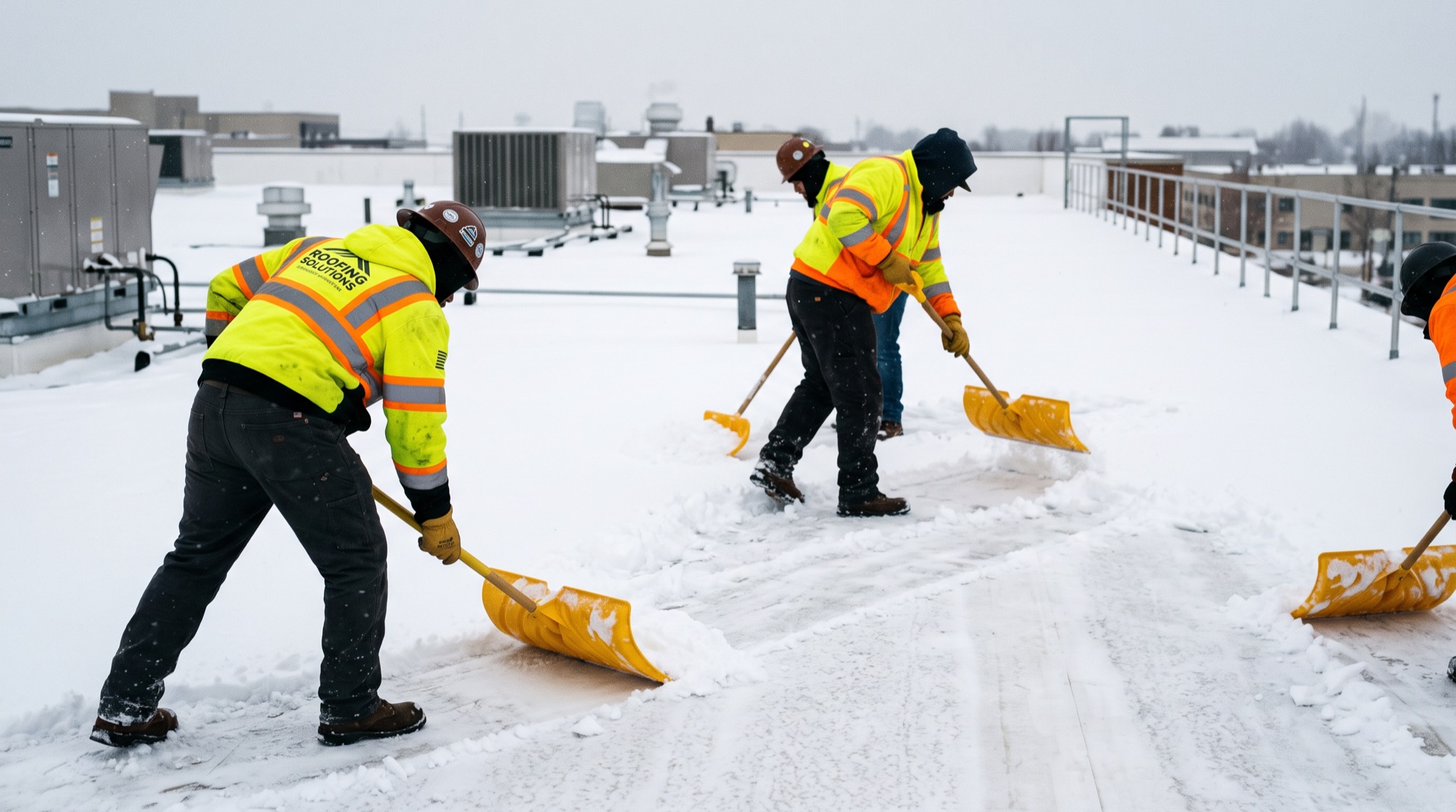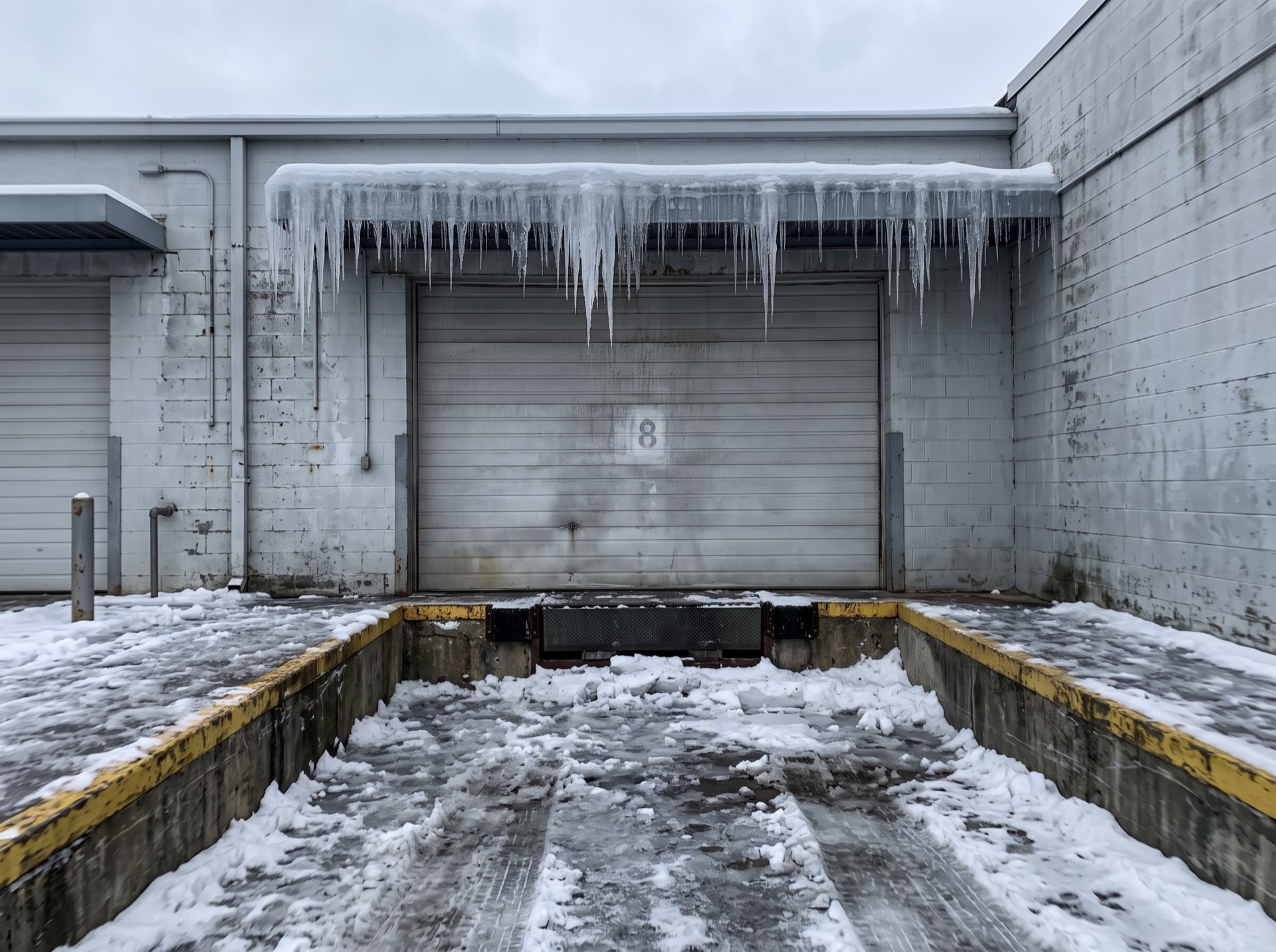
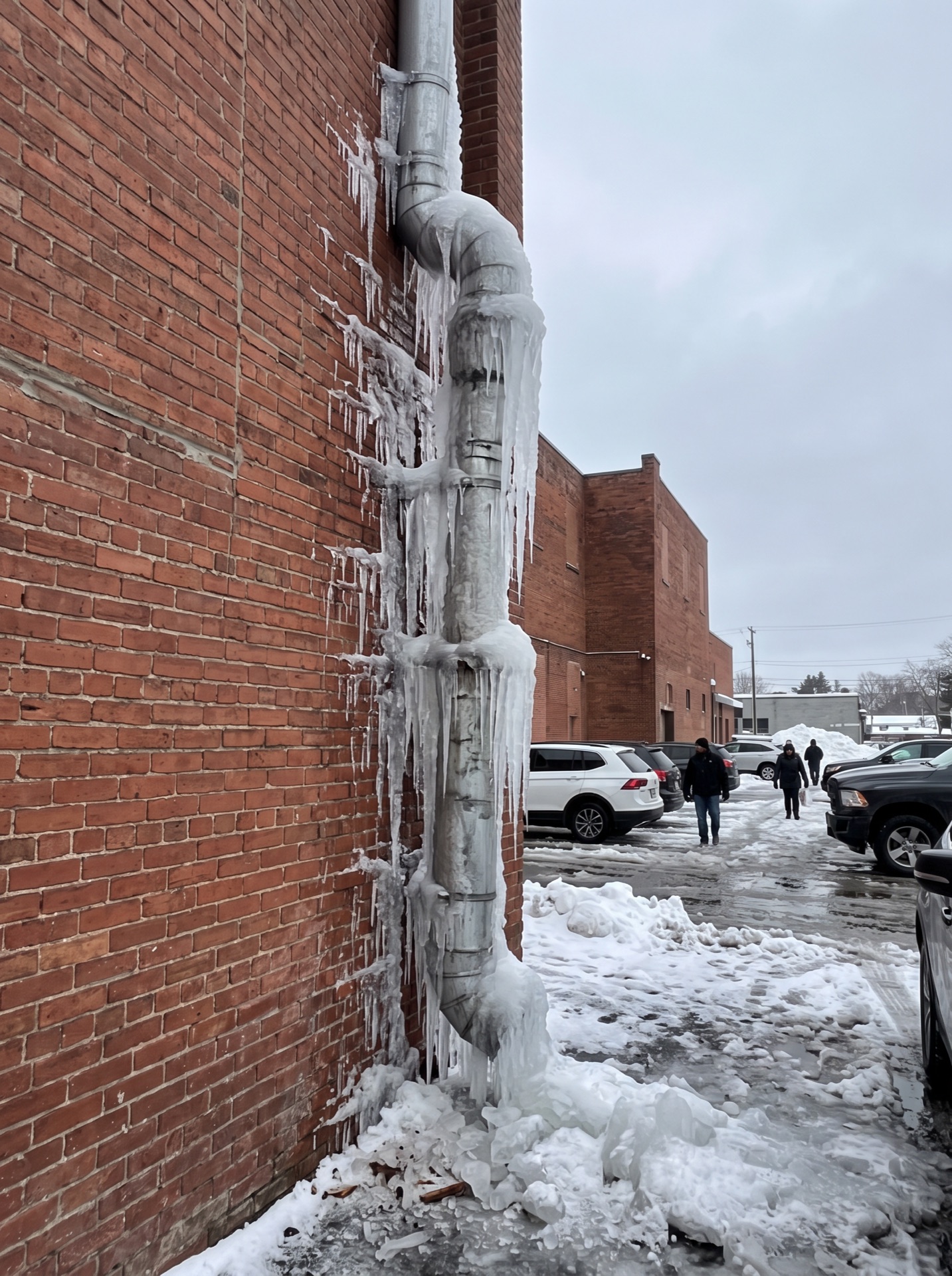
By the time a roof in Lebanon has a visible ridge of ice at the eave, meltwater has already been pooling behind it for several freeze-thaw cycles. As part of our complete Lebanon winter roof services, crews handle commercial ice dam removal across Lebanon County.
Why Lebanon Roofs Dam Up: Nor'easter Load and the Maritime Swing
Lebanon County gets the worst combination for ice: snow with high water content, followed by temperatures that oscillate rather than settle. The pack does not stay frozen and it does not drain.

Older Lebanon County housing stock makes it worse. Shallow eave returns, knee-wall attics and additions built over unheated space all put warm air against a cold roof deck with very little insulation in between.
Ice-barrier practice in Lebanon County
In most coastal Pennsylvania towns the eave membrane requirement extends past the interior wall line rather than stopping at the first course. On a roof in Lebanon with a deep overhang, that is further up than it sounds.
Commercial Ice Dam Removal in Lebanon: How The Work Runs
Flat roofs fail differently
A pitched residential roof dams at the eave. A commercial deck dams at its drainage: frozen scuppers, iced-over internal drains, and ponding that refreezes into a sheet across the low spots. Water then sits on the membrane at depth, finds a seam or a flashing detail, and comes through into the tenant space below.
Parapet walls make it worse by holding the melt on the deck instead of letting it run off an edge. By the time it shows up as a ceiling tile stain in a Lebanon unit, there is usually standing water up there.
Overflow scuppers are the tell
Water running out of an overflow scupper in winter means the primary drains are not taking it. On a Lebanon building that is a sign the roof is holding standing water somewhere above a frozen drain, and the load is being carried rather than shed.
Scuppers are checked first for exactly that reason, and a dry scupper above a wet roof is as informative as a running one.
Parapets hold the water in
A parapet is why a commercial deck ponds instead of shedding. Scuppers through the parapet are the only exit, and they are narrow, exposed on three sides and the first thing to freeze solid.
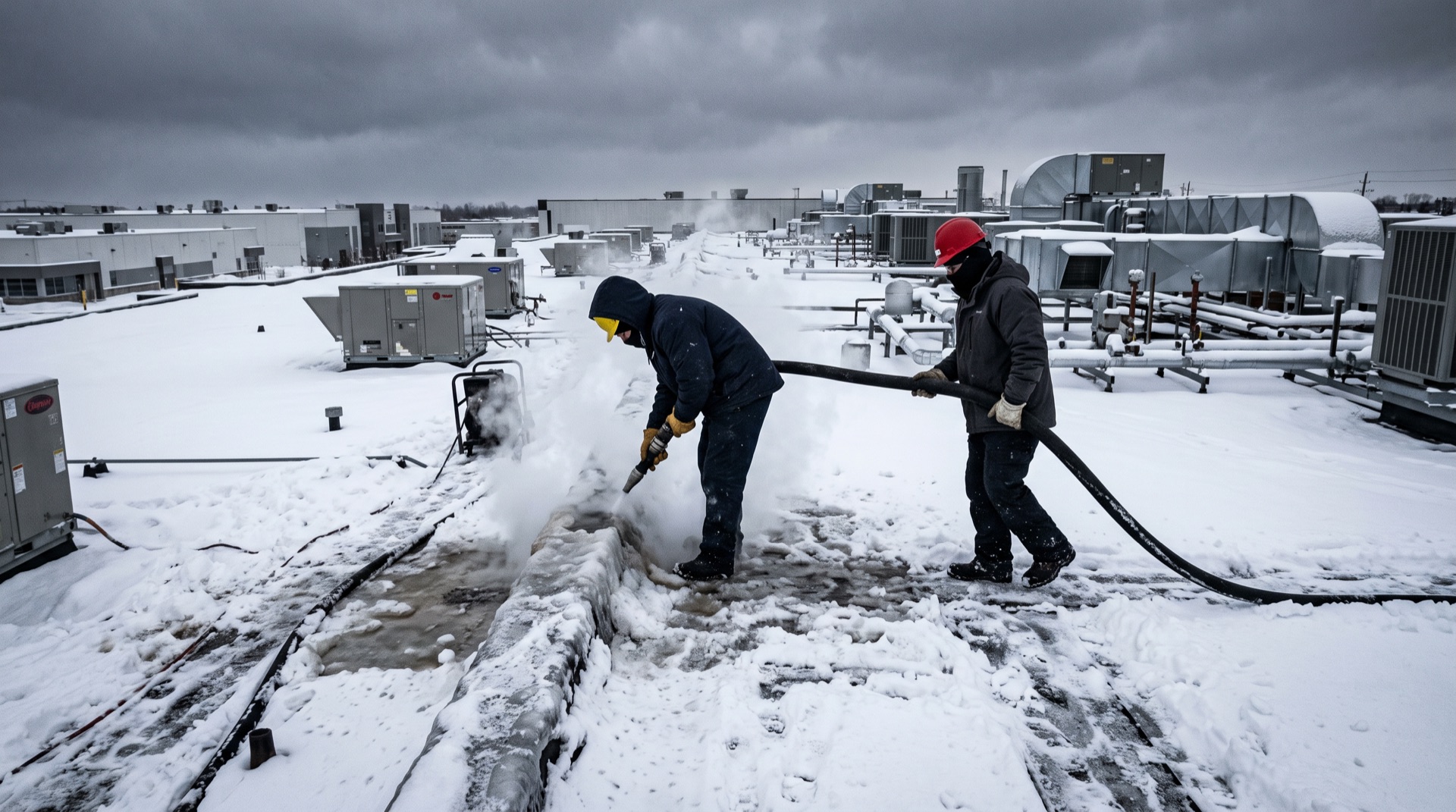
Steaming a scupper throat open is often the single highest-value twenty minutes of a commercial Lebanon call.
Membrane-safe means something specific
EPDM, TPO and modified bitumen all tolerate steam at low pressure and none of them tolerate chipping, scraping or a pressure washer. Crews steam the drains and scuppers open first to restore flow, then work the ponded ice, and they stay off seams and flashing details with the lance.
Mechanical units, conduit runs, solar racking and safety railing all get worked around rather than over.
Access control, hatches and escorts
Getting onto a commercial roof is a procedure: keys or fobs, a hatch that may be padlocked, a ladder in a locked plant room, sometimes a site induction and an escort for the duration.
Sorting that out with the property manager in advance is the difference between a crew starting at seven and a crew waiting in the parking lot until nine. Where a tenant controls the only access, that conversation happens before the dispatch rather than on the roof.
What you get in Lebanon
- EPDM, TPO and mod-bitLow-pressure steam only, seams and flashing details avoided
- Drains and scuppers firstFlow restored before the ponded ice is worked
- Overnight windows availableWork scheduled outside occupancy where access demands it
| Local ice-barrier practice | Eave membrane standard on re-roofs |
|---|---|
| Primary climate stressor | Nor'easters, rapid thaw-freeze swing |
| Typical scope | Steam, 4-10 crew hours typical |
| Documentation | Dated before and after photos, written scope in Xactimate line items |
| Coverage area | Lebanon and Lebanon County |
| Dispatch window | Same day to 24 hours |
| Removal method | Low-pressure steam only. No chipping, salt or pressure washing. |
Neighborhoods and Towns We Reach From Lebanon
Crews working Lebanon cover the adjoining communities on the same route — Quentin, Cornwall, Rexmont, Annville and Mount Gretna — so a storm week usually means one truck handling several addresses in Lebanon County rather than separate trips.
Nearest hub towns with their own commercial ice dams pages: Lancaster, Harrisburg, Reading, York, Pottstown, Carlisle.
Coverage runs across Lebanon and the nearby towns all winter, and capacity is surged into whichever Pennsylvania market the storm actually hits.
Most jobs do not stop at one service. Commercial Ice Dams in Lebanon often runs alongside commercial roof snow removal in Lebanon, and both get written into one scope rather than billed as separate visits.
Active leak right now? Our 24/7 Lebanon steam ice dam removal crews are dispatched first during a freeze event. Call (888) 561-9664.